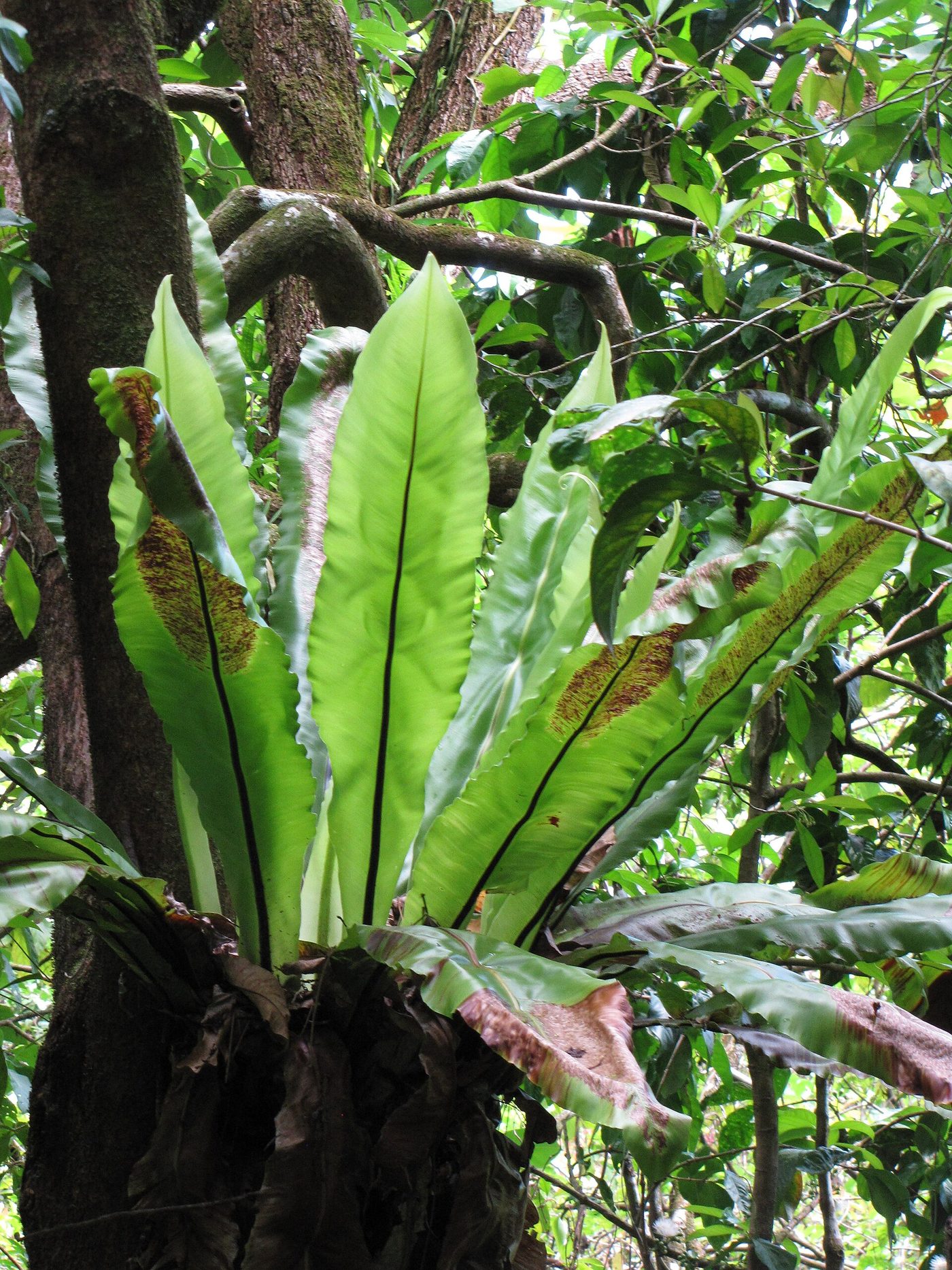
Photo: Forest and Kim Starr · CC BY 3.0 us
Bird's nest fern
Asplenium nidus
The bird's nest fern is an elegant epiphytic fern with glossy fronds in a rosette, one of the most decorative and easy houseplants.
Characteristics
A rosette of glossy fronds
The bird's nest fern is an epiphytic fern with large, entire, glossy and wavy fronds of a bright green, arranged in a spiral around a centre that resembles a nest — hence the common name. Unlike many ferns, its leaves are not divided but have a continuous blade, with a prominent dark central rib. New fronds unfurl from the heart of the rosette like little coils.
Origin and habitat
It is native to the tropical regions of Southeast Asia, eastern Australia, Hawaii, Polynesia, India and eastern Africa. In the wild it is epiphytic: it grows on the trunks and branches of rainforest trees, gathering leaves and debris in its 'nest' that, as they decompose, feed it.
Cultivation
It is one of the easiest ferns to grow indoors. It loves filtered light or part shade — never direct sun, which scorches the fronds — and high ambient humidity. Keep it in a light, well-draining mix, always slightly moist but never soggy. It is important not to pour water into the centre of the rosette, where it could stagnate and encourage rot.
Care
It prefers temperatures between 18 and 27 °C and dislikes cold below 13 °C. It enjoys misting of the fronds and the company of other plants that raise humidity. Feed it sparingly in spring and summer. It is non-toxic, so it is safe even in homes with children and pets.
Notable facts
In the wild the central 'nest' acts as a real nutrient-collecting system: it traps fallen leaves and rainwater, creating a microhabitat that even hosts small invertebrates.
Flowering season
Practical tips
Water needs: Regular, mix always slightly moist — always check soil moisture before watering.
Prefers Filtered light or part shade, no direct sun: provide the right light and rotate the plant for even growth.
Recommended soil: Light, humus-rich and free-draining. Refresh the substrate every 1-2 years.
Dust the leaves with a damp cloth to support photosynthesis.
Feed during the growing season (spring-summer) and stop in winter.
Pros
- Elegant and highly decorative
- Easy and beginner-friendly
- Non-toxic, safe with children and pets
Cons
- Dislikes direct sun and cold
- Water in the rosette can cause rot