Photo: Chhe (talk) · Public domain
Peacock plant
Goeppertia makoyana
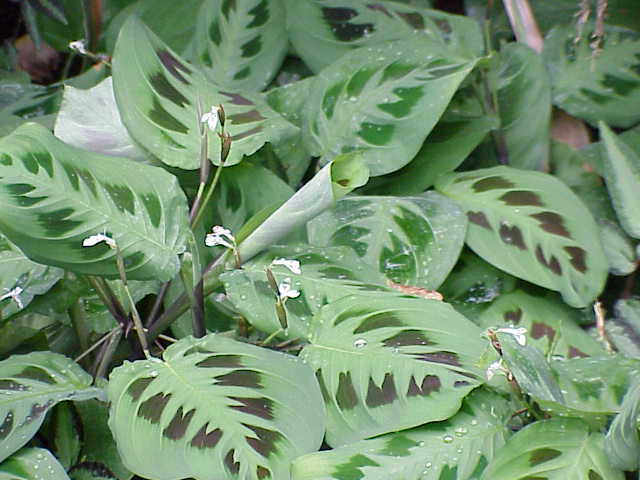
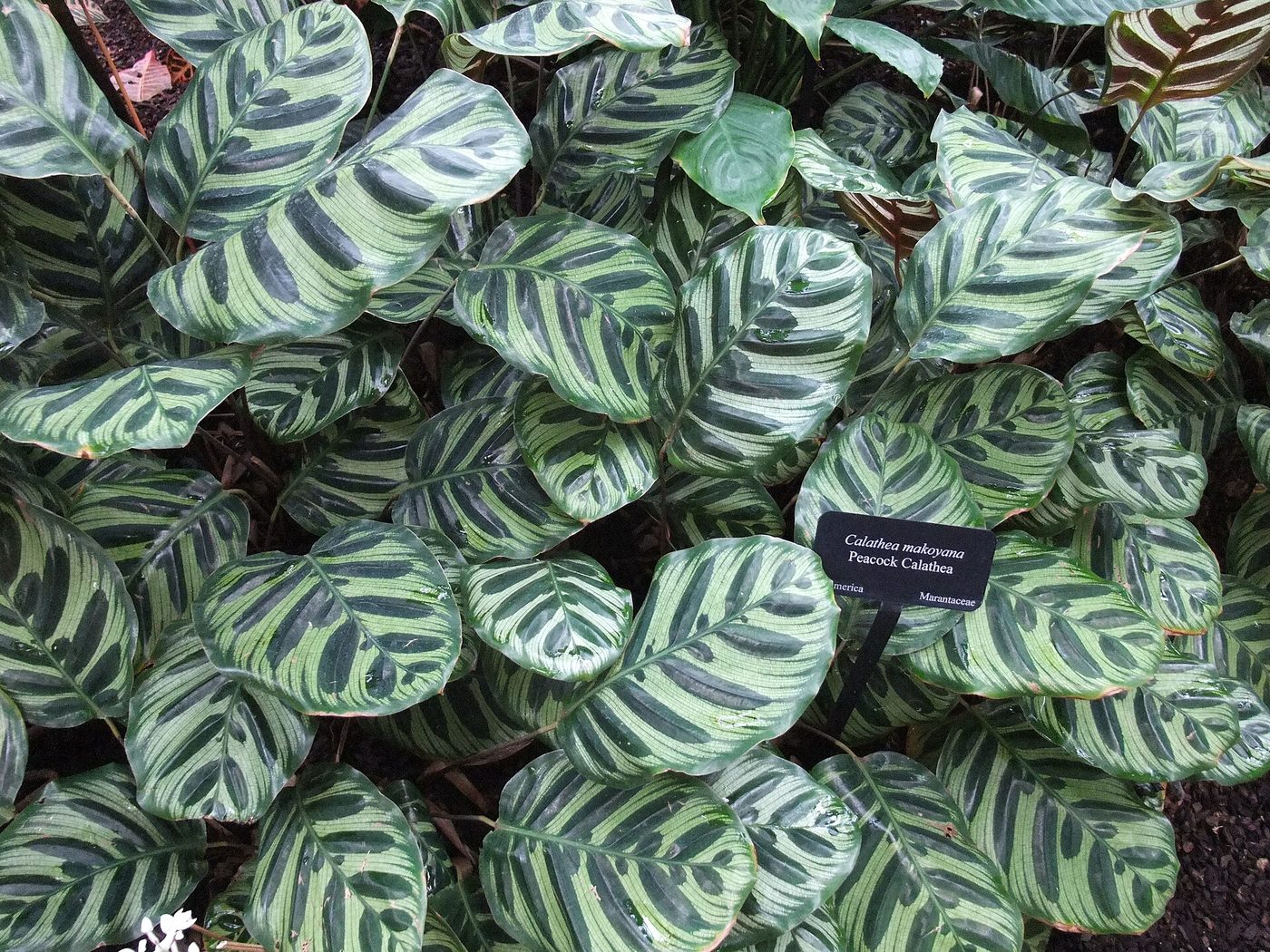
The peacock plant is a houseplant with large oval leaves bearing an elegant pattern that recalls the feathers of a peacock.
Characteristics
Description
The peacock plant, now classified as Goeppertia makoyana, is a beautiful houseplant of the arrowroot family. Its large oval leaves, thin and semi-translucent, carry a refined pattern of dark-green spots and veins on a pale-green ground, recalling the feathers of a peacock's tail or the windows of a cathedral; the underside is flushed with red-purple. Like other marantas, at night it raises its leaves, in a movement that recalls praying hands.
Origin
It is native to the tropical forests of eastern Brazil, in the state of Espírito Santo, where it grows in the damp, shady understorey. It has received the Royal Horticultural Society's prestigious Award of Garden Merit.
Cultivation and care
It is a beautiful but demanding plant, recreating the conditions of the tropical understorey. It wants bright but indirect light, never direct sun, which fades and scorches the leaves. It likes high humidity and steady temperatures between 18 and 26 °C. The soil should be kept lightly moist at all times, preferably with non-calcareous, room-temperature water.
- Place in filtered light, away from direct sun
- Keep humidity high, with frequent misting
- Avoid cold draughts and hard water
Facts and care
The movement of the leaves, rising at night and lowering by day, is typical of the arrowroot family and is due to changes in turgor at the base of the leaf stalk. Unlike many other houseplants, it is completely non-toxic to cats and dogs, making it a safe choice even in homes with pets.
Flowering season
Practical tips
Water needs: Regular, soil always lightly moist — always check soil moisture before watering.
Prefers Bright indirect light: provide the right light and rotate the plant for even growth.
Recommended soil: Rich, soft, well-drained. Refresh the substrate every 1-2 years.
Dust the leaves with a damp cloth to support photosynthesis.
Feed during the growing season (spring-summer) and stop in winter.
Pros
- Leaves beautifully patterned like peacock feathers
- Non-toxic to cats and dogs
- Moves its leaves with the rhythm of day and night
Cons
- Demanding as to humidity and light
- Sensitive to hard water and direct sun
- Dislikes cold and draughts