Photo: tato grasso · CC BY-SA 2.5
Venus flytrap
Dionaea muscipula
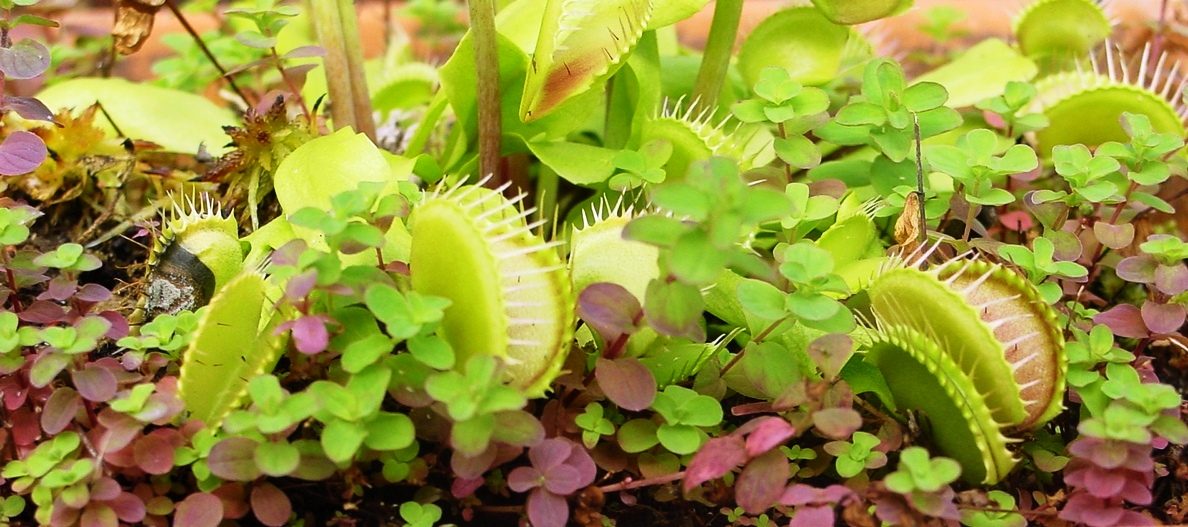
The Venus flytrap is the most famous carnivorous plant: its trap-like leaves snap shut in a flash to catch the insects that land on them.
Characteristics
The plant that catches insects
The Venus flytrap is without doubt the most famous carnivorous plant in the world. At the tips of its leaves it bears extraordinary structures: two lobes edged with long bristles, like small green traps often reddened inside. When an insect lands and brushes against the fine sensory hairs on the surface, the trap snaps shut with surprising speed, closing and imprisoning the prey. It is one of the most fascinating spectacles in the plant world.
Habitat and distribution
In the wild the Venus flytrap lives in a very restricted area of the south-eastern United States, in particular in the bogs and moist, marshy soils of some coastal areas. These are soils poor in nutrients: precisely for this reason the plant has evolved the ability to 'hunt', supplementing with insects the nutrients, such as nitrogen, that the soil cannot provide.
How the trap works
The mechanism of the Venus flytrap is surprisingly sophisticated. Inside each lobe are tiny sensitive hairs: the trap snaps shut only if these are touched several times in a short period, a device that avoids wasting energy on false alarms such as a raindrop. Once closed, if the prey is alive and struggles, the trap seals itself and begins digestion, which lasts several days. Each individual trap can snap shut only a limited number of times before it is exhausted.
Cultivation and care
The Venus flytrap is much loved as a houseplant and a collector's plant, but it requires particular care. It loves plenty of light, preferably direct sun, and an acidic, poor substrate without fertiliser. Water is crucial: it must be watered only with rainwater or distilled water, never with tap water, which is rich in salts that are harmful to it. It should not be 'fed' by hand or teased for fun: triggering the traps for no reason weakens it.
Conservation
The Venus flytrap is classified as a vulnerable species. In the wild it is threatened by the destruction of its habitat and by the illegal collection of wild plants. Fortunately it is today widely cultivated: choosing nursery-grown specimens, rather than ones taken from the wild, is the most responsible way to enjoy this extraordinary plant.
Flowering season
Practical tips
Water needs: Always moist, only rainwater or distilled water — always check soil moisture before watering.
Prefers Plenty of light, direct sun: provide the right light and rotate the plant for even growth.
Recommended soil: Acidic and poor, without fertiliser (peat and sand). Refresh the substrate every 1-2 years.
Dust the leaves with a damp cloth to support photosynthesis.
Feed during the growing season (spring-summer) and stop in winter.
Pros
- The most famous and fascinating carnivorous plant
- Catches insects with snap traps
- Non-toxic to humans
- Great for enthusiasts and collectors
Cons
- Must be watered only with rainwater or distilled water
- Should not be teased: the traps wear out
- Requires winter rest and careful attention