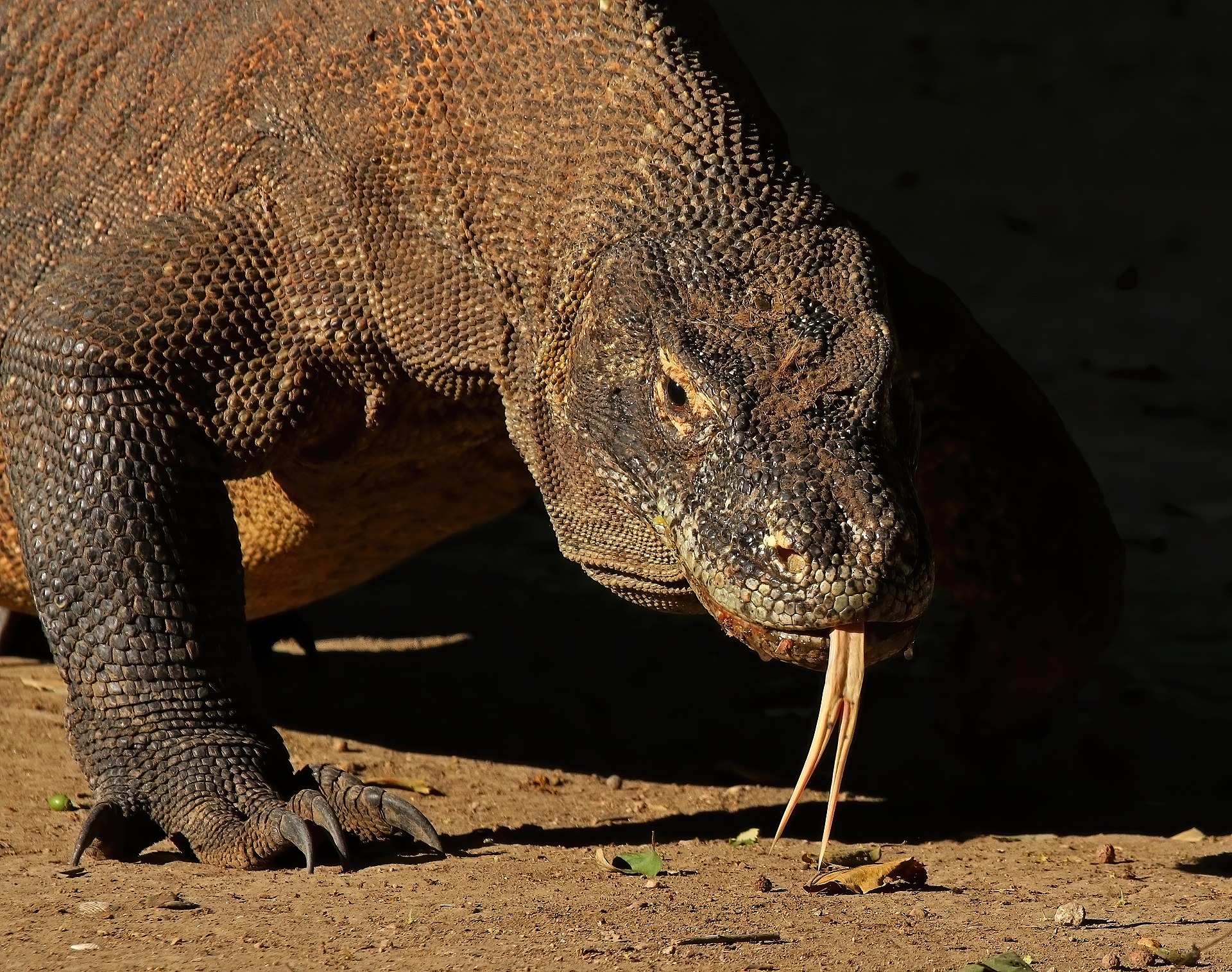
Komodo Dragon
Varanus komodoensis
Characteristics
Temperament
Solitary, territorial, ambush predator. Toxic saliva with anticoagulants. Capable of parthenogenesis (reproduction without male). Cannibalism of juveniles. NOT a terrarium species.
Diet
Apex predator and scavenger carnivore: Rusa deer, wild boar, buffalo, goats, occasionally humans. Toxic bite technique, prey dies in 24-72 hours. Single meal up to 80% of body weight.
The Komodo Dragon (Varanus komodoensis) is the largest living lizard in the world. Endemic to the Lesser Sunda Islands in Indonesia, it is a survival from the prehistoric era: it represents the most direct descendant of the giant monitors widely distributed during the Miocene. Unknown to the Western world until 1910, when Dutch lieutenant van Steyn van Hensbroek encountered the species on Komodo island, it has rapidly captured the collective imagination as a "real dragon" — protagonist of documentaries, films and UNESCO national parks.
Classification and category
The Komodo Dragon belongs to the order Squamata, suborder Lacertilia, family Varanidae, genus Varanus. The genus comprises about 80 species of monitor lizards distributed across Africa, Asia and Australia, but V. komodoensis is the largest and most iconic species. Average length of adults is 2-3 metres, with documented record specimens up to 3.13 m. Average adult weight is 70-100 kg, but in captivity well-fed specimens can exceed 166 kg. Males are significantly larger and more robust than females. The morphology is typical of monitors: elongated body, short but muscular legs, tail as long as the body, flexible neck, elongated head, yellow forked tongue.
Habitat and distribution
The natural habitat of the Komodo Dragon is limited to only five Indonesian islands: Komodo, Rinca, Padar (now dragon-free), Gili Motang and Western Flores. The total area is only about 700 km². The environment is typical of tropical dry forests, grassy savannahs and coastal areas: hot and dry climate, with rainy season concentrated from November to March. Dragons prefer coastal plains and rolling hills up to 800 m altitude, where low vegetation and rocky outcrops offer ambush spots.
The total population is estimated at about 3,000-4,000 wild individuals, with only 350-500 breeding females. Conservation status was classified as Endangered (EN) by the IUCN in 2021 (previously Vulnerable), due to growing threats from climate change (sea level rise reducing coastal habitats), habitat loss and poaching. The species has been protected since 1980 with the establishment of Komodo National Park, declared UNESCO World Heritage Site in 1991 and Biosphere Reserve. It is listed in CITES Appendix I (maximum international protection).
Diet
The Komodo Dragon is a carnivorous apex predator and opportunistic scavenger. Adult diet includes: deer of the endemic species Rusa timorensis (main prey, over 50%), wild boar, introduced water buffalo, wild goats, macaques, small birds, eggs and occasionally humans (rarely, but with documented annual victims). Juveniles, up to 1 metre, live mainly in trees and feed on insects, lizards, small mammals and eggs.
The hunting technique is based on ambush: the dragon can remain motionless for hours camouflaged in vegetation, then attacks prey with a lightning leap of a few metres. Its most lethal weapon is not the bite (which can reach 600 N), but a toxic saliva: for years it was believed to be populated by pathogenic bacteria, but a 2009 study revealed that the jaw contains venom glands that secrete a powerful anticoagulant and vasodilatory proteins. The prey, even if it escapes after the attack, dies within 24-72 hours from haemorrhage and shock; the dragon follows it tracking its scent with its forked tongue and Jacobson's organ. A single meal can represent up to 80% of the dragon's body weight, which then fasts for weeks.
Physical features
The Komodo Dragon has a massive and low body, perfectly adapted to hunting in terrestrial environment. Colour varies from dark grey-brown to olive-green on the back, with lighter and ochre-yellowish hues on the belly. The skin is covered with bone-like scales reinforced by osteoderms, small subcutaneous bony nodules that form a real natural chainmail. This armour is so resistant that wooden arrows and even light spears cannot pierce it.
The head is long and sharp, with broad muzzle, well-developed yellow eyes. The mouth contains about 60 serrated and curved-backward teeth, up to 2.5 cm long, which function like those of sharks (continuous renewal). The yellowish forked tongue is hyperextensible and functions as an olfactory organ: the dragon can detect carcasses up to 9-11 km away. The limbs are short but powerful, equipped with sharp claws of 5-7 cm. The tail is long and muscular, used as a weapon to strike or as a counterbalance. Dragons can swim for kilometres (even from one island to another), run briefly at 20 km/h, and climb trees (juveniles up to 2-3 m in length). Adult male specimens develop characteristic yellow skin on the throat.
Behaviour and curiosities
The Komodo Dragon is a solitary, territorial animal with complex social structures. A hierarchy forms around carcasses, where large males dominate females and juveniles. Territorial combat between males is ritualised: they stand on their hind legs using the tail as a third support and embrace trying to unbalance the opponent.
Reproduction has extraordinary characteristics. Courtship takes place from May to August; the female lays 20-30 eggs in July-September, digging a deep hole or reusing old megapode nests. The eggs are incubated for 7-8 months and the young are born in March-April. An exceptional scientific discovery: the Komodo Dragon is capable of parthenogenesis (reproduction without a male). Documented cases in zoos (London 2006, Chester 2006) have shown that isolated females can lay fertile eggs that develop completely — a unique mechanism among large reptiles. Newborns measure 35-45 cm and immediately take refuge in trees to avoid cannibalism by adults (which is a significant cause of mortality). Sexual maturity is reached at 8-9 years; longevity is about 30 years in nature. Palaeontological excavations have shown that giant monitors similar to V. komodoensis were widespread in Australia until 4 million years ago.
Pros
- Più grande lucertola vivente del mondo (3 m, 100 kg)
- Sopravvissuto preistorico, fascino indiscutibile
- Protetto dal Parco Nazionale di Komodo (UNESCO)
- Capacità unica di partenogenesi
Cons
- Specie protetta CITES I, detenzione vietata fuori da zoo accreditati
- Morso letale per l'uomo (anticoagulanti tossici)
- IUCN Endangered: solo 3.000-4.000 esemplari rimasti
- Minacciato dal cambiamento climatico