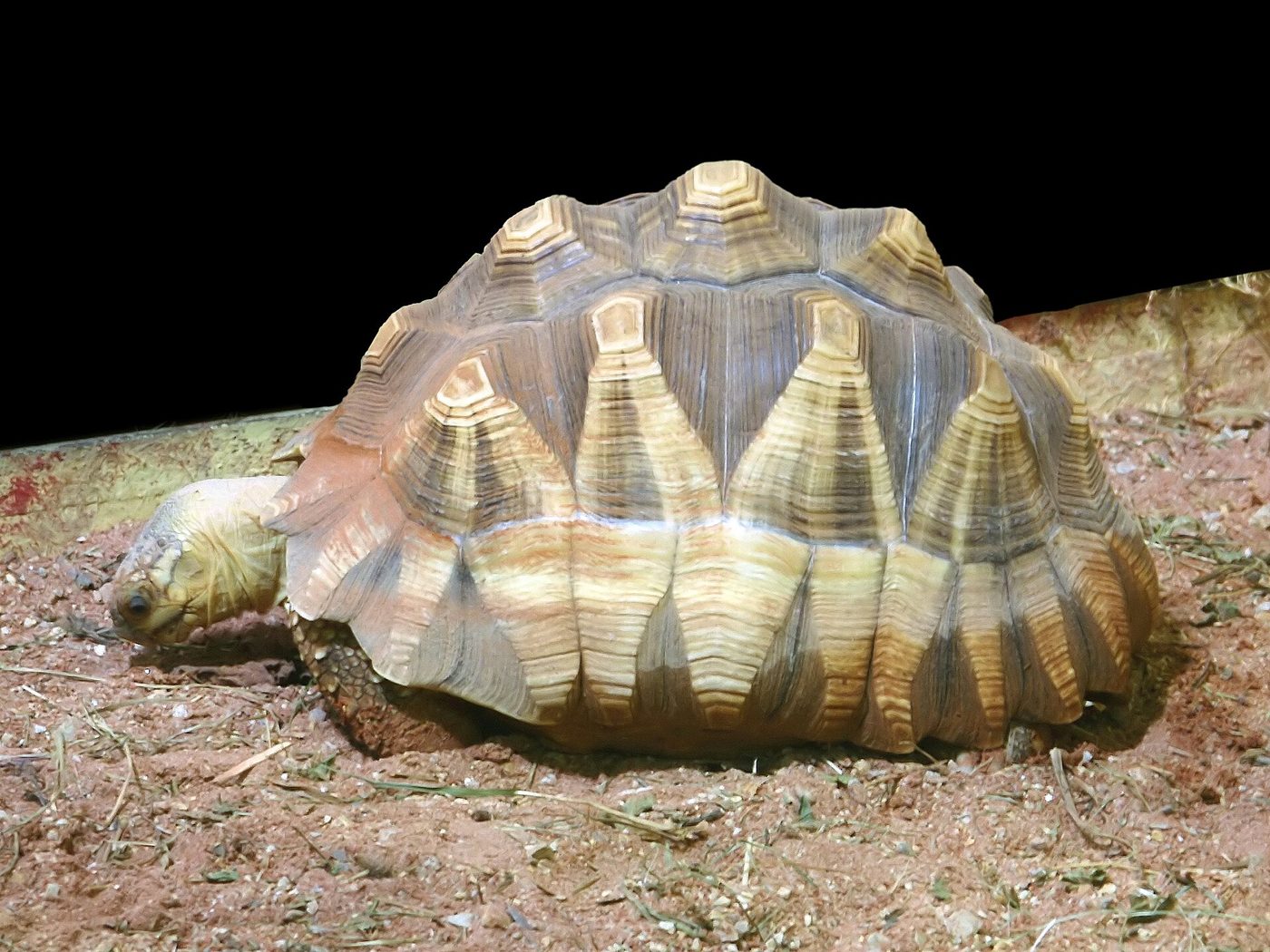
Photo: Hans Hillewaert · CC BY-SA 4.0
Ploughshare tortoise
Astrochelys yniphora
Endemic to Madagascar and critically endangered, the ploughshare tortoise is named for a projection of its shell that males use as a weapon in duels.
Characteristics
Temperament
Diurnal, herbivorous, males fight with the spur
Diet
Herbivore: grasses, leaves, shoots, fruit
A tortoise with an armed shell
The ploughshare tortoise, also known as the angonoka, is a land tortoise with a tall, domed shell, golden-brown in colour with concentric rings on the scutes. Its most curious feature is a projection of the plastron (the underside of the shell) that extends forward under the neck, curving upward like the blade of a plough or ploughshare. This structure, far more developed in males, is used as a weapon in territorial duels: rivals try to slip it under their opponent to flip it over.
Habitat and distribution
It is endemic to a tiny area of north-western Madagascar, in the dry forests and savannas of the Baly Bay region near Soalala. It is one of the rarest tortoises in the world: perhaps only a few hundred individuals survive in the wild.
Behaviour
It is herbivorous and diurnal, feeding on grasses, leaves, shoots and fruit. Males fight in the breeding season by shoving with the spur of the plastron. Growth is slow and sexual maturity is reached only after many years, which makes the species particularly fragile in the face of threats.
Curiosities
Its rarity and the beauty of its shell have made it a target of the illegal collector trade, the gravest of the dangers it faces. To combat trafficking, some conservationists have even engraved codes on the shells to make them less appealing to poachers.
Conservation
The IUCN classifies the species as Critically Endangered. The threats are poaching for the exotic pet trade, fires and destruction of the dry forest. Captive-breeding programmes and habitat protection are trying to save it from extinction.
Pros
- Unique spurred plastron used in duels
- Golden-brown shell with beautiful rings
- A flagship for Madagascar conservation
Cons
- Critically endangered, among the rarest tortoises
- Target of the illegal trade
- Very slow growth, late maturity