Chinese hibiscus
Hibiscus × rosa-sinensis
With its large, brightly coloured flowers and showy central column of stamens, the Chinese hibiscus is one of the most beloved tropical ornamental shrubs in the world.
Characteristics
A profusion of large flowers
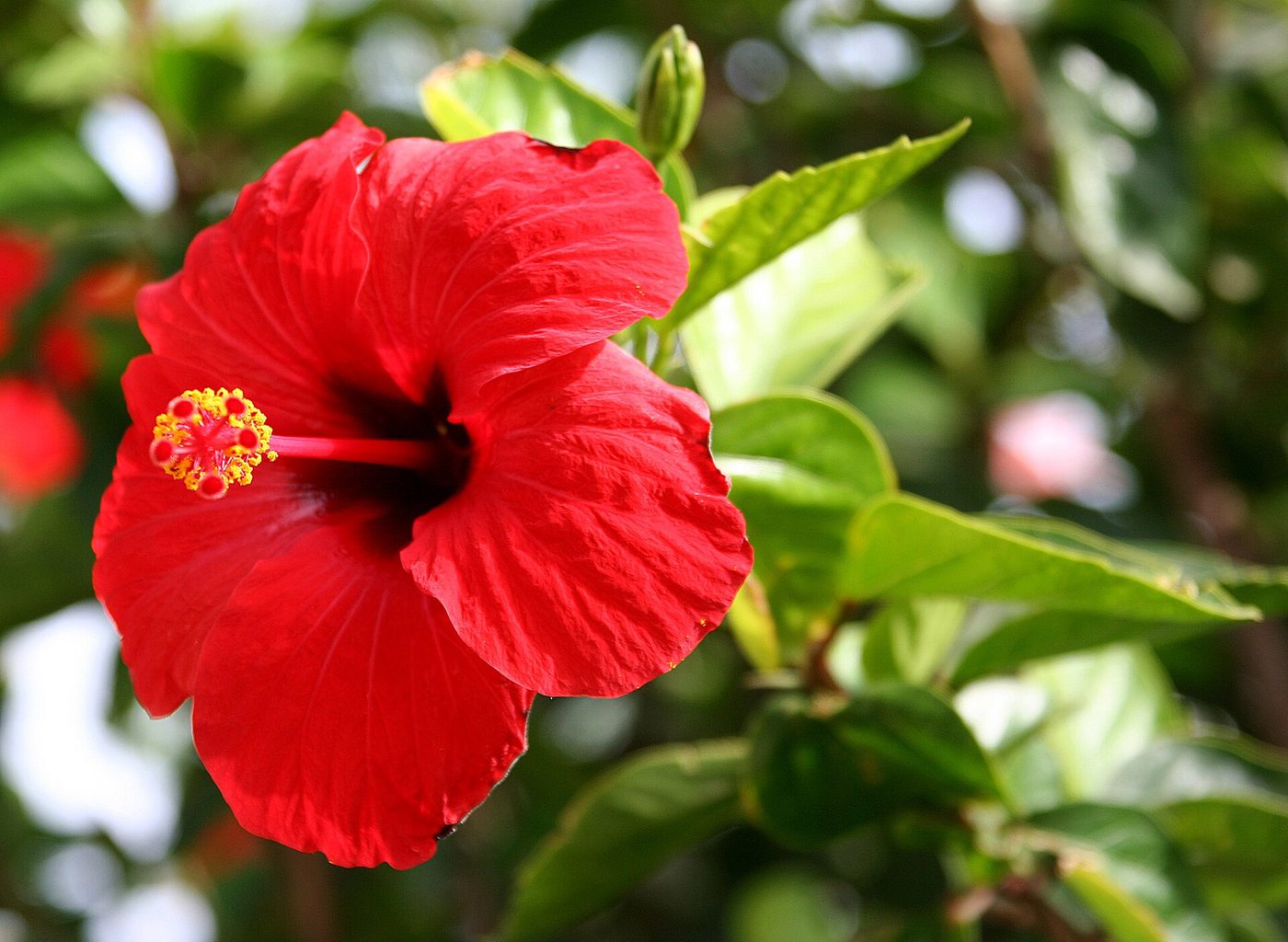
The Chinese hibiscus, or hibiscus, is an evergreen shrub much loved for its spectacular flowering. Its flowers are large and showy, funnel- or cup-shaped, with five petals that may be red, pink, orange, yellow, white or variegated, depending on the countless varieties. At the centre stands a long column bearing the stamens and pistil, protruding and elegant. Each individual flower usually lasts only a day, but the plant produces them continuously, giving an abundant and prolonged flowering.
Origin and distribution
It is native to East Asia, probably eastern India or China, although its wild form is shrouded in uncertainty, being known above all as a cultivated plant. Today it is widespread all over the world as an ornamental plant, in the gardens of warm climates and as a houseplant or greenhouse plant in temperate regions. It is the national flower of Malaysia.
Cultivation and care
It loves full sun and warmth, essential for a rich flowering. It prefers a fertile, well-drained soil and regular watering during the growing season. It fears frost: in temperate climates it should be grown in a pot and sheltered indoors or in a greenhouse during winter. It has a fairly rapid growth and responds well to pruning, which keeps its compact shape and stimulates new flowers. It can be grown as a bush, as a flowering hedge or in a pot.
Uses and curiosities
The Chinese hibiscus is prized not only as an ornamental: its flowers are edible and are used in some traditions to prepare infusions and teas, as well as a natural dye. In several cultures it also has symbolic meanings. It is a non-toxic plant, safe to keep in the garden and at home.
Flowering season
Practical tips
Water needs: Regular during growth — always check soil moisture before watering.
Prefers Full sun: provide the right light and rotate the plant for even growth.
Recommended soil: Fertile and well-drained. Refresh the substrate every 1-2 years.
Dust the leaves with a damp cloth to support photosynthesis.
Feed during the growing season (spring-summer) and stop in winter.
Pros
- Large, colourful, spectacular flowers
- Abundant, prolonged flowering
- Edible flowers for teas
- Suitable for garden, hedge or pot
Cons
- Fears frost, only warm climates or winter shelter
- Each flower usually lasts only a day
- Needs full sun to flower well