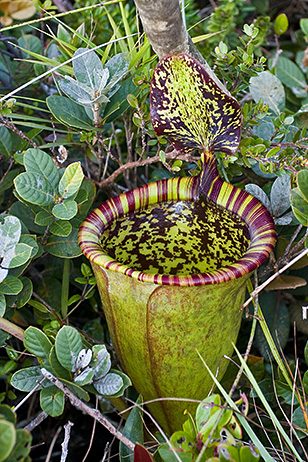
Photo: Dr. Alastair Robinson · CC BY 3.0
Attenborough's pitcher plant
Nepenthes attenboroughii
A giant carnivorous plant discovered on a Philippine mountain, Attenborough's pitcher plant bears huge bell-shaped pitchers able to digest even small rodents.
Characteristics
A carnivore named after David Attenborough
Attenborough's pitcher plant is a spectacular carnivorous plant, among the largest of its genus. It is named after the celebrated British naturalist and broadcaster Sir David Attenborough, a keen enthusiast of these plants. It is characterised by broad bell-shaped pitchers — the urn-like traps typical of the Nepenthes — that can exceed 30 centimetres in height, topped by a narrow, upright lid. The stem can climb to around a metre and a half.
Habitat and distribution
It is a strictly endemic species: it grows only on the slopes and summit of Mount Victoria, an ultramafic mountain on the island of Palawan in the Philippines, between 1,450 and 1,726 metres altitude. It thus lives in a cool montane climate, on poor, metal-rich soils, where catching insects makes up for the scarcity of nutrients.
Giant traps
Its pitchers are so large that they can trap, besides a multitude of insects, even small vertebrates such as frogs and rodents that fall in and are slowly digested by the plant's fluids. It is a striking example of how a plant can 'hunt' surprisingly large prey.
Curiosities
The species was located during an expedition in 2007, after reports of unusually large plants on the mountaintop, and was scientifically described in 2009. Its relatively recent discovery is a reminder of how many species remain to be found in tropical mountains.
Conservation
The IUCN classifies the species as Critically Endangered, because of its tiny range and illegal collection for collectors. Cultivation requires highland conditions hard to reproduce; it is a rare plant, suited only to very experienced growers.
Practical tips
Water needs: High: permanently moist substrate — always check soil moisture before watering.
Prefers Bright but filtered light: provide the right light and rotate the plant for even growth.
Recommended soil: Ultramafic, poor, acidic and free-draining. Refresh the substrate every 1-2 years.
Dust the leaves with a damp cloth to support photosynthesis.
Feed during the growing season (spring-summer) and stop in winter.
Pros
- Spectacular giant bell-shaped pitchers
- Can trap even small vertebrates
- Iconic species named after David Attenborough
Cons
- Critically endangered and rare
- Very hard to grow: highland conditions
- Target of illegal collection