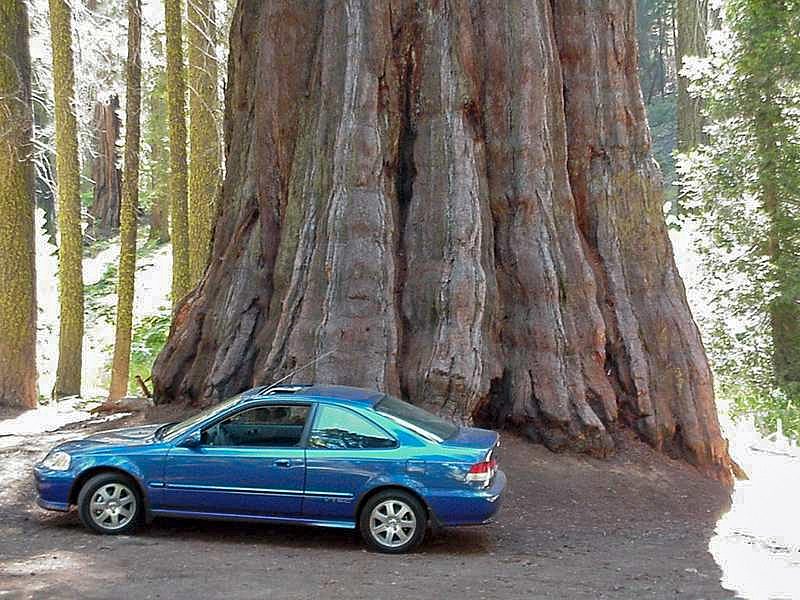
Photo: Jon Sullivan · Public domain
Giant sequoia
Sequoiadendron giganteum
Among the largest and longest-lived living beings on the planet, the giant sequoia towers for dozens of metres and lives for millennia, a plant colossus that defies time.
Characteristics
A living colossus
The giant sequoia is one of the most imposing trees on the planet and, by volume, the largest living organism on Earth. It can exceed eighty metres in height and develop a trunk several metres in diameter at the base. It is not the tallest tree of all — that record belongs to the coast redwood, its relative — but it is the most massive. The bark, thick, fibrous and of a warm red-brown colour, can reach considerable thicknesses. The crown, conical in young specimens, rounds off with age.
A tree that lives for millennia
The giant sequoia is among the longest-lived organisms in the world: some specimens have exceeded three thousand years of age. Trees of this species were already majestic when the ancient civilisations flourished. This extraordinary longevity is made possible by wood and bark rich in substances that protect them from insects, fungi and disease.
A friend of fire
One of the most fascinating features of the giant sequoia is its relationship with fire. The thick bark insulates it from the heat of fires, which the species not only tolerates but depends on: the heat opens the cones, releasing the seeds, and clears the undergrowth of competing vegetation, creating the ideal conditions for the young seedlings to sprout and grow in the light.
Where it grows and how to cultivate it
In the wild the giant sequoia grows only in certain areas of the Sierra Nevada, in California. It prefers climates with dry summers and snowy winters, well-drained soils and plenty of light. It can be grown as an ornamental tree in parks and large gardens in temperate regions, where, however, it reaches such sizes as to require very ample spaces. It is hardy and cold-resistant, but needs years to express its grandeur.
Conservation
The giant sequoia is regarded as a species of great conservation value. Its natural range is restricted and the populations are threatened by climate change, which makes fires more intense and destructive, and by drought. Protecting these millennia-old woods is a commitment that goes beyond the single species: it means safeguarding some of the most ancient living monuments of nature.
Practical tips
Water needs: Moderate, fears prolonged drought — always check soil moisture before watering.
Prefers Full sun: provide the right light and rotate the plant for even growth.
Recommended soil: Deep and well-drained. Refresh the substrate every 1-2 years.
Dust the leaves with a damp cloth to support photosynthesis.
Feed during the growing season (spring-summer) and stop in winter.
Pros
- Among the largest and longest-lived trees in the world
- Thick, fire-resistant bark
- Hardy and cold-resistant
- A majestic ornamental tree for large spaces
Cons
- Reaches enormous sizes: needs very ample spaces
- Sensitive to prolonged drought
- Takes many years to express its grandeur