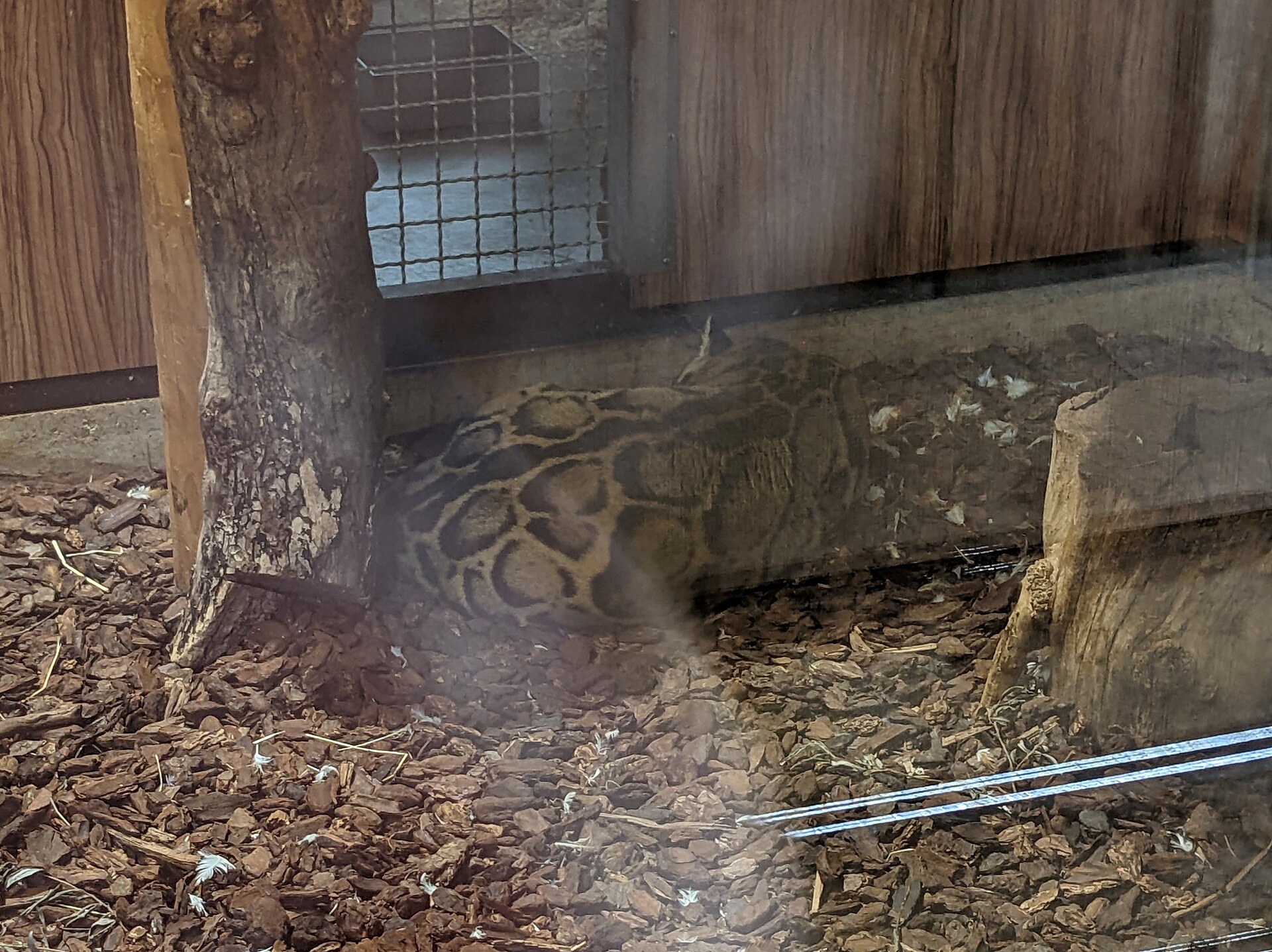
Clouded Leopard
Neofelis nebulosa
Characteristics
Temperament
Solitary, elusive, nocturnal/crepuscular. THE "MODERN SABER-TOOTH": longest canines (relative to skull) of any living felid, jaw gaping to 90°. THE MOST ARBOREAL OF CATS: climbs down trees headfirst (hind ankles rotate 180°), hangs upside down by hind feet, dangles from a branch by a single paw. Very long balance-pole tail. Camouflaging "cloud" coat. Evolutionary bridge between small and big cats: cannot roar or purr continuously.
Diet
Arboreal carnivorous predator. Primates (gibbons, macaques, langurs — hunted even in trees), small/medium ungulates (muntjac, mouse-deer, young boar), large rodents (porcupines, squirrels), birds, other mammals (pangolins, civets, hares), occasional reptiles. Ambush predator using cloud camouflage; can pounce from above. Powerful bite with long canines to the neck. Active at dusk and night.
The Clouded Leopard (Neofelis nebulosa) is one of the world's most extraordinary and elusive cats, inhabiting the forests of Southeast Asia. Famous for:
- THE "MODERN SABER-TOOTH"! It has the longest canine teeth relative to skull size of any living felid (up to 4 cm) — proportions recalling the extinct saber-toothed cats!
- THE MOST ARBOREAL OF CATS: it climbs down trees headfirst like a squirrel, hangs upside down from branches by its hind feet alone, and can dangle from a branch by a single paw!
- Hind ankles rotating 180°: exceptional flexibility for climbing
- Very long tail: nearly as long as the body, for balance among branches
- "Cloud" coat: large cloud-shaped dark-edged blotches — perfect forest camouflage
- Evolutionary bridge: between small and big cats — it cannot fully roar but doesn't purr like small cats either
IUCN status: Vulnerable (VU). Threatened by deforestation and poaching (skins, teeth, bones). One of the hardest cats to observe in the wild.
Classification and category
Order Carnivora, family Felidae, subfamily Pantherinae (the "big cats"), genus Neofelis. Despite its name it is NOT a true leopard (Panthera pardus): it belongs to its own genus, Neofelis, distinct from Panthera. Genus Neofelis: 2 species — N. nebulosa (mainland, this entry, Himalaya to mainland SE Asia) and N. diardi (Sunda clouded leopard, Borneo/Sumatra, recognized as separate in 2006). Etymology: "Neofelis" Greek "neos" (new) + Latin "felis" (cat); "nebulosa" Latin "nebula" (cloud) for the cloud-shaped coat blotches. Considered an EVOLUTIONARY BRIDGE between the two great cat divisions: it belongs to Pantherinae but is the most basal/small member, CANNOT fully roar (intermediate hyoid/vocal apparatus) nor purr continuously like small cats — it mews, hisses, snorts. Parameters: Body 70-110 cm. Tail 60-90 cm (nearly body length!). Weight 11-23 kg. Canines up to 4 cm (proportional record among living cats). Longevity 11-15 years (17 captive). 1-5 cubs.
Habitat and distribution
Mainland clouded leopard ranges across Southeast Asia and the Himalayan foothills: Himalayan range (Nepal, NE India, Bhutan), southern China, mainland SE Asia (Myanmar, Thailand, Laos, Vietnam, Cambodia), Malay Peninsula. Habitats: tropical/subtropical rainforest (dense, mature — ideal), evergreen and deciduous forest, montane forest to 2,500-3,000 m (Himalaya), occasional secondary forest and mangroves, scrub at forest edges. Closely tied to forest with dense tree cover for climbing and hunting. Spends much time in trees (rest, travel, sometimes hunting), exploiting the vertical forest dimension like few other cats. IUCN: Vulnerable, declining — main threats deforestation and poaching (spotted skins, long canines, bones for traditional medicine, live exotic trade).
Diet
Carnivorous predator. Diet: arboreal primates (gibbons, macaques, langurs — hunts even in trees), small/medium ungulates (muntjac deer, mouse-deer, young wild boar), large rodents (porcupines, squirrels), birds (including tree-nesters), other mammals (pangolins, civets, hares), occasional reptiles. Technique: ambush predator using cloud camouflage to approach unseen, can pounce on prey from a branch (arboreal advantage), powerful bite with long canines to neck/nape, nocturnal/crepuscular hunting. The extraordinarily long canines and powerful jaw muscles suggest a deep penetrating bite — a "modern saber-tooth kit" that may let it take relatively large prey for its size.
Physical features
A body perfectly adapted to arboreal life. Coat: tawny-yellowish/grey-brown base; large irregular CLOUD-SHAPED blotches with dark edges and paler centres (the pattern that names the species); smaller solid spots on head, legs, belly; dark-ringed tail; exceptional camouflage among forest light and shadow. Head and teeth: elongated skull with a gape approaching 90°; very long canines (up to 4 cm — longest proportionally among living cats, "modern saber-tooth"); large eyes with oval pupils (intermediate between small and big cats). Climbing anatomy: robust broad paws with large pads and sharp claws for grip; hind ankles rotating 180° (climb down headfirst and hang); very long tail (nearly body length, essential balance pole among branches); long low body for arboreal balance.
Behaviour and curiosities
Solitary, elusive, nocturnal/crepuscular. So secretive and forest-bound that scientists know relatively little of its wild behaviour — much comes from captive animals and camera traps. Communicates by scent marking and tree scratching. Solitary except for mating; ~3-month gestation; female bears 1-5 cubs in a sheltered den (tree hollows, crevices); cubs born blind, open eyes at ~10 days, climb early, stay with mother to ~10 months.
Famous: "modern saber-tooth" — longest canines relative to skull of any living felid (up to 4 cm in an 11-23 kg cat), recalling extinct saber-toothed cats (e.g. Smilodon); jaw gapes to nearly 90° (vs ~65-70° in typical cats). "Acrobat cat": most arboreal of all cats — climbs down trees headfirst (180° hind ankles), hangs upside down by hind feet alone, dangles by a single hind paw, runs along undersides of branches; long tail as balance pole. "Evolutionary bridge": most basal Pantherinae, intermediate between big and small cats — cannot fully roar nor purr continuously, mews/hisses/snorts. "Two species": Sunda clouded leopard (N. diardi) split off as separate species in 2006 (~1.4 million years divergence). "Cloud coat": one of the most beautiful feline coats, superb camouflage (and sadly a poaching target). "Mystery animal": among the least-known cats, documented mainly via camera traps. Conservation: CITES Appendix I, captive breeding programmes; a symbol of SE Asian rainforest conservation.
Pros
- Felino unico — canini da "saber-tooth moderno" e doti acrobatiche
- Mantello "a nuvole" tra i più belli del mondo felino
- Ponte evolutivo tra piccoli e grandi felini
- Protetto da CITES, simbolo delle foreste asiatiche
Cons
- IUCN Vulnerabile — popolazioni in declino
- Minacciato da deforestazione e bracconaggio (pelli, denti, ossa)
- Elusivo e poco studiato in natura
- Non è un animale domestico (felino selvatico protetto)