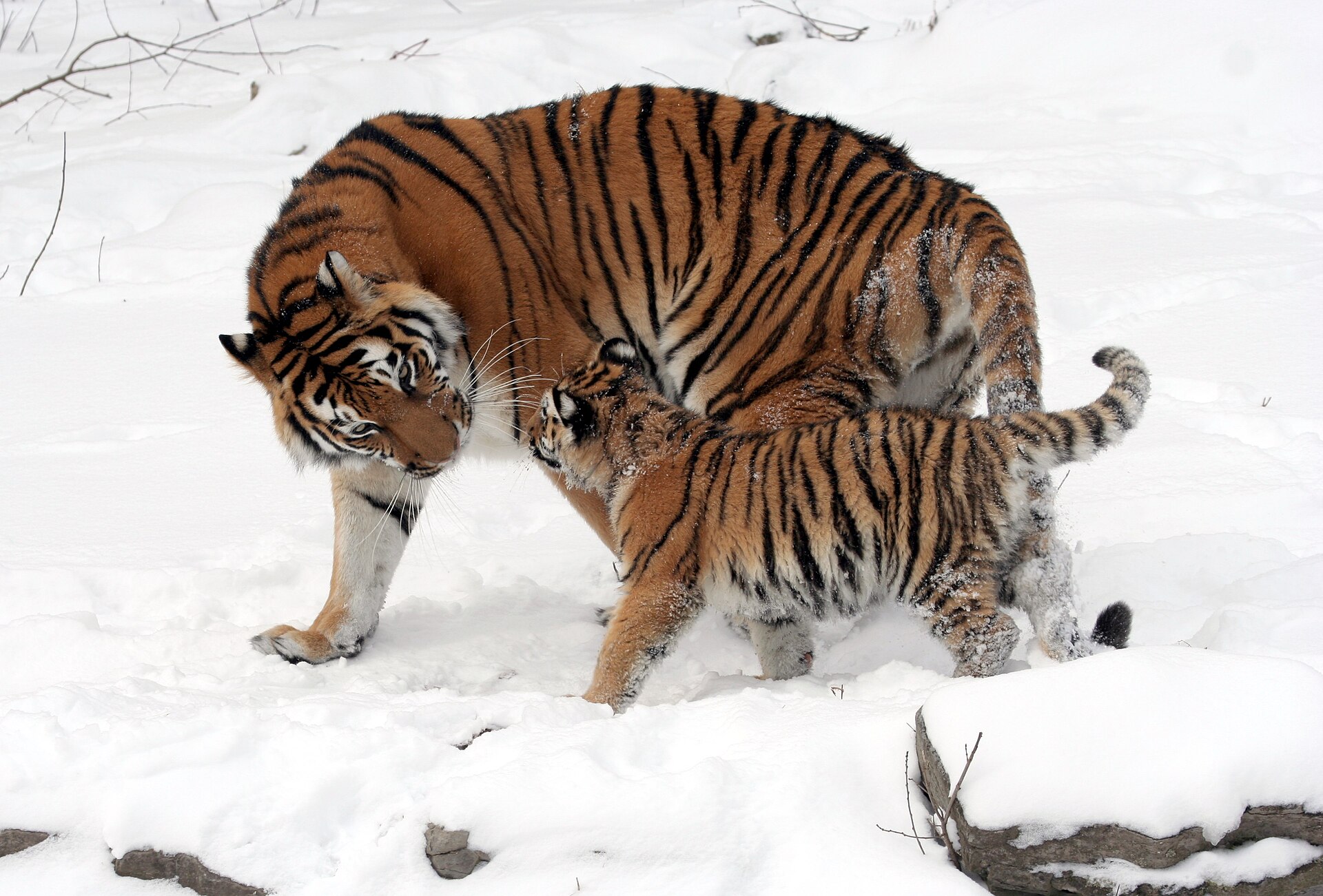
Tiger
Panthera tigris
Characteristics
Temperament
Solitary, crepuscular-nocturnal, strongly territorial. Ambush predator. Excellent swimmer (rare among cats). Roar audible up to 3 km. Six living subspecies.
Diet
Strict carnivore: deer, wild boars, water buffalo, gaurs. 5-7 kg of meat per day. Solitary ambush hunt with success rate 1/10-20. Carcasses covered with leaves.
The Tiger (Panthera tigris) is the largest living cat in the world and one of the most imposing terrestrial carnivores on the planet. Recognisable for its characteristic black-striped orange coat (a pattern unique to each individual like a fingerprint), it is the apex predator of its ecosystems and a key species for the conservation of Asian wildlife. After a dramatic 96% decline over the last century, populations are showing a cautious recovery thanks to international protection programmes.
Classification and category
The Tiger belongs to the order Carnivora, family Felidae, subfamily Pantherinae, genus Panthera. The genus includes five great cats (tiger, lion, leopard, jaguar, snow leopard), all characterised by the ability to roar (modified hyoid apparatus). There are currently six recognised living subspecies: P. t. tigris (Bengal), P. t. amoyensis (South China, probably extinct in the wild), P. t. altaica (Siberian, the largest), P. t. corbetti (Indochinese), P. t. jacksoni (Malayan) and P. t. sumatrae (Sumatran, the smallest). It is a huge cat: body length ranges from 200 to 330 cm (tail included), average adult weight from 90 to 310 kg with Siberian males reaching 320 kg.
Habitat and distribution
The Tiger's habitat is extraordinarily varied, reflecting the geographic diversity of subspecies: tropical rainforests (Sumatra, Malaysia), temperate deciduous forests (Bengal, Indochina), boreal forests and taiga (Siberia), mangroves (Sundarbans between India and Bangladesh) and grasslands with scrub. It prefers areas with dense vegetation cover for stalking, access to running water (it is an excellent swimmer, rare among cats) and abundant availability of ungulate prey.
The historical range covered 30 Asian countries from eastern Turkey to eastern Russia and the Indonesian archipelago. Today the species survives in only 13 tiger range countries: India (3,682 individuals, 75% of the world population), Russia (~750), Indonesia (~400 in Sumatra), Bangladesh, Bhutan, China, Malaysia, Myanmar, Nepal, Thailand, Vietnam, Laos and Cambodia. The estimated global population in 2023 is about 5,574 individuals (Global Tiger Forum), up from the historic low of 2010 (~3,200). Conservation status is listed as Endangered (EN) by the IUCN; the species is in CITES Appendix I and protected by numerous international conventions.
Diet
The Tiger is a strict carnivore and a solitary predator of large prey. The diet consists mainly of medium-large ungulates: deer (sambar, chital, axis), wild boars, water buffalo, gaurs, moose (in Siberia), tapirs (in Indochina) and occasionally smaller prey such as monkeys, fish, birds, reptiles. An adult tiger consumes an average of 5-7 kg of meat per day; a single large meal (e.g. a whole deer) can provide food for 5-6 days.
The hunting technique is typical of big cats: silent stalking up to 10-20 metres from prey, then explosive attack. The tiger kills with a bite to the nape (small prey) or to the throat/trachea (large prey). Success rate is low: only 1 hunt in 10-20 succeeds. Carcasses are often dragged into hiding places and covered with leaves for consumption in the following days. Unlike lions, the tiger hunts exclusively alone: each individual defends a vast territory (50-1,000 km² depending on prey availability).
Physical features
The Tiger has a powerful, muscular body, with broad chest, sturdy legs and a wide head. The coat, as mentioned, is orange (with variations from light tawny to deep rust) with vertical black stripes distributed uniquely on each individual. Stripes serve as camouflage in forests and tall grass. The belly, cheeks and inner legs are white; the tail measures 90-110 cm and ends with black rings.
Colour variations include the rare white tiger (Bengal genetic mutation with white background and brown or black stripes, due to a recessive gene) and the very rare golden tabby tiger (with paler stripes). The forelegs have retractable claws up to 10 cm long, capable of fracturing a prey's skull. The canines measure 7-8 cm, the longest among living cats. Bite force is estimated at 450 kg/cm². The Tiger is an excellent swimmer — a unique case among big cats — and can swim over 6 km in a single stretch.
Behaviour and curiosities
The Tiger is a solitary, crepuscular-nocturnal and strongly territorial species. Adult males defend large territories that often partially overlap with those of 2-4 females. Territorial marking is done with urine (sprayed on trunks and rocks), claw marks at visible height and vocalisations: the famous roar of the Tiger, audible up to 3 km away, has a frequency lower than the human ear fully perceives — it also emits infrasounds that can temporarily "paralyse" prey at close range (a controversial but documented effect).
Sexual maturity is reached at 3-4 years in females, 4-5 in males. Gestation lasts 100-110 days; the female generally gives birth to 2-4 cubs in a sheltered den. Infant mortality is high: only half of the cubs survive the first year. The young stay with the mother for 2-2.5 years, learning hunting techniques. Lifespan in the wild is 10-15 years, up to 20-26 in captivity. Among the most threatened subspecies, the Sumatran Tiger has fewer than 400 individuals and could become extinct in the coming decades if deforestation of its habitat continues at the current rate.
Pros
- Specie iconica simbolo della conservazione asiatica
- Predatore apicale fondamentale per gli ecosistemi
- Longevo (20-26 anni in cattività)
- Popolazione in lieve crescita dal 2010
Cons
- Specie selvatica e protetta, NON è un animale da compagnia
- Endangered IUCN (solo ~5.574 individui in natura nel 2023)
- Habitat in frammentazione, deforestazione critica
- Bracconaggio per medicina tradizionale e pellicce