Dhole
Cuon alpinus
Characteristics
Temperament
Highly social (packs 5-30 matriarchal with monogamous alpha pair). UNIQUE WHISTLING vocalisations (Whistling Dog!). Cynopharaonini tribe (with African Wild Dog + South American Bush Dog). ONLY 4 FRONT TOES (tribe diagnostic). Only 40 teeth (reduced posterior molars vs 42 in other canids). Coordinated pack hunting, can kill 200 kg prey. Endemic Asia. IUCN Endangered ~2,500 individuals.
Diet
Social hypercarnivorous carnivore. Deer 60-70% diet (chital, sambar, muntjak, wild boar), gaur (up to 1,000 kg!), nilgai, hares, occasional fruit (unusual for canids — shared frugivory with Maned Wolf in catalogue). Pack hunting coordinated by WHISTLES, 4-6 km chase at 50-60 km/h. Historical cases of packs killing TIGERS. 1-2 kg meat/day.
The Dhole (Cuon alpinus), also known as Asiatic Red Dog, Whistling Dog, is one of the most fascinating social canids in the world. Endemic to Asia, famous for:
- WHISTLING vocalisations: the "Whistling Dog" communicates with whistles unique among canids
- Cynopharaonini tribe: closest relative of the African Wild Dog/Lycaon (in catalogue!) and the Bush Dog. Three genera form a unique evolutionary triad
- Only 4 front toes: same as Lycaon (diagnostic of the tribe — other canids have 5)
- Packs of 5-30: highly social with monogamous alpha pair
- Coordinated pack hunting: can kill 200 kg prey (sambar, gaur)
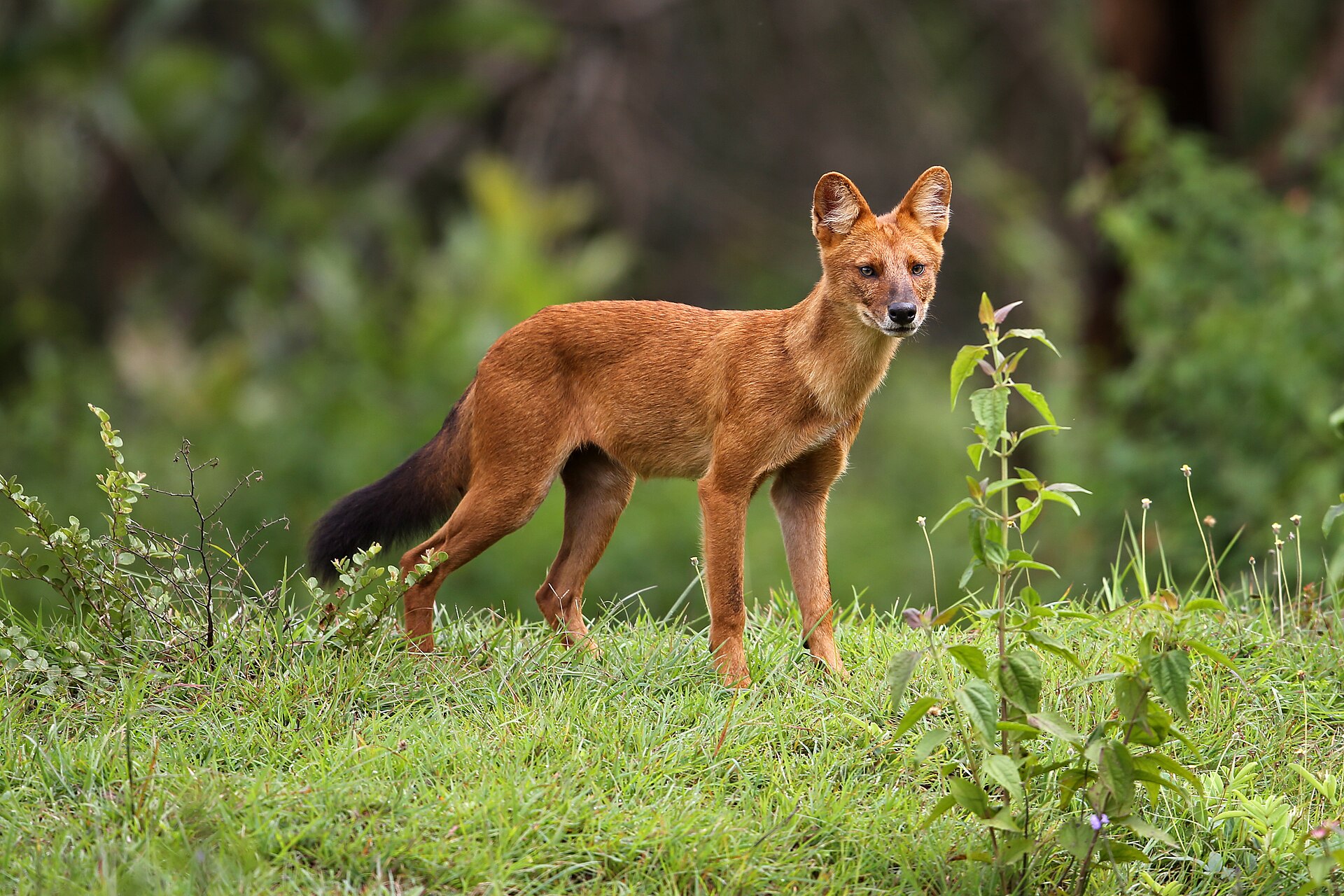
- Bright reddish-orange coat: distinctive "giant fox"
- Reduced dentition: only 40 teeth (vs 42 in other canids) — reduced posterior molars for fresh meat
IUCN status: Endangered (EN) since 2008. Global population: ~2,500 mature individuals in 11 Asian countries.
Classification and category
Order Carnivora, family Canidae, subfamily Caninae, tribe Cynopharaonini, genus Cuon (monotypic). 3-4 subspecies recognised: alpinus, dukhunensis, primaevus, sumatrensis. Closest relatives: Lycaon (in catalogue) and Bush Dog (Speothos venaticus). The three genera form the unique evolutionary tribe Cynopharaonini, separated 5-7 Mya. Etymology: "Cuon" Greek "kýōn" (dog). "Alpinus" Latin "alpine". "Dhole" from Nepali/Hindi. Described by Pallas 1811. Parameters: Weight 12-25 kg. Length 90-110 cm. Shoulder 42-55 cm. Tail 40-50 cm with black tip. Longevity 10-13 years natural, 15-16 captive. Sexual maturity 12-18 months. Gestation 60-62 days. Litter 4-12 cubs (avg 6-8).
Habitat and distribution
Endemic to subtropical-temperate Asia. Historic range: Russia to Indonesia, India to Korea (vast!). Current fragmented. Main populations: India (~1,500), Nepal (~400), Bhutan (~300), Thailand (~150-300), Myanmar, Laos, Cambodia, Vietnam, Malaysia, Indonesia, China SW, Russia Far East (~100). Mongolia, Korea, Iran, Central Asia all EXTINCT. Habitats: tropical moist forests, dry deciduous forests, mountain forests up to 4,300 m (highest among canids!), alpine steppes, boreal forests. IUCN: Endangered. Threats: deforestation (main), prey depletion, canine distemper from village dogs, persecution, fragmentation, tiger competition, traps/poisons. CITES: Appendix II.
Diet
Obligate carnivorous hypercarnivore, social. Diet: deer 60-70% (chital, sambar, barking deer, wild boar), gaur (up to 1,000 kg!), nilgai, hares, occasional rodents, occasional fruit (unusual for canids — figs, jamun), rare livestock. Pack hunts at dawn/twilight with vocal coordination (WHISTLES), 4-6 km chase at 50-60 km/h, multi-directional attack, eviscerating kill. Documented historical packs killing tigers (rare). Consumes 1-2 kg meat/day.
Physical features
Slender silhouette like giant red fox. Coat: bright reddish-orange dorsally, cream-white belly, long bushy tail with BLACK TIP. Geographic variation: Indian bright orange, Himalayan darker, Russian lighter, Sumatran intense red. Head: short fox-like muzzle, rounded ears with white inner fur, amber/brown eyes, only 40 teeth (reduced molars). Body: long muscular legs, only 4 FRONT TOES (Cynopharaonini diagnostic), 40-50 cm bushy tail. Speed 50-60 km/h endurance. UNIQUE vocalisations: whistle (long-distance forest comms), cluck, growl, yap, scream, mew. 12-13 distinct calls documented.
Behaviour and curiosities
Most social Asian canid. Packs 5-12 (rarely 30+), matrilineal with monogamous alpha pair. Territory 100-200 km² per pack. Collective pup care with regurgitation. Breeding seasonal. 4-12 cubs/litter.
Famous: WHISTLING. The "Whistling Dog" — unique modulated whistles audible 200+ m in forests. Cynopharaonini triad: Dhole (Asia), Lycaon (Africa), Bush Dog (S.America) — relict distribution from 5-7 Mya. 4 front toes like Lycaon. Tiger hunting: documented historical cases (India 1880, 1920, 2017 camera trap) — packs can overpower tigers. Highest altitude canid: up to 4,300 m Himalayas. Complex vocalisations: 12-13 distinct calls including phrases. Fruit diet: rare for canids (also Maned Wolf in catalogue). Indian culture: Sanskrit "chenna kutta" / "sona kutta", revered by Gond/Baiga tribes. Recent extinctions: Iran, Central Asia, Mongolia, Korea, Bangladesh. IUCN Dhole Action Plan 2017. 2020 Animal of the Year in India. Longevity: 16 years captive.
Pros
- Vocalizzazioni con fischi UNICHE tra canidi (Whistling Dog)
- Membro della tribù Cynopharaonini (triade evolutiva)
- Canide a maggior altitudine al mondo (4.300 m)
- Frugivoro occasionale (raro tra canidi)
Cons
- IUCN Endangered, popolazione in declino ~2.500 globali
- Estinto in Iran, Asia Centrale, Mongolia, Corea
- Vulnerabile a malattie virali da cani domestici
- Distribuzione storica vastissima ora frammentata