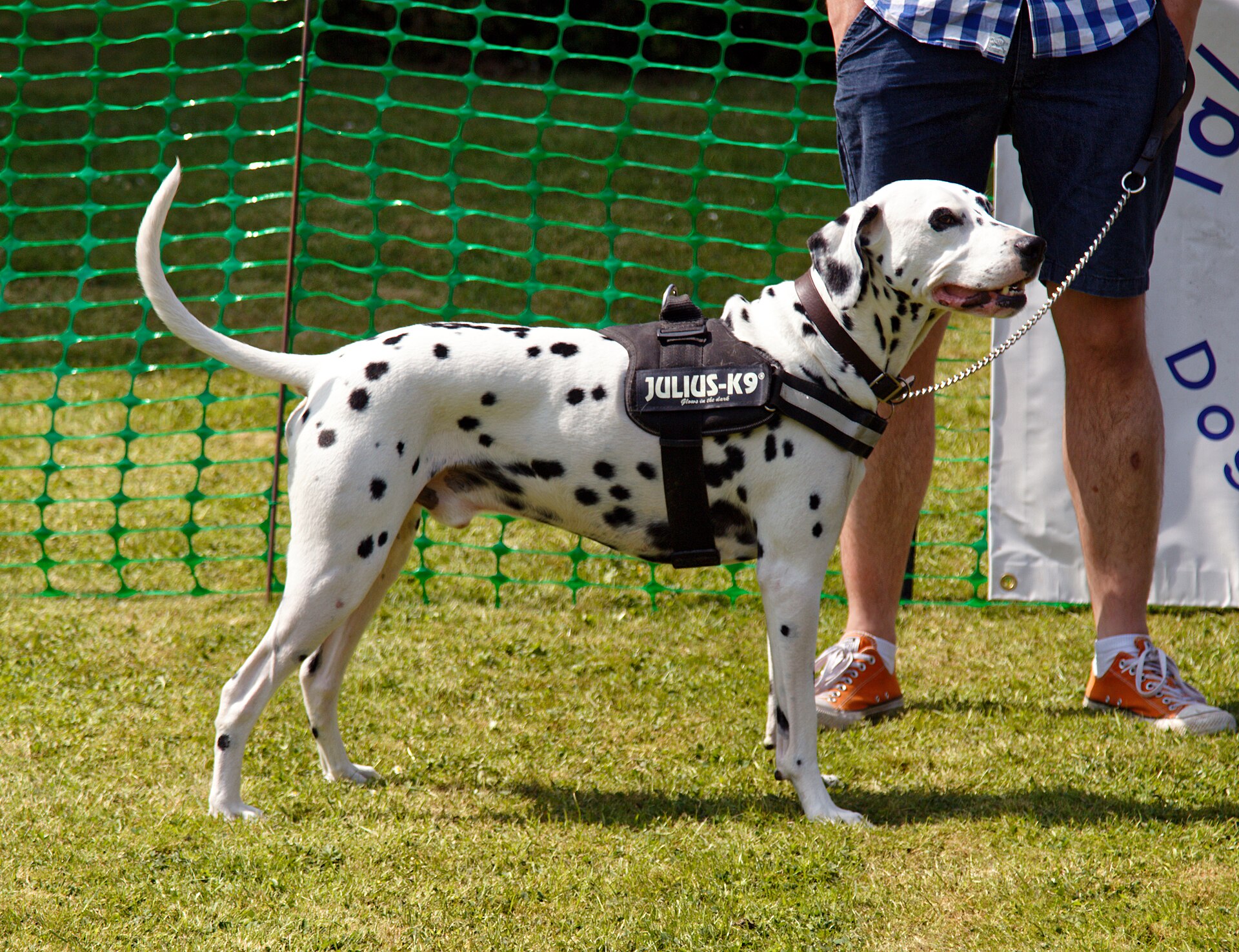
Dalmatian
Canis lupus familiaris
Characteristics
Temperament
Energetic, intelligent, loyal, sensitive. "Velcro dog" — very attached to family. Reserved with strangers but rarely aggressive. Historic "coach dog" (carriage dog) with unique affinity for horses. Historic US firefighter mascot. Inexhaustible energy (2+ hours exercise/day).
Diet
SPECIFIC diet for hyperuricemia (universal genetics): low-purine content. Avoid red meats, organs, sardines/mackerel. Favour chicken, eggs, dairy, rice. Plenty of water. Breed-specific kibble. 350-450 g/day in 2 meals.
The Dalmatian (Canis lupus familiaris) is a dog breed FCI Group 6 Section 3 (related breeds) native to the historic region of Dalmatia, today Croatia. It is the most visually distinctive dog in the world: the white coat covered with black (or brown) spots of uniform size (1-3 cm) makes it unmistakable at a glance. FCI standard: height 54-61 cm at withers, weight 24-32 kg for males (slightly lower for females). It is an athletic, energetic, tireless dog: historic "coach dog" — carriage dog that ran alongside stagecoaches in the 18th-19th centuries, protecting passengers and horses during long journeys (can cover 40-60 km a day without tiring). In the United States it became the official mascot of firefighters from 1870: Dalmatians accompanied horse-drawn carts to fires, calming the horses and protecting equipment. The Disney film "101 Dalmatians" (1961, and 1996 live action remake) made it a global pop icon. Unique feature: puppies are born completely white and develop spots in the first 2-4 weeks of life. Life expectancy: 11-14 years. Unfortunately, the breed has significant genetic problems: congenital deafness (8% bilateral + 22% unilateral) and uric acid urolithiasis.
Classification and category
The Dalmatian belongs to Canis lupus familiaris, subspecies of the grey wolf. The FCI classification (Fédération Cynologique Internationale) is Group 6 - Scenthounds and related breeds, Section 3 - Related breeds. Official FCI standard No. 153 (Croatia as country of origin, recognised in 1994). The AKC (American Kennel Club) classifies it as "Non-Sporting Group", recognised since 1888. The British Kennel Club classifies it as "Utility Group".
The geographical origin was long debated: called "Dalmatian" in Italian from the name of the coastal region of Dalmatia (Croatia), with iconographic evidence of similar dogs in 16th-17th century paintings from Split churches. However, depictions of similar dogs already appear in Egyptian tombs (3700 BC) and Minoan frescoes (Crete, 1500 BC), suggesting very ancient origins. The official recognition of Croatia as the country of origin happened with the FCI in 1994. The modern standard was codified in 1882 in England by Vero Shaw.
The morphological parameters are: height at withers 54-61 cm for males, 54-59 cm for females; weight 24-32 kg for males, 22-27 kg for females. The coat is short, dense, shiny (smooth); the base colour is pure white with well-defined spots black (most common) or brown (rare variants, called "liver"). The spots must be of uniform size (1-3 cm), uniformly distributed throughout the body (head, ears, tail included), never overlapping. The longevity is 11-14 years. Unique feature in cynology: puppies are born completely white; spots appear progressively from 2-4 weeks of life and complete within 6 months.
Habitat and distribution
As a domestic breed, the Dalmatian is distributed worldwide. Ideal habitat: the breed is particularly suited to environments with ample space (houses with gardens, farms, equestrian estates). The Dalmatian has inexhaustible energy and requires at least 2 hours of vigorous physical exercise per day: running, jogging, cycling (likes to run alongside bicycles or horses), search activities, agility. It is not suitable for life in a small apartment without long walks: its unhappiness manifests with destructive behaviour (destruction of furniture, excessive barking, digging). The Dalmatian has a historic bond with horses: the breed was developed to run alongside carriages, and even today shows an extraordinary affinity with horses. Numerous equestrian farms keep them as "working farm dogs".
The Dalmatian is a popular but no longer most widespread breed: it occupies 56th place in the 2023 AKC USA ranking (it was 7th in 1995 thanks to the Disney film, then collapsed due to impulse buying and abandonment). In Italy it is a relatively rare breed (about 200-300 ENCI registered puppies per year). The FCI recognises 80+ breeds of "related breeds" in Group 6; the Dalmatian is one of the most recognisable. Specialised breeders operate in: Croatia (origin), United Kingdom (historic breeding capital), United States, Italy. The average cost of a Dalmatian puppy with FCI pedigree is 800-1,500 € (higher for show lines). Important: after the release of the Disney film "101 Dalmatians" (1961), there was a boom in impulse purchases of Dalmatians followed by a wave of abandonment due to behavioural problems resulting from poor socialisation/training. The phenomenon was repeated with the 1996 live-action remake. The British Dalmatian Club stated that "Dalmatians are extraordinary dogs, but not for every family". Today serious breeders refuse sales to families without time for intense daily exercise.
Diet
The Dalmatian requires a specific diet due to a genetic peculiarity unique among mammals: all Dalmatians have a defect in SLC2A9 functionality (urate transport gene), which causes hyperuricemia (high uric acid levels in blood) and predisposes to uric acid urolithiasis (urinary stones). It is an autosomal recessive trait fixed throughout the breed: 100% of Dalmatians are affected (on the other hand, only some specimens develop clinical stones).
The dietary recommendations are:
- Low-purine diet: avoid red meats, organs (liver, kidneys, brain), fish such as sardines/mackerel/anchovies (rich in purines)
- Favour "low-purine" proteins: chicken, eggs, cheese, dairy, rice
- Plenty of water always available: constant hydration dilutes uric acid in urine
- Breed-specific kibble: brands such as Royal Canin "Dalmatian 28" are specifically formulated
- Avoid beer, dried fruit, sweets
- Quantity: 350-450 g of kibble/day (divided into 2 meals)
- Frequency: puppy 3-4 meals/day until 6 months, then 2 meals
Without the specific diet, the risk of developing urolithiasis during life reaches 30%; with adequate diet it drops to 5-10%. Stone symptoms: blood in urine, straining to urinate, abdominal pain. Stone removal surgery (lithotomy) is common in poorly managed Dalmatians. A breed variant called "LUA Dalmatian" (Low Uric Acid Dalmatian) was created through cross-breeding with Pointer (1973) to introduce the normal gene; LUA Dalmatians have been recognised by the AKC since 2011 but remain controversial.
Physical features
The Dalmatian has an athletic, muscular, slender structure, typical of an endurance dog. The posture is elegant, proud. The head is of moderate length, flat in the skull, with a well-defined muzzle. The nose is the same colour as the spots (black or brown). The eyes are medium, round, well-spaced; dark brown in black-spotted Dalmatians, amber in brown-spotted Dalmatians. The ears are medium, high-set, pendulous, very fine, wide at the base and pointed at the tip. The conformation: body length slightly greater than height at withers. The neck is long, muscular, slightly arched. The chest is deep. The back is straight, strong. The tail is of medium length, slightly curved, carried low at rest, high in action (never curled over the back).
The legs are long, straight, strong, well-muscled. The feet are compact, round in shape, with arched toes ("cat foot"). The nails are black in black Dalmatians, brown in "liver" ones; they can be white where there is a white spot on the paw. The movement is elegant, fluid, powerful: the Dalmatian can gallop at 50 km/h and maintain a trot for hours. It is one of the fastest dogs in its weight category.
The coat is the most distinctive feature: short hair (1-3 cm), dense, shiny, well-adherent to the body. The base colour is bright pure white; the spots are black (Dalmatian "black") in the most common variant or liver brown (Dalmatian "liver") in the rarer variant. The FCI standard requires: spots well separated (not merged), uniformly distributed throughout the body (head, ears, tail included), diameter 2-3 cm on the body and 1-2 cm on head, tail and legs. Spots with rings (peacock eye) or unpigmented central areas are defects. The "tri" colour (with blue-grey spots) or "complete albino" are not recognised by the standard.
Behaviour and curiosities
The Dalmatian is an energetic, intelligent, loyal, sensitive dog. It is deeply affectionate with the family: forms very strong bonds with its owners ("velcro dog" — does not want to be away from the family). Towards strangers it can be reserved/cautious, but rarely aggressive: the breed is classified as moderately wary. It has inexhaustible energy: AKC score 5/5 for energy, recommended exercise 2+ hours/day vigorous (walks not sufficient — needs running). Trainability is moderate-high (4/5): it is intelligent but stubborn and tends to get bored during repetitive exercises. Responds best to positive reinforcement (rewards, play) than to correction. The shedding is significant: short but dense coat, sheds all year (4/5 on the shedding scale), with two seasonal moults. Recommended brushing 2-3 times/week.
The social behaviour: the Dalmatian is moderately good with children if well socialised (it can be too energetic for small children, who need to be protected from accidental bumps). With other dogs: generally well, especially if raised together. With cats: well if introduced as puppies; medium chase instinct. With horses: exceptionally well due to genetic heritage (history of "coach dog").
Famous curiosities: the "coach dog" history: in the 18th-19th centuries, stagecoaches were accompanied by 2-4 Dalmatians that ran under the wheel axle for hours. Functions: protection of horses (calming for horses — the Dalmatian-horse bond is genetically strong), protection of baggage (deterrent against thieves on bridges), company for the coachman. They were trained to run under carriages, sometimes between horses' legs — extraordinary motor skill. Firefighter curiosity: in the 19th century, American fire wagons were horse-drawn, and Dalmatians ran alongside as "fire-house dogs". Functions: calming horses during the noise of fires, chasing stray dogs from the road, protecting equipment from thieves. After the advent of motorised trucks (~1920), the function ceased, but the Dalmatian remained the official mascot of many US fire departments. Even today, some American firehouses (e.g. Chicago, New York) have a resident Dalmatian as a traditional symbol. Disney curiosity: the animated film "101 Dalmatians" (1961) introduced the Dalmatian to the global public; based on Dodie Smith's novel "The Hundred and One Dalmatians" (1956). The Dalmatians Pongo and Perdita are the protagonists, and the villain Cruella De Vil tries to kidnap them to make fur coats from their skins. The 1996 live-action remake (with Glenn Close as Cruella) used over 200 real Dalmatians and generated a wave of impulse purchases followed by abandonment. Disney even published a consumer warning urging reflection before purchase. Scientific curiosity: Dalmatians are the only dog breed with universal hyperuricemia — a metabolic anomaly genetically fixed for thousands of generations. The cause is a mutation in the SLC2A9 (URAT1) gene. Genetic curiosity: congenital deafness affects 30% of Dalmatians: 8% bilateral deafness (completely deaf), 22% unilateral deafness (deaf in one ear). The "piebald" gene (responsible for spots on a white background) interferes with embryonic development of the inner ear. Blue-eyed Dalmatians have a higher probability of deafness. BAER testing (Brainstem Auditory Evoked Response) recommended at 6 weeks. Linguistic curiosity: the name "Dalmatian" derives from the Dalmatia region (Croatia); in English "Dalmatian" is also an adjective (e.g. "Dalmatian coat" = spotted coat). Sports curiosity: the Dalmatian is excellent in agility, flyball, canicross; world record for duration running alongside a carriage: 65 km in 8 hours (1936, Yorkshire). Historical curiosity: Dalmatians were used in the 1800s as guard dogs of postal carriages throughout Europe, replacing Greyhounds previously used. Famous Dalmatians curiosity: "Pongo" from Disney films; "Sparky" mascot of the US National Fire Protection Association; "Patch" in "101 Dalmatians"; "Dipstick" from "George of the Jungle". Black-and-white curiosity: some purist breeders reject the LUA Dalmatians (Low Uric Acid) created in 1973 by crossing with Pointer to eliminate hyperuricemia, considering them "not pure" — a controversy that divides the cynological community even today (AKC recognised them only in 2011, FCI still not).
Pros
- Razza visivamente unica e iconica (macchie distintive)
- Atletico, resistente, perfetto per famiglie attive
- Affinità storica eccezionale con i cavalli
- Intelligente e leale, forte legame con i proprietari
Cons
- Energia molto alta (2+ ore esercizio/giorno richieste)
- Problemi genetici: iperuricemia universale (dieta specifica obbligatoria)
- Sordità congenita nel 30% dei soggetti
- Perdita di pelo abbondante tutto l'anno