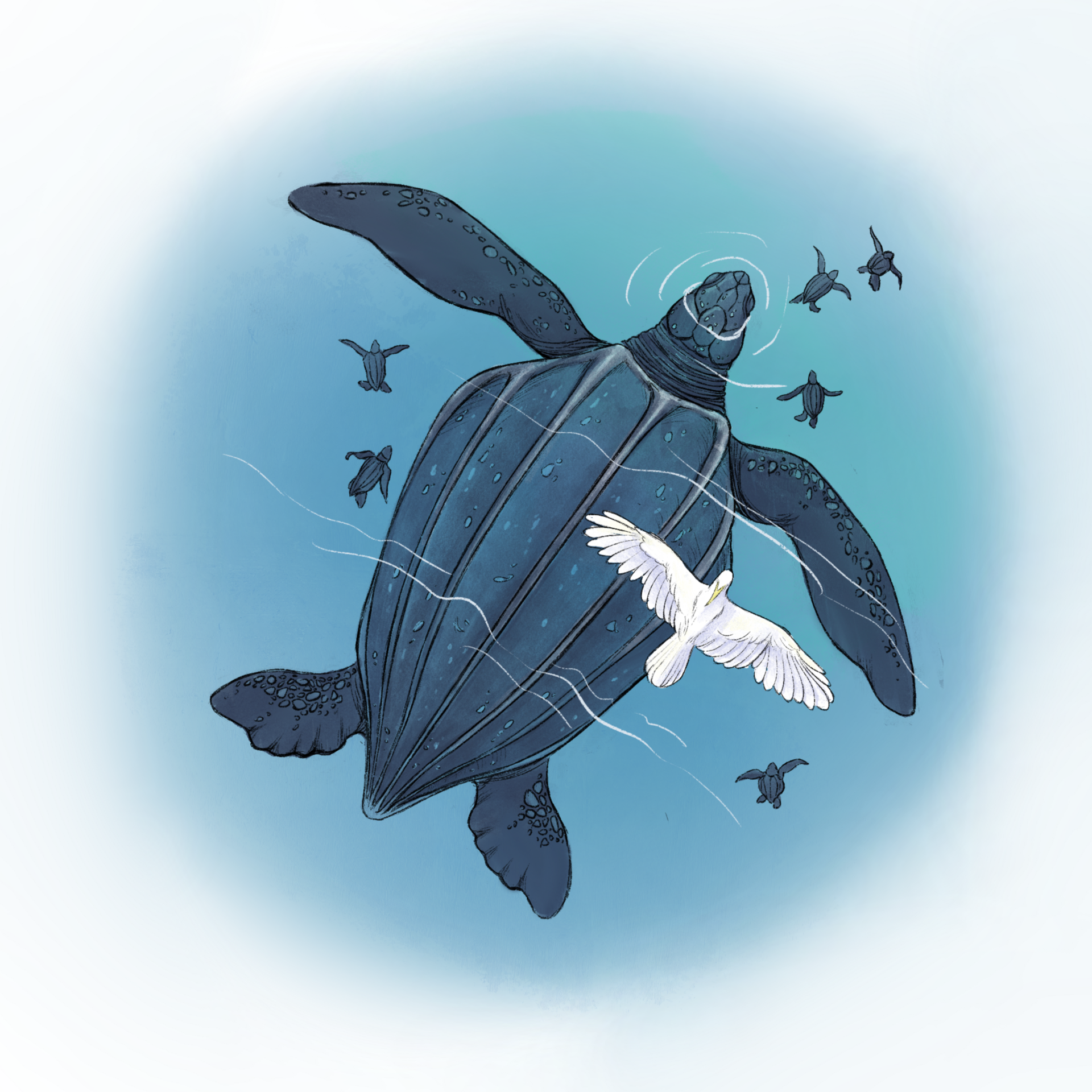
Leatherback Sea Turtle
Dermochelys coriacea
Characteristics
Temperament
Solitary, pelagic, migratory. LARGEST TURTLE in the world (916 kg record). ONLY with leathery shell (no scutes). DEEPEST-DIVING REPTILE in the world (1,250 m record!). "Gigantothermy" — body 18°C above water. Only turtle in polar waters. Migration 16,000 km/year. JELLYFISH-only diet. "Living fossil" 110 million years.
Diet
OBLIGATE JELLYFISH-EATER (100% diet). Throat/oesophagus lined with keratin papillae (15-20 cm) oriented backwards — jellyfish cannot escape. Eats up to 73% body weight/day (500 kg jellyfish!). Vulnerable to plastic (confuses with jellyfish): 1/3 of individuals have plastic in stomach. Target species: Aurelia, Cyanea, Pelagia, Rhizostoma.
The Leatherback Sea Turtle (Dermochelys coriacea) is the largest turtle in the world and the most phylogenetically isolated living reptile. Imposing measurements: length 1.5-2.2 m (record 2.5 m), weight 250-700 kg (absolute record 916 kg, landed in Wales 1988!). It is unmistakable for the LEATHERY shell (hence the Italian name) — the only living turtle to have it: instead of rigid bony scutes like all other turtles, it has a black-bluish, flexible skin, marked by 7 longitudinal keels. This skin is composed of small osteoderms embedded in a resistant collagen matrix (like a "soft armour"). It is the deepest-diving reptile: record 1,250 m, over 85 minutes of apnoea — deeper than sperm whales! It has a unique feature among reptiles: "gigantothermy" — maintains body temperature 18°C above surrounding water thanks to body mass, fat insulation and countercurrent vascular exchange. For this reason it is the only sea turtle that survives in polar waters (it has been observed in Norway, Iceland, Alaska, southern Chile). Extraordinarily specialised diet: eats only jellyfish (throat and oesophagus lined with thousands of "oesophageal papillae" — backward-pointing keratin spines that prevent gelatinous prey from escaping). Performs migrations of 16,000 km/year, between feeding sites and tropical nesting beaches. IUCN status: Vulnerable (VU) globally, but Critically Endangered Pacific populations (95% decline since 1980!).
Classification and category
The Leatherback Sea Turtle belongs to the order Testudines, suborder Cryptodira, super-family Chelonioidea (sea turtles), family Dermochelyidae — a monotypic family! This means it is the only living species in its family. All other 6 species of sea turtles belong to the family Cheloniidae (Green Turtle, Loggerhead, Hawksbill, etc.).
The phylogenetic separation between Dermochelyidae and Cheloniidae occurred about 110-130 million years ago (Cretaceous!), before the separation of lemurs and primates. The Leatherback is therefore a true "living fossil", almost morphologically unchanged for over 100 million years. Closely related fossils (extinct genus Archelon, ~75 Mya) reached 4 metres in length and 2-3 tonnes.
Etymology: Dermochelys from Greek "derma" (skin) + "chelys" (turtle) = "turtle of skin"; "coriacea" from Latin "coriaceus" = "leathery". The English name "leatherback" and the Italian "liuto" derive from the shell shape, similar to an inverted lute musical instrument. The species was scientifically described by Vandelli in 1761 with the original name "Testudo coriacea"; transferred to the genus Dermochelys by Blainville in 1816.
There are at least 7 genetically distinct populations worldwide, recently identified (Dutton et al., 2013):
- Eastern Pacific: nests in Costa Rica, Mexico, Nicaragua — CR Critically Endangered (population reduced 95%)
- Western Pacific: nests in Papua, Indonesia, Vanuatu — CR
- Northwestern Atlantic: nests in Suriname, French Guiana — healthier
- Southwestern Atlantic: Brazil
- Northeastern Atlantic: nests in Gabon, world's largest population ~5,000 females/year
- Southeastern Atlantic: South Africa
- Indian: Sri Lanka, Sumatra
The morphological parameters:
- Carapace length: 1.5-2.2 m (record 2.5 m)
- Weight: 250-700 kg average (absolute record "Harlech turtle" Wales 1988: 916 kg)
- Front flipper width: 2.7 m (the longest in proportion among sea turtles)
- Skull: 30 cm, sharp beak
Longevity: 30-45 years in nature, estimated 50-80 years potentially. Sexual maturity: 13-25 years (latest among sea turtles). Reproduction: female comes to tropical beach 3-7 times every 2-3 years; each night lays 70-100 eggs (record 175!), total up to 1,000 eggs in a season.
Habitat and distribution
The Leatherback is the most widely distributed sea turtle in the world: pan-oceanic, present in all oceans. Its unique feature is the tolerance to cold waters thanks to gigantothermy.
Distribution:
- Tropical waters: all oceans — nesting sites on sandy beaches between 25° N and 25° S
- Temperate waters: the Leatherback can live at 12-25°C — not possible for other sea turtles
- Polar/sub-polar waters: the only sea turtle observed in Norway (record 71° N), Iceland, Alaska (60° N), Patagonia (55° S), South Africa
- Depth: surface to 1,250 m (diving record). 90% of time within 300 m, but regular deep dives
Extraordinary migrations: the Leatherback covers over 16,000 km/year between tropical nesting sites and feeding sites (areas rich in jellyfish, often near mid-latitude oceanic fronts). A single turtle can cross the entire Pacific (Indonesia → California) in a few months. Satellite tracking has shown migrations of 12,000-20,000 km between egg laying.
Estimated global population: ~26,000 reproductive adult females (IUCN 2013). IUCN status: Vulnerable (VU) since 2013 (previously Critically Endangered). However:
- Eastern Pacific: 95% decline in 30 years — only 100-200 females remaining, Critically Endangered
- Western Pacific: 70-80% decline, CR
- Atlantic: more stable or slightly recovering populations (Gabon has the world's largest population)
Threats:
- Bycatch (accidental capture): main cause — longlines, trawl nets, fishing nets catch and drown thousands of turtles
- Plastic ingestion: confuse plastic bags with jellyfish (their prey); cause death by intestinal obstruction
- Egg poaching: in many tropical countries, eggs are collected for consumption (illegal but widespread)
- Traditional hunting: in some Caribbean and African countries the meat is still consumed
- Coastal erosion: loss of nesting sites (Florida, Caribbean)
- Light pollution: hatchlings are disoriented by urban lights, head towards land instead of sea
- Climate change: increases in sand temperature alter sex ratio (TSD); rises in sea level destroy nests
CITES: Appendix I. Conservation: active projects in 20+ countries. Success in Northeast Atlantic (Gabon, Suriname) thanks to beach protection and bycatch fishing bans. The "Leatherback Project" of the Marine Conservation Society monitors world populations.
Diet
The Leatherback is an "obligate jellyfish eater" — feeding exclusively on jellyfish (Cnidarians) and other gelatinous organisms. A most unique feeding specialisation in the animal kingdom:
- Jellyfish: 100% main diet — target species: Aurelia (moon jellyfish), Cyanea capillata (lion's mane jellyfish), Pelagia noctiluca (mauve stinger), Rhizostoma, Velella velella
- Salps and tunicates: gelatinous organisms similar to jellyfish
- Small cephalopods: rare observations
- Jellyfish-eating fish: occasional
The anatomical specialisation is extraordinary. The problem with eating jellyfish: they are 96% water, slippery, gelatinous — very difficult to hold in the mouth. The Leatherback has developed a unique system:
- Sharp beak: two keratinised "blades" on the upper jaw (the "cuspids") that grab jellyfish from outside
- Tongue with papillae: muscular, covered with keratinised spines
- Throat and oesophagus lined with PAPILLAE: thousands of keratinised "backward-pointing spines" (15-20 cm long), all oriented down and back. Function: prevent jellyfish from escaping the throat — the jellyfish enters easily but cannot go back
- Long oesophagus: 1+ m, allows swallowing of large whole jellyfish
Impressive quantity: an adult Leatherback consumes up to 73% of its body weight daily in jellyfish (500+ kg/day!). This is because jellyfish are very poor energetically (5-10 kcal/kg, against 1,000 kcal/kg of fish). Its dependence on jellyfish explains the long migratory distances: it must continuously find new "blooms" of jellyfish.
Plastic hazard: the jellyfish-eating specialisation makes the Leatherback extremely vulnerable to floating plastic bags, which it confuses with jellyfish. Studies show that over 1/3 of Leatherbacks contain plastic in the stomach — often causing fatal obstruction.
Physical features
The Leatherback has a perfectly hydrodynamic body, optimised for long-distance pelagic migrations. Unique features among turtles:
Leathery carapace (the most diagnostic difference):
- Material: thick skin (4-7 cm), black-bluish, flexible
- Structure: NOT formed by bony scutes like other turtles (Cheloniidae). Instead, contains small osteoderms (1-2 mm bone plates) embedded in a resistant collagen and oil matrix
- 7 longitudinal keels: relief lines running along the carapace, from head to tail. Function: structural reinforcement and aerodynamics
- Colour: bright black with white-blue spots (especially on the belly)
- Function: the flexible carapace allows it to withstand the pressure of deep dives (1,250 m = 125 atm). A "traditional" turtle with bony carapace would "crush" at such depth
The head is large, with a sharp beak. The eyes are medium, black, with excellent underwater vision. On top of the skull is the "pineal gland" visible as a white-pink spot — functional for circadian rhythm regulation and migration (probably feels the Earth's magnetic field).
The front flippers are huge: 2.7 m (45-50% of body length) — the longest in proportion among sea turtles. They are powerful propellers: a single "row" propels the turtle 2-3 m. They have no claws (unlike other sea turtles). The rear flippers are smaller, mainly used as rudders and for digging the nest on the beach.
Gigantothermy — the most extraordinary adaptation:
- Body temperature: maintained at 25-30°C even in waters of 5-10°C (+18°C above the environment)
- Mechanisms:
- Large body mass (regulates thermoregulation)
- Fat insulating layer under the leathery shell
- Countercurrent vascular system: in the flippers, hot arteries from the inside wrap around the cold veins of the surface, exchanging heat and reducing losses (like in penguins)
- Reduction of resting metabolism
- Effects: ability to survive in polar waters, make long dives in cold depths, sustain long migrations
- Status: the Leatherback is classified as "mesotherm" — between ectotherm and endotherm. Only living reptile with this capability (except small "incubating" pythons that warm nests)
Behaviour and curiosities
The Leatherback is a solitary, pelagic, migratory animal. Lives almost always in the open sea, coming ashore only to nest. Adult females arrive at tropical nesting beaches (the same as birth — natal philopatry) every 2-3 years; adult males never come ashore again after birth.
Nesting behaviour: the female arrives at the beach at night (to avoid predators and heat). She looks for a point above the tide line (rarely 30+ m from the shore). She digs a cavity of 60-80 cm with her hind legs. Lays 70-100 eggs (record 175) — white eggs, "phantom eggs" or "yolked" (these are "yolked" eggs without yolk or without hatching, debated purpose — perhaps protection against bacteria or thermoregulation). Covers the nest with sand, does "tracking" and false traps to camouflage the site, then returns to the sea. A single female lays 3-7 batches per season, spaced 10 days apart — total up to 1,000 eggs in a season night!
The incubation lasts 60-65 days. Temperature-dependent sex determination (TSD): eggs incubated below 28°C produce only males, above 31°C only females, 29-30°C mix. Important implication for climate change: increases in sand temperature are producing imbalanced sex ratio (>90% females in some populations — threat to future reproduction).
The hatchlings: emerge from the sand at night (en masse, "boil-out"), run towards the sea guided by stars reflected on the water. Vulnerable to urban lights: hatchlings head towards the brightest lights, confusing street lamps for stars — they can die disoriented. Juvenile mortality: 99% in the first year (predators, predation on the beach by birds/crabs, marine predators). Only 1 in 1,000 reaches sexual maturity.
Famous curiosities: the weight record. The largest Leatherback ever documented was "Harlech turtle": an adult female landed dead at Harlech (Wales, UK) on 23 September 1988. Weight: 916 kg (2,000 lbs!). Length: 2.55 m. Cause of death: ingestion of a plastic bag. It is exhibited at the National Museum Cardiff. Also known as the "giant turtle of Harlech".
"Oesophageal papillae" curiosity: the throat and oesophagus of the Leatherback are lined with thousands of curved keratin spines ("papillae"), all oriented toward the stomach. Function: prevent jellyfish from going back while being swallowed. The spines are 15-20 cm long! Underwater photographer David Doubilet in 1993 published a famous photo of the inside of the throat of a dead Leatherback — the image is viral and looks "horror".
Diving record curiosity: the Leatherback holds the diving record for any living reptile — 1,250 m deep and 85 minutes of apnoea (Eckert et al., 1989, satellite tracking). For comparison: sperm whales dive to 2,250 m (record), but turtles are the second deepest among air-breathing vertebrates. Deep dives are probably to hunt jellyfish from the "scattering layer" — a layer of gelatinous organisms at 500-800 m that migrate vertically at night.
Speed curiosity: the Leatherback is the fastest among turtles. Sprint speed: 35 km/h (Guinness World Records — faster than a horse at trot!). Cruising speed in migration: 1-3 km/h, with occasional bursts at 35 km/h to avoid predators (sharks). Trans-oceanic migration curiosity: the Leatherback makes longer migrations than any other reptile. Satellite tracking has shown individuals crossing the entire Pacific (Indonesia → Oregon USA, ~20,000 km) and the entire Atlantic (Suriname → Gabon, ~15,000 km). Migration is guided by: Earth's magnetic field (magnetoreceptive sense), ocean currents, and memory. "Living fossil" curiosity: the Leatherback is practically identical morphologically to its fossil ancestors of 110 million years ago (dinosaur era!). The oldest fossils of the Dermochelyidae lineage date back to the Cretaceous. A fossil of 75 million years (Archelon) reached 4 m in length. The Leatherback survived the K-Pg extinction (66 Mya) that eliminated dinosaurs and 80% of marine life. "Jellyfish drift" curiosity: the Leatherback is one of the few natural predators of jellyfish — its extinction could cause a global "jellyfish explosion" (seas have fewer jellyfish predators → more jellyfish → more problems for fishing and tourism industries). A "jellyfish explosion" is already happening in some areas (e.g. Mediterranean) for other reasons (eutrophication, warming), but the decline of Leatherbacks contributes. "Apicius's jellyfish" curiosity: the famous 20th century poaching (for turtle "soups", considered "aphrodisiac") decimated populations. Today banned worldwide for Leatherback (CITES Appendix I). However traditional hunting persists in some Caribbean countries. "Oil rig predator" curiosity: the Leatherback has been documented diving to offshore oil platforms — probably attracted by jellyfish "blooms" that form near these structures. "Strange voice" curiosity: hatchlings emerging emit subsonic "chirps" (below 100 Hz) to coordinate emergence from the sand. 2014 study (Ferrara et al.) shows that vocal coordination increases survival (all emerge simultaneously — predators overwhelmed). "Satellite tracking" curiosity: the Leatherback is one of the most studied reptiles with satellite trackers (since 1980). Programmes like "Sea Turtle Conservancy" maintain interactive online maps of tagged turtle movements — popular educational attractions. "Yolkless eggs" curiosity: during nesting, each female lays some (5-20) "phantom eggs" — eggs without yolk or sterile. The function is debated: perhaps they are "scaffold" for nest thermoregulation, or "decoy" for predators. Found only in Cheloniidae and Dermochelyidae turtles. "Jellyfish blooming" curiosity: jellyfish "blooms" are increasing globally due to warming, eutrophication, and decline of jellyfish predators — paradoxically, this could BENEFIT the Leatherback (more food), but other factors (bycatch, plastic) undermine its survival.
Pros
- La tartaruga più grande al mondo (record assoluto 916 kg)
- Unicum tra rettili: 'gigantotermia' (sangue quasi caldo)
- Rettile più profondo al mondo (1.250 m record)
- 'Living fossil' di 110 milioni di anni — sopravvissuto a K-Pg
Cons
- Popolazioni Pacifico Critically Endangered (-95% in 30 anni)
- Vulnerabile a plastica (confonde con meduse): 1/3 ingerisce
- Mortalità giovanile 99% nel primo anno
- Maturità sessuale 13-25 anni (lentissima)