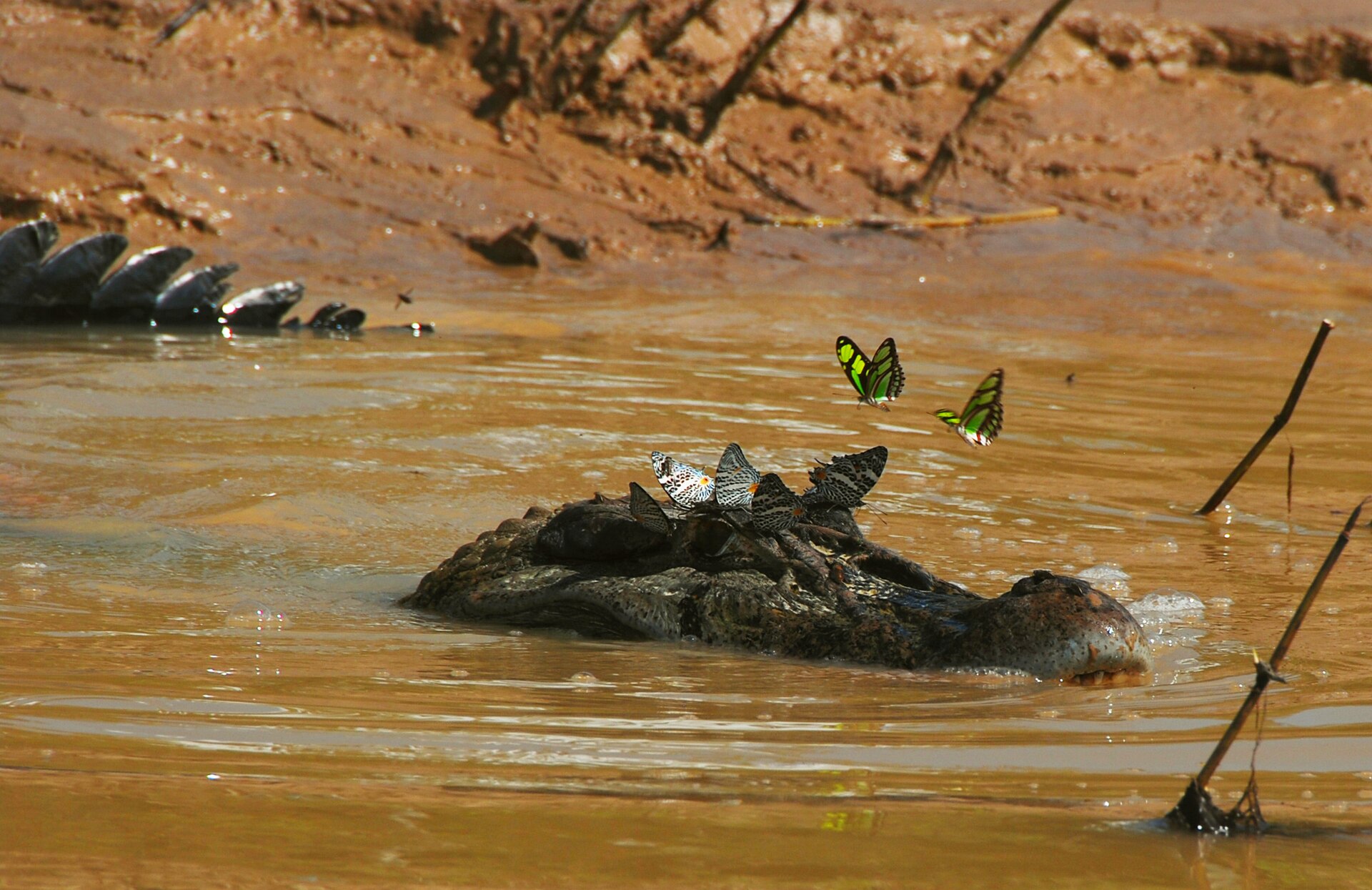
Black Caiman
Melanosuchus niger
Characteristics
Temperament
Solitary, nocturnal, aquatic. LARGEST AMAZON PREDATOR (apex river predator, up to 5-6 m). BLACK (melanistic) skin for thermoregulation + nocturnal camouflage. Monotypic genus. Large reflective red eyes (night vision, used for censuses). Notable PARENTAL CARE (mother carries cubs in mouth, communicates with vocalizations). RECOVERY STORY from near-extinction (skin hunting 50s-70s → CITES → recovery). Competes with jaguar for apex.
Diet
Obligate apex predator. Juveniles: insects, crustaceans, small fish. Adults: fish (main — piranha, pirarucu/Arapaima up to 200 kg!), capybara (in catalogue!), paca (in catalogue!), deer, turtles, water birds, young anacondas, occasionally jaguars. Hunting: aquatic ambush (floats motionless, black nocturnal camouflage) + explosive strike + 5,000 N bite + "death roll". Keystone species regulating fish/capybara.
The Black Caiman (Melanosuchus niger), in Portuguese Jacaré-açu ("big caiman"), is the largest predator of the Amazon and the largest crocodilian of South America. Endemic to the Amazon basin, famous for:
- LARGEST AMAZON PREDATOR: apex predator of Amazonian rivers, up to 5-6 meters long
- BLACK skin: dark (melanistic) skin absorbing heat (thermoregulation) and providing nocturnal camouflage — hence the name
- Large reflective red eyes: excellent night vision (eyes glow red in torchlight)
- Monotypic genus: Melanosuchus contains only this species
- Large prey predator: capybara (in catalogue!), paca (in catalogue!), deer, giant fish (pirarucu), turtles, occasionally jaguars/anacondas
- Parental care: mother protects nest and cubs, communicates with vocalizations
- Recovery story: hunted near to extinction for skin (1950s-70s), now recovering
IUCN status: Least Concern (LC) since 2000 (downlisted from Conservation Dependent thanks to recovery). Distribution: Amazon basin — Brazil, Peru, Colombia, Ecuador, Bolivia, Venezuela, Guyana.
Classification and category
Order Crocodilia, family Alligatoridae, subfamily Caimaninae, genus Melanosuchus (MONOTYPIC). Alligatoridae includes true alligators (American Alligator in catalogue!) and caimans (Black Caiman, Spectacled Caiman, Yacaré, dwarf caimans). Closest relatives: other South American caimans. Black Caiman is the largest of subfamily Caimaninae. Caimans differ from true crocodiles (Crocodylidae) by: broader snout, lower teeth fitting into pits (not visible when mouth closed), ventral bony plates. Etymology: "Melanosuchus" Greek "black" + "crocodile". "Niger" Latin "black". "Jacaré" Tupi-Guaraní. Described by Spix 1825. Parameters: Length 4-5 m average (record 5.8-6.1 m). Weight 300-450 kg (record 600+ kg). Teeth 72-76. Longevity 50-80 years estimated. Sexual maturity 10-15 years. 30-65 eggs/year. Incubation 42-90 days (temperature-dependent sex determination).
Habitat and distribution
Endemic to Amazon and Orinoco basins: Brazil (Amazon main, Pantanal), Peru, Colombia, Ecuador, Bolivia, Venezuela, Guyana, Suriname, French Guyana. Habitats: slow Amazonian rivers (main), lakes and lagoons, varzea floodplain forest, igapó black-water forest, swamps/Pantanal, flooded grasslands. Avoids fast rivers, brackish waters, areas without water. IUCN: Least Concern since 2000. Recovery story: 1950-70 intensive skin hunting (99% population loss in many areas), 1973 CITES Appendix I, gradual recovery, 2000 downlisted, now LC. Threats: illegal hunting (persists), habitat loss, human conflict, mercury pollution (gold mining), overfishing of prey. CITES: Appendix I (some populations Appendix II for sustainable farming).
Diet
Obligate apex predator. Diet changes with age. Juveniles (2 m): fish (main — piranha, pirarucu/Arapaima up to 200 kg!, catfish), capybara (in catalogue!), paca (in catalogue!), deer, turtles (powerful jaws crack shells), water birds, young anacondas (apex competition), terrestrial mammals near water (young tapirs, peccary, occasionally jaguars!), occasional livestock. Hunting: aquatic ambush (floats motionless, only eyes/nostrils above water — perfect black camouflage at night) + silent approach + explosive strike + ~5,000 N bite + "death roll" for large prey + whole/dismembered swallowing. Apex predator regulating fish/capybara populations — keystone species. Dominant nocturnal river predator.
Physical features
Typical crocodilian silhouette but imposing size and dark coloration. Skin: BLACK (melanistic) in adults — darkest of all crocodilians. Juveniles black with yellow/white bands (camouflage) fading with age. Black functions: thermoregulation (absorbs heat), nocturnal camouflage, UV protection. Osteoderms (bony plates). Head: broad snout (alligatorid feature), LARGE EYES (proportionally larger than other crocodilians — night vision adaptation), reflective red eyes (tapetum lucidum — glow red in torchlight, used for night censuses), 72-76 conical teeth, ~5,000 N bite force. Body: massive robust elongated, long laterally-flattened powerful tail (aquatic propulsion), short legs with partially webbed toes, bony armor. Swims fast, terrestrial sprint 30 km/h, excellent night vision, up to 1 hour underwater.
Behaviour and curiosities
Solitary, mainly nocturnal, aquatic. Dominant males defend breeding territories. Female builds vegetation nest on bank, lays 30-65 eggs (decomposition generates heat). Temperature-dependent sex determination (higher temps = more males). Incubation 42-90 days. Parental care (notable for reptile!): mother guards nest, hears cubs vocalize FROM INSIDE EGGS, opens nest, carries cubs in mouth to water, protects cubs for weeks/months ("creches"). Adults have few natural predators (apex). Cubs predated by herons, anacondas, jaguars, other caimans, piranhas. Rare human attacks (~1-2 fatal/year Amazon).
Famous: RECOVERY STORY — 1950-70 hunted for skin, 99% population loss, near extinction. CITES Appendix I (1973), gradual recovery, 2000 downlisted, now LC. Exemplary crocodilian conservation. "Largest Amazon predator": 4-6 m, 300-600 kg, dominates water (vs jaguar land, anaconda shallows). "Black skin": thermoregulation + nocturnal camouflage + UV protection. "Red-eye census": eyes glow red in torchlight, used for night population counts. Parental care: mother carries cubs in mouth, archosaur ancestral trait (crocs closest living relatives of birds). "Jacaré-açu": Amazon folklore river spirit. Jaguar competition: apex rivalry, mutual predation. "Death roll": for large prey. Longevity: 50-80 years. Pirarucu recovery: trophic cascade — more caimans = more fish (nutrient fertilization).
Pros
- Più grande predatore dell'Amazzonia (apex acquatico)
- Storia di recupero esemplare da quasi-estinzione
- Specie chiave (trophic cascade: più caimani = più pesci)
- Cura parentale notevole (tratto ancestrale archosauri)
Cons
- Caccia illegale per pelle/carne persiste
- Deforestazione amazzonica minaccia habitat
- Bioaccumulo di mercurio (miniere d'oro)
- Conflitto con umani (rari ma documentati attacchi)