Photo: Wikimedia Commons · CC BY-SA 2.0 de
Chinese water dragon
Physignathus cocincinus
The Chinese water dragon is a brilliant green arboreal agamid of Southeast Asia, a superb climber and swimmer, and a popular reptile in the pet trade.
Characteristics
Temperament
Diurnal, lively and territorial; becomes fairly tame with handling.
Diet
Mainly insectivorous; adults also take small vertebrates, eggs and plants.
An emerald-green agamid
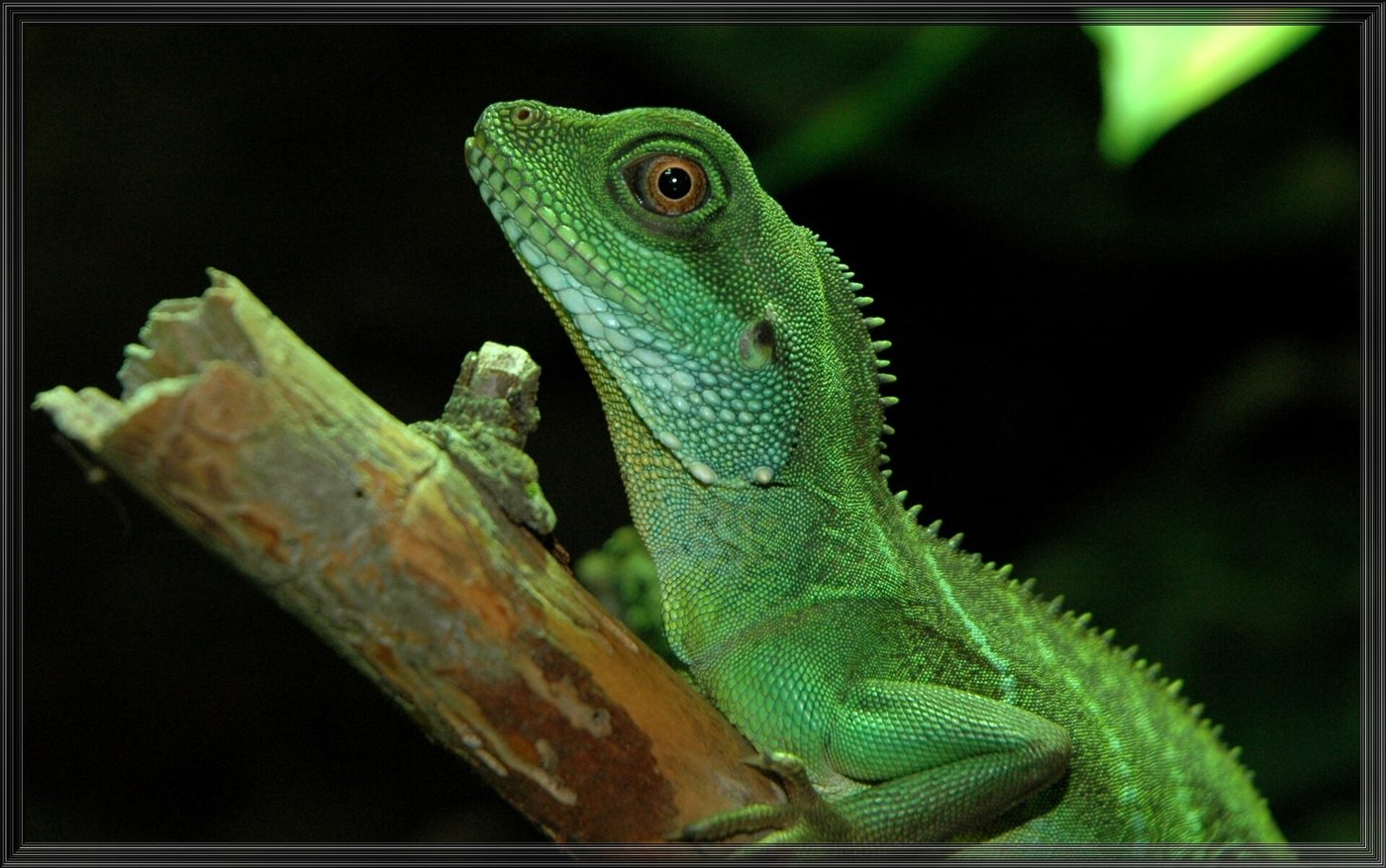
The Chinese water dragon (Physignathus cocincinus) is a lizard of the family Agamidae and the only species in the genus Physignathus. Its body is a vivid green ranging from emerald to olive, with a throat often washed in blue, pink or orange in adult males. A crest of pointed scales runs along the back and tail, larger in males, which also have a bulkier head. The very long tail makes up roughly two-thirds of the total length and serves as a rudder in water and a balancing whip among branches.
Habitat and range
It lives in the rainforests and woodlands of mainland Southeast Asia — southern China, Vietnam, Thailand, Laos and Cambodia — always near watercourses. It is a semi-arboreal, semi-aquatic species: it spends much of its time on branches overhanging rivers and pools, ready to drop into the water at the first sign of danger. It is an excellent swimmer and can stay submerged for long periods.
Behaviour and diet
It is a diurnal, active and territorial reptile, especially among males. It feeds mainly on insects and other invertebrates, but adults supplement their diet with small vertebrates, eggs and plant matter. In captivity it is one of the most widely kept agamids, needing tall planted terrariums, a water basin, high humidity and UVB lighting.
Did you know?
Like many agamids, it has a rudimentary "third eye" (a parietal eye) on top of its head, sensitive to light and useful for detecting predators from above. When startled, it escapes by plunging into water from considerable heights.
Conservation
The IUCN lists it as Vulnerable. Heavy collection for the pet trade and the loss of riparian forest have reduced wild populations, so captive-bred animals are the better choice.
Pros
- Spectacular green colouring
- Skilled climber and swimmer
- Very active and rewarding to watch
Cons
- Needs large, tall, very humid terrariums
- Vulnerable species: choose captive-bred animals
- Males can be territorial with each other