Red Wolf
Canis rufus
Characteristics
Temperament
A social wild predator, shy and wary of humans, living in small family packs led by a breeding pair. More reserved and less conspicuous than the gray wolf, it communicates with howls and territorial marking and cooperates in hunting and pup-rearing. It is NOT a pet or a trainable animal: it is a critically endangered wild wolf, managed only within strict conservation programmes.
Diet
An opportunistic predatory carnivore. It feeds on small and medium mammals (rabbits, hares, rodents, nutria), white-tailed deer (especially young or weak ones), raccoons and other small carnivores, and occasionally birds, insects and plant matter. It hunts in pairs or small family packs to take larger prey, but bases its daily diet on small prey, behaving in an intermediate way between the gray wolf and the coyote.
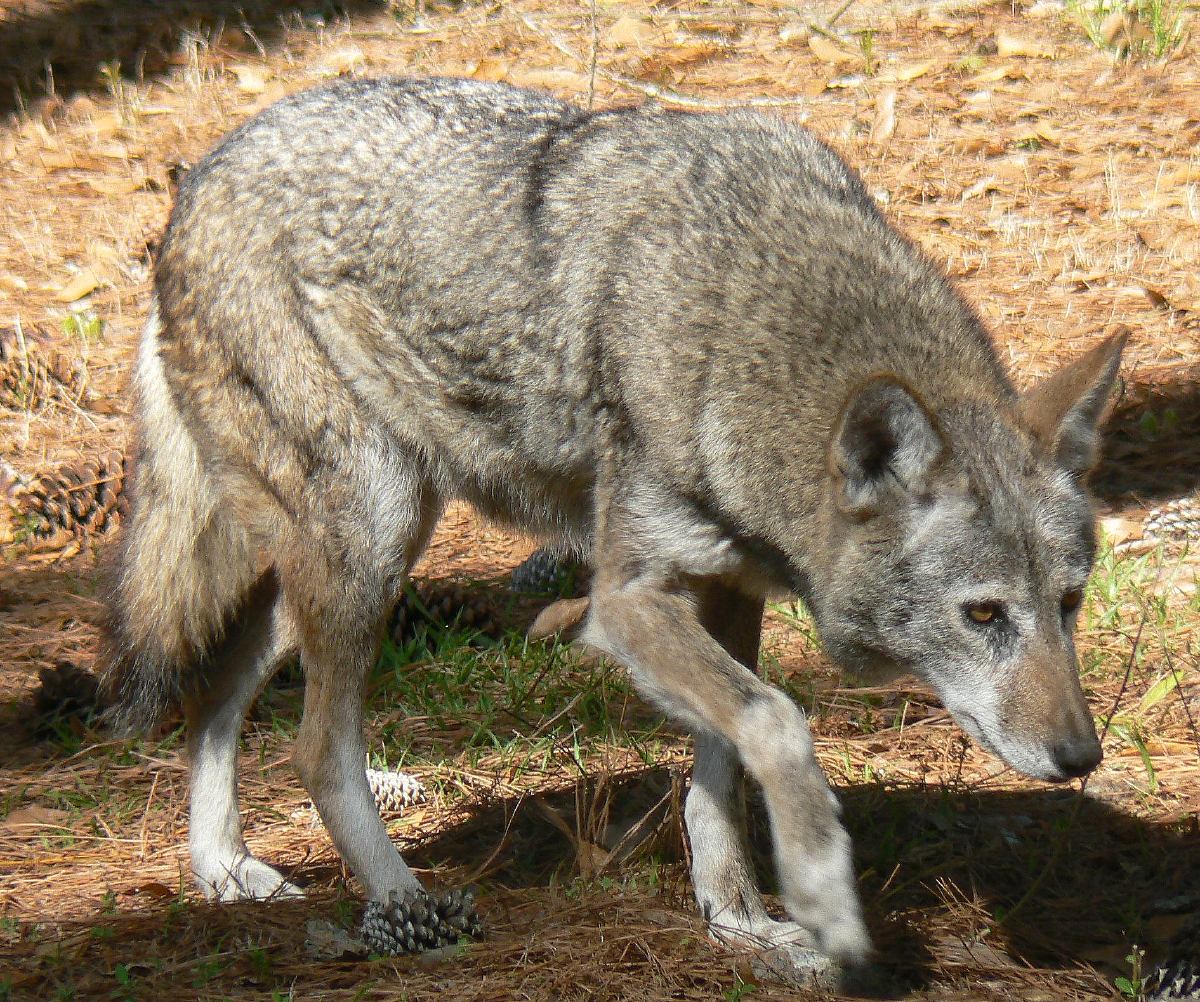
The Red Wolf (Canis rufus) is one of the rarest and most threatened canids in the world: an elegant, long-legged wolf, intermediate in size between the coyote and the gray wolf, a living symbol of North American wildlife conservation. Famous for:
- Extreme rarity: it is Critically Endangered, with just a handful of free-ranging individuals — one of the rarest mammals on the planet
- Its tawny-reddish coat: brown-gray with red and rusty tones behind the ears, on the muzzle and legs
- Intermediate size: larger than a coyote, smaller than a gray wolf, with a slim, rangy look
- A rescue story: declared extinct in the wild in 1980, it was returned to the wild through captive breeding
- Large ears and long legs: adaptations to the warm, humid climate of the American Southeast
- A taxonomic puzzle: its exact identity as a species has been at the centre of scientific debate for decades
IUCN status: Critically Endangered (CR). It joins the other wild canids of the portal (Gray Wolf, Ethiopian Wolf, Coyote, Dhole, African Wild Dog…) as one of the most dramatic examples of a species on the brink of extinction, and one of North America's best-known and most contested conservation stories.
Classification and category
Order Carnivora, family Canidae (the canids), genus Canis — the same as the gray wolf (Canis lupus), the coyote (Canis latrans) and the domestic dog. Among these it occupies, physically too, an intermediate position. Its classification is one of the most debated among mammals: some scholars regard it as a species in its own right (Canis rufus), ancient and distinct; others consider it the product of hybridization between gray wolf and coyote; recent genetic studies suggest an ancient evolutionary lineage, partly shared with eastern coyotes, with a possible "ghost" origin from now-vanished North American canid populations. The IUCN and the U.S. authorities nonetheless treat it as a distinct species deserving protection, Canis rufus. In the portal it is placed among the wild canids, alongside the other wolves and wild cousins of the dog. Etymology: "Canis" is Latin for "dog", "rufus" means "red", in reference to the coat's tones. Parameters: Length about 1.4-1.6 m including the tail. Shoulder height about 66-79 cm. Weight 20-40 kg (averaging around 25 kg). Longevity about 6-8 years in the wild, up to 12-15 in captivity. Reproduction: monogamous, with a dominant breeding pair per pack; the pups (usually 2-6) are born in spring and raised by the whole family group.
Habitat and distribution
The Red Wolf is an exclusively North American canid: its historical range covered much of the southeastern United States, from Texas to Florida up to the mid-Atlantic states; its current range is reduced to a small reintroduced area of eastern North Carolina (the Alligator River National Wildlife Refuge area). Preferred habitats: temperate forests and woodlands of the Southeast; wetlands, swamps and coastal marshes; and coastal prairies and mosaic farm-forest landscapes. Historically very adaptable, it occupied a wide variety of environments. Today the wild population is confined to a sliver of territory and depends closely on human management. Declared extinct in the wild in 1980, the Red Wolf was saved by capturing the last individuals to start a captive-breeding programme; in 1987 the first animals were reintroduced to the wild in North Carolina. The U.S. Fish and Wildlife Service's "Red Wolf Recovery Program" still manages its extremely delicate recovery. IUCN: Critically Endangered. The free-ranging population has swung dangerously, dropping to a few dozen and at times a handful of individuals, making this species one of the absolute priorities of global conservation.
Diet
The Red Wolf is a predatory carnivore with an opportunistic diet tuned to the prey of the American Southeast. It eats: small and medium mammals (rabbits and hares, rodents, nutria/coypu); white-tailed deer, especially young or weak ones; raccoons and other small carnivores; and occasionally birds, insects and plant matter. Hunting strategies: hunting in pairs or small family packs, which allows it to take larger prey such as deer; opportunistic predation of small animals, the daily basis of the diet; and the chase, using long legs and stamina. Crucially, although it is a hunter capable of bringing down a deer, the Red Wolf feeds largely on small prey, behaving in an intermediate way between the large gray wolf (a pack hunter of big ungulates) and the coyote (more of a generalist and solitary hunter). Like all wolves, it plays an important ecological role in controlling prey populations.
Physical features
A slender, rangy, long-legged canid, intermediate between coyote and gray wolf. Coat and colouring: mainly brown-gray fur, with marked tawny, red and rusty tones, especially behind the ears, on the muzzle, neck and legs; paler underparts; a sometimes darker back; an overall more "reddish" look than the gray wolf. The body: a slim, athletic build, less massive than the gray wolf's; long legs and large ears, adaptations to dispersing heat in the warm, humid Southeast; and an elongated head with a relatively slender muzzle. Performance: stamina in running, useful for chasing prey; keen smell and hearing, typical of canids; and howling, communicating at a distance like other wolves, with similar calls but often a higher pitch.
Behaviour and curiosities
The Red Wolf is a social, family animal, living in small packs made up of a breeding pair and its offspring from one or more litters. The pack defends a territory, hunts together and raises the pups cooperatively. It is generally shyer and less conspicuous than the gray wolf, and tends to avoid humans.
The return from extinction: the Red Wolf is one of very few animals in the world to have been officially declared "extinct in the wild" and then successfully reintroduced — in the 1970s, facing the species' collapse, biologists captured the last remaining red wolves to start a captive-breeding programme; in 1980 the species was declared extinct in the wild, but in 1987, starting from those few founders, the first animals returned to the wild in North Carolina; it is a symbolic case, for better and worse, of the difficulties of conservation. The wolf "between two worlds": in size, ecology and behaviour the Red Wolf sits exactly halfway between the coyote and the gray wolf — it hunts larger prey and lives in more structured packs than the coyote, but is smaller, slimmer and less tied to big ungulates than the gray wolf; this intermediate position is one of the reasons for the long debate over its identity as a species. Hybridization, an insidious threat: besides road collisions, poaching and habitat loss, the Red Wolf faces a subtler danger — hybridization with the coyote; since the two animals are closely related, they can mate and produce fertile hybrids; with such a small red-wolf population and so many coyotes around, every "mixed" mating risks diluting the species' gene pool, which is why recovery programmes carefully manage matings and try to limit crossbreeding. Cousin of the Ethiopian wolf: the Red Wolf shares with the Ethiopian Wolf, also in the portal, the sad distinction of being among the rarest canids in the world; both are "specialized", geographically isolated wolves, reduced to a few populations and dependent on intense conservation efforts — two faces of the same fragility that strikes large predators in an increasingly human-dominated world. The name and the colour: the "red" of the name does not mean a vividly red coat, but the warm tawny and rusty tones that colour the animal's ears, muzzle and legs, especially in sunlight — a discreet, "earthy" red that blends well with the woods and swamps of the American Southeast where this wolf is trying to survive.
Pros
- Specie-bandiera della conservazione nordamericana: storia di salvataggio dall'estinzione
- Predatore con un ruolo ecologico importante negli ecosistemi del Sud-Est USA
- Affascinante anello intermedio tra coyote e lupo grigio
- Fonte di sensibilizzazione sulla fragilità dei grandi carnivori
Cons
- NON è un animale domestico: è un lupo selvatico in Pericolo Critico
- Minacciato da ibridazione con i coyote, investimenti e bracconaggio
- Sopravvive solo grazie a costosi programmi di gestione umana
- La sua stessa identità di specie è oggetto di dispute scientifiche e legali