Yorkshire Terrier
Canis lupus familiaris
Characteristics
Temperament
Lively, courageous, independent, alert. Authentic terrier character in 3 kg. Tends to bark and be territorial. Becomes deeply attached, suffers from loneliness. Smart and trainable but stubborn.
Diet
Omnivore, fast metabolism. 150-200 kcal/day in 2-3 meals (4-5 in puppies). Toy kibble rich in protein (28-32%). Predisposed to hypoglycaemia and pancreatitis. Frequent dental cleaning.
The Yorkshire Terrier (Canis lupus familiaris), affectionately called "Yorkie", is one of the smallest and most popular dog breeds in the world. Born in the mid-19th century in the mines and textile factories of Yorkshire as a rat hunter, it is today a refined companion dog symbol of Victorian and modern elegance. Its silky, long and flowing coat distinguishes it immediately: it resembles human hair more than canine fur, earning it the nickname of "the most beautiful dog in the world". Courageous, lively, intelligent and surprisingly powerful for its size, the Yorkshire condenses in 3 kg an authentic terrier character, capable of challenging much larger dogs and becoming completely attached to its owner.
Classification and category
The Yorkshire Terrier belongs to the species Canis lupus familiaris, the domestic subspecies of the grey wolf. It is classified by the FCI in Group 3 — Terriers, section 4 (Toy Terriers). The official standard sets a maximum weight of 3.2 kg (both males and females); no standard withers height is specified, but is normally 18-25 cm. The breed has been officially recognised by the British Kennel Club since 1886 and by the FCI since 1954. It is one of the oldest and most codified "toy" breeds, and its global diffusion has made it one of the top 10 most popular breeds worldwide for annual registrations. The Yorkshire shares the typical characteristics of terriers (courage, quick reflexes, independence), but in miniaturised format.
Habitat and distribution
The Yorkshire Terrier is a dog perfectly adapted to apartment life: its small size, low requirements for extreme physical exercise and natural predisposition to human company make it ideal for urban families of any size. It does not require large spaces, but suffers greatly from prolonged loneliness (over 5-6 hours). It tolerates moderate heat and temperate climates well, but is particularly vulnerable to intense cold due to the undercoat-free coat: during winter it needs protective coats even for short walks.
The distribution today is global, with major concentrations in North America (USA, Mexico), Western Europe (UK, Spain, Italy, France), Brazil and Russia. In the United States the AKC registers about 40,000-50,000 new Yorkshires per year; it has been for 30 years in the top 10 of most registered breeds, with the peak in the 80s-2000s. In Italy ENCI registers about 6,000-8,000 new specimens per year. The average price of a pedigree FCI puppy is 1,200-2,500 euros; specimens from show lines or rare variants (e.g. "Biewer Terrier", parti-colour recognised as a separate breed) can reach 3,500-5,000 euros. Beware of prices below 800 euros: often these are specimens from the unofficial market, with high risk of health problems and so-called "teacup yorkies" (specimens under 2 kg, obtained through abusive selection, extremely fragile).
Diet
The Yorkshire Terrier is a domestic omnivorous dog with fast metabolism: its small size involves high caloric requirement in proportion to weight. An average adult of 2.5-3 kg needs about 150-200 kcal per day, distributed in 2-3 small meals. The ideal diet consists of high-quality kibble for toy dogs (small format kibble, rich in animal protein 28-32%, low in grains), or quality wet food or BARF under veterinary supervision.
Foods to carefully avoid: sweets, chocolate, grapes, onions, fatty foods and cooked bones. The breed is particularly predisposed to hypoglycaemia (especially puppies under 12 weeks): they must be fed frequently (4-5 small meals per day until 4 months) to avoid hypoglycaemic crises, which can be fatal. Other dietary risks: pancreatitis for excess fats, tartar for the conformation of the jaw (regular dental cleaning needed with chewing sticks or brushing). Fresh water always available. Portions must be reduced: the Yorkshire easily tends to be overweight, even if "cute", can significantly reduce longevity.
Physical features
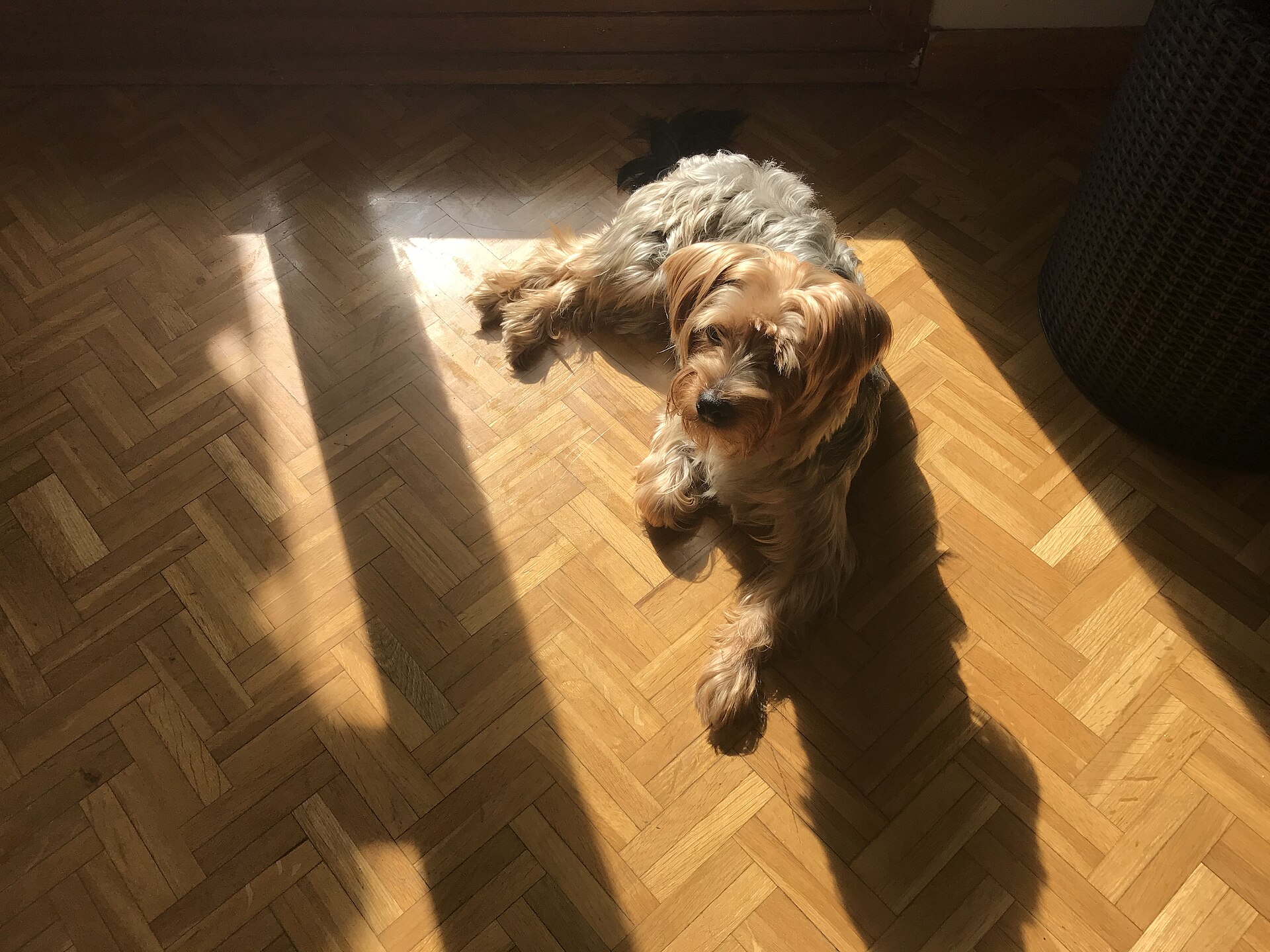
The Yorkshire Terrier has a small, compact, well-proportioned body with straight back and short but muscular limbs. The head is small and flat on the skull, with not too long muzzle and black nose. The ears are small, triangular, carried erect, covered with short pink hair on the back. The eyes are medium, dark, brilliant, with intelligent and lively gaze. The tail is high, of medium length, carried slightly above the back (never docked, prohibited in Italy since 2007).
The coat is the undisputed signature of the breed: long, silky, shiny, perfectly straight (not curly or wavy) hair, with texture similar to human hair. In show specimens the hair reaches the floor (requires daily maintenance: brushing, weekly washing, specific oils); in companion specimens it is generally cut short ("puppy cut") to facilitate management. The colour standard is characteristic: puppies are born all black, and growing develop the unique adult pattern — dark steel blue on the back (from nape to base of tail) and bright tan gold on head, chest, legs and underside. Colour transition takes place gradually from 6 months to 2 years. The fur is undercoat-free, and for this reason the Yorkshire is considered a hypoallergenic breed (sheds less hair, ideal for those who suffer from mild allergies).
Behaviour and curiosities
The Yorkshire Terrier has a surprisingly powerful temperament: it contains in 3 kg all the character of an authentic terrier. It is lively, courageous, independent, alert: it does not realise its own small size and can attack much larger dogs if it feels threatened (or to defend its owner). It tends to be barker and territorial, characteristics that must be managed with early education. It is very intelligent and trainable, but also stubborn and selective in obedience. It becomes deeply attached to the owner, develops very close relationships, and can suffer from separation anxiety if often left alone for many hours.
It gets along with respectful older children (not with small ones, due to bone fragility), other dogs (if well socialised from puppyhood) and cats (if introduced gradually). Due to its size it requires attention: falls from sofas or beds can cause fractures, and rough games with children are risky. The history of the breed is fascinating: it was born around 1860 in the English counties of Yorkshire and Lancashire during the Industrial Revolution, when Scottish workers (coming from the Highlands with their old terriers) emigrated to textile factories and mines. Their rat-hunting dogs were crossbred with various English terriers (Black and Tan, Skye, Maltese) creating a new type: small, agile, with long fur that protected from parasites. The first officially named "Yorkshire Terrier" was "Huddersfield Ben" (1865-1871), considered the founder of the modern breed. In the Victorian era the Yorkshire was rapidly adopted by the British aristocracy as "muff dog" of elegant ladies, departing from working-class origins. Curiosity: during World War II, a Yorkshire named "Smoky", found by an American soldier in a trench in New Guinea (1944), became one of the most famous war dogs, completing 12 combat missions and was a pioneer of modern pet therapy in military hospitals.
Pros
- Taglia minuscola, ideale per appartamento
- Ipoallergenico (no sottopelo, poca perdita)
- Longevità eccellente (13-16 anni)
- Elegantissimo, simbolo di stile vittoriano e moderno
Cons
- Fragile fisicamente, no bambini piccoli
- Predisposto a ipoglicemia, pancreatite, lussazione rotula
- Abbaione e territoriale se non educato
- Manto richiede toelettatura intensa