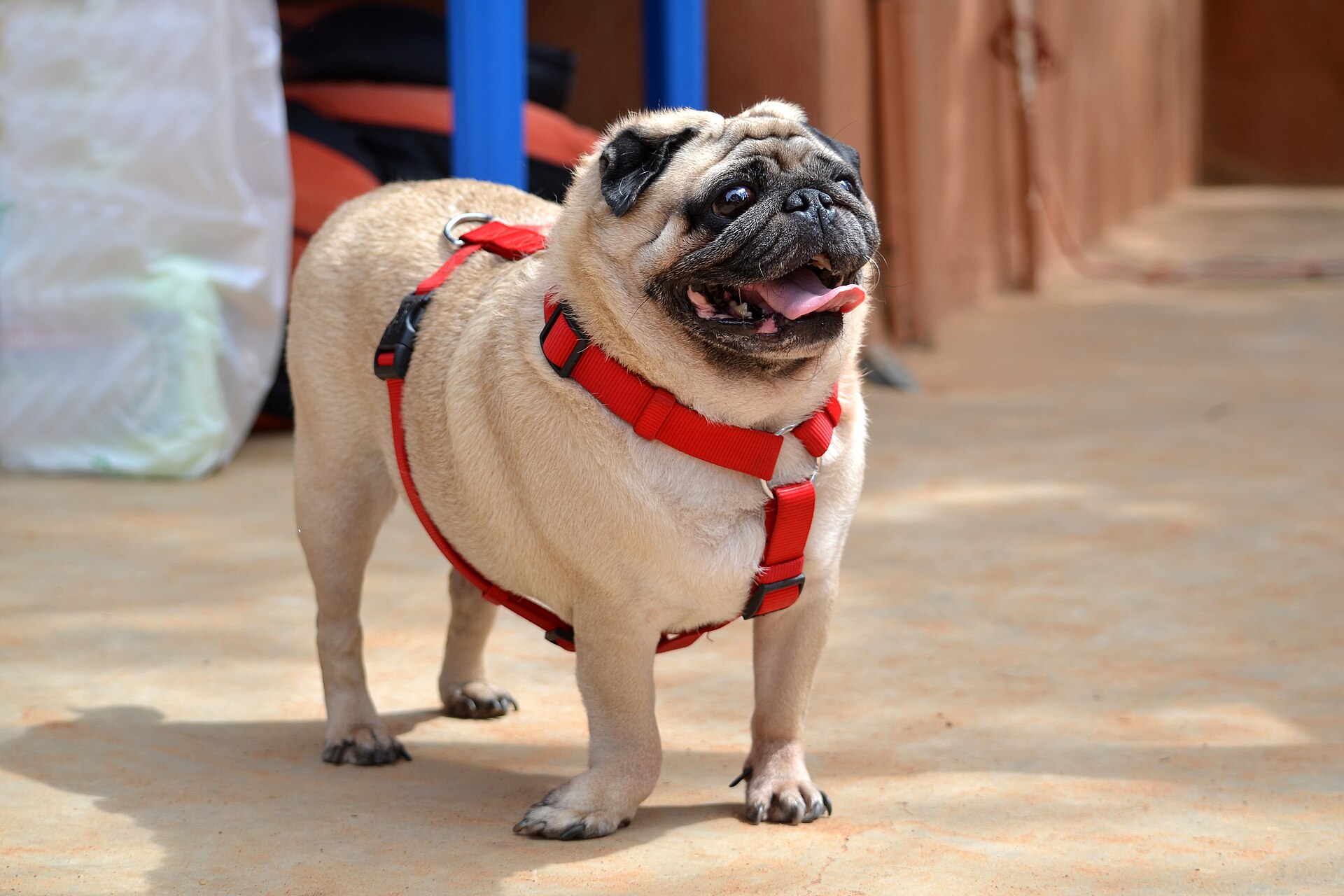
Pug
Canis lupus familiaris
Characteristics
Temperament
Affectionate, cheerful, playful. "Shadow dog", follows the owner everywhere. Suffers from loneliness. Sociable with children and other animals. Intense snoring. Comical for expressions and movements. Chinese imperial origin, over 2,000 years of history.
Diet
Omnivore, slow metabolism, very strong tendency to obesity (50% overweight). 350-450 kcal/day in 2 meals. Brachycephalic kibble (medium format). Predisposed to pancreatitis, diabetes, skin fold dermatitis.
The Pug (Canis lupus familiaris) is one of the oldest and most fascinating dog breeds in the world. Born in China over 2,000 years ago as a companion dog for the emperors of the Han dynasty, it arrived in Europe in the 16th century thanks to Dutch merchants of the East India Company and quickly conquered the European royal courts, becoming the favourite dog of Marie Antoinette, Joséphine de Beauharnais, Queen Victoria and many other sovereigns. Its unmistakable appearance — round head, flat muzzle (brachycephalic), large expressive eyes, curled tail, fawn or black coat — and playful and affectionate temperament make it a perfect apartment dog. Today it is one of the most widespread breeds in the world, although its health is the subject of growing ethical debate due to problems related to brachycephaly.
Classification and category
The Pug belongs to the species Canis lupus familiaris, the domestic subspecies of the grey wolf. It is classified by the FCI in Group 9 — Companion Dogs, section 11 (Small Molossian-type Dogs), the same as the French Bulldog. The official standard provides for a withers height of 25-30 cm and a weight of 6-8 kg for both sexes (with slight sexual dimorphism: males tend to be slightly larger). The breed has been officially recognised by the British Kennel Club since 1885 and by the FCI since 1956. The official coat colour is fawn (with very pronounced black mask on muzzle and forehead), apricot, silver, black. The FCI standard explicitly mentions the need for a "not excessively crushed nose" to avoid brachycephalic complications, a directive that many responsible breeders are following to moderate the extreme phenotype of the breed.
Habitat and distribution
The Pug is a dog perfectly adapted to urban apartment life: its small size, calm nature and low intense physical exercise requirements make it ideal for urban families, even small ones, with children, elderly people and other animals. It is particularly vulnerable to heat: the brachycephalic structure predisposes it to heatstroke above 24-26 °C, especially during physical activity. Exercise should be avoided in the hot hours of the day, and in summer constant control is necessary (always fresh water, air-conditioned or shaded environments). It is not a breed that lives well outdoors or in kennels.
The history of the breed has very ancient origins. The first written documents on Pugs date back to the Han dynasty (206 BC - 220 AD) in China, where they were described as "lion-dogs" or "imperial dogs", reserved exclusively for the emperor's family and aristocracy. They are thought to derive from crossbreedings between ancient Chinese molossoids and Pekingese. For over 2,000 years they remained confined to the Chinese courts. The arrival in Europe is documented from 1572, when a Pug named "Pompey" saved the life of Prince William I of Orange, giving the alarm at the arrival of Spanish assassins — since then the Pug is the heraldic symbol of the House of Orange. In the 18th century it became the favourite dog of European aristocracy: Goya, Hogarth and other painters have portrayed them several times. The average price of a pedigree FCI puppy is 1,000-2,000 euros; show line specimens can reach 2,500-4,000 euros. Beware of lower prices (unofficial market, high risk of severe brachycephaly and other pathologies).
Diet
The Pug is a domestic omnivorous dog with slow metabolism and very strong tendency to obesity: overweight is the number one health problem of the breed. The daily caloric requirement of a 7 kg adult is about 350-450 kcal, distributed in 2 meals. The ideal diet consists of high-quality kibble for toy/brachycephalic dogs (medium-format kibble to facilitate grip with crushed muzzle, rich in protein 25-30%, low in fat), or wet feeding or BARF under veterinary supervision.
Foods to carefully avoid: sweets, chocolate, grapes, onions, fatty foods, cooked bones. The Pug is particularly predisposed to: obesity (50% of adult specimens are overweight), pancreatitis, diabetes, contact dermatitis in the folds of the muzzle and body (requires daily cleaning with antiseptic wipes). Deep skin folds of the muzzle should be dried and cleaned daily to prevent infections. Water must always be available, never cold from the fridge (risk of regurgitation due to brachycephalic spasm). Portions must be rigorously controlled: an 8 kg Pug that weighs 10 kg reduces its life expectancy by 2-3 years.
Physical features
The Pug has a compact, muscular, sturdy body, defined by the standard as "multum in parvo" (much in little), which describes the idea of great physical substance concentrated in a small dimension. The head is large in proportion to the body, round (not apple-shaped like the Chihuahua), with skin that forms deep and symmetrical wrinkles on muzzle and forehead (iconic characteristic of the breed). The muzzle is short, square, well-firm (not excessively crushed according to the modern standard), with slightly prognathic lower jaw and well covered by drooping lips.
The eyes are large, round, dark, expressive, slightly prominent — one of the most loved traits of the breed, but also a source of problems (keratoconjunctivitis, corneal ulcers). The ears are of two types both accepted by the standard: "rose" (rose ears, folded backwards) or "button" (button ears, folded forwards and with tips turned towards the eye). The tail is characteristic: tightly curled over the back, ideally with double turn (called "double curl"), distinctive trait highly sought in show specimens. The coat is short, glossy, soft, fine. The standard colours are: fawn (with well-defined black mask), apricot, silver (rare), black. A dark longitudinal stripe along the back (called "trace") is appreciated in fawn specimens. Brachycephaly, although mild compared to the French Bulldog or English Bulldog, is still marked: the Pug is subject to Brachycephalic Syndrome (BOAS) in about 40-50% of specimens, with symptoms such as noisy breathing, exercise intolerance, intense snoring, predisposition to heatstroke.
Behaviour and curiosities
The Pug has an extremely affectionate, cheerful and playful temperament. It is often defined as a "shadow" dog: it follows the owner in every room, loves to be cuddled and constantly seeks human company. It tolerates prolonged solitude badly (over 4-5 hours), can develop separation anxiety. It is sociable with children (of compatible age, because it can be fragile), elderly people, other dogs and cats if well socialised. It is not territorial nor aggressive: poor guard dog (rarely barks, never aggressive).
Intelligence is considered medium level: the Pug easily learns basic commands, but can be stubborn and selective in obedience (inheritance of its origin as imperial dog, not working dog). It tends to be "comical" for its funny way of moving, its exaggerated facial expressions, its snoring and occasional yelps when it demands attention. It gets along with other Pugs in pairs or groups. The literary history is rich: Hogarth painted his Pug Trump in several portraits, Joséphine Bonaparte had a Pug named Fortune (who deeply bit Napoleon the wedding night!), Queen Victoria owned over 30. Contemporary curiosity: the Pug character "Frank" in the film Men in Black (1997) and the Pugs "Otis" (St. Trinian's) have made the breed even more popular. Today it is the subject of growing ethical debate for brachycephalic health problems: in Norway a court in 2022 banned Pug breeding for "hereditary suffering" (sentence later partially suspended), and several European countries are introducing more severe regulations. Calls multiply for a "retro-Pug" with longer muzzle, more functional and healthy.
Pros
- Ideale per appartamento, taglia piccola
- Carattere affettuoso, allegro e socievole
- Non abbaia, non aggressivo, mai pericoloso
- Longevità 12-15 anni con cure adeguate
Cons
- BOAS (Sindrome Brachicefalica) nel 40-50% dei soggetti
- Fortissima tendenza all'obesità (50% sovrappeso)
- Vulnerabile al caldo (>24-26 °C pericolosi)
- Problemi oculari (cheratite, ulcere corneali), pliche cutanee a rischio infezioni