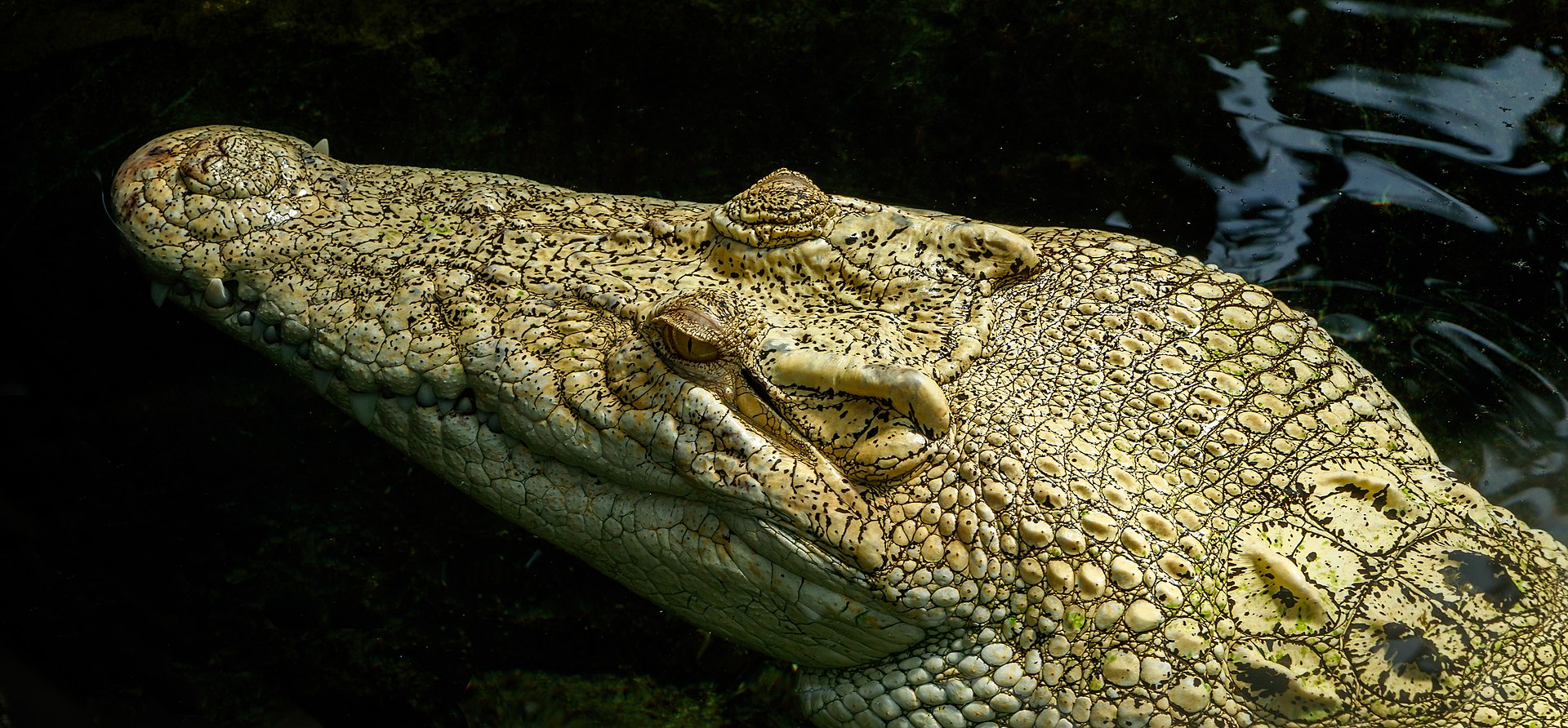
Saltwater Crocodile
Crocodylus porosus
Characteristics
Temperament
Solitary, territorial, hyper-aggressive. Largest living reptile. Bite force 3,700 psi (world record). Mother protects nest 90 days and transports young in mouth. Dangerous species: 100+ deaths/year in Asia/Australia.
Diet
Opportunistic carnivore. As pup: insects, crabs, fish. Adult: buffaloes, deer, wild boar, kangaroos, even tiger sharks. Strategy: water ambush + "death roll". Eats only 5% of weight/week thanks to ectothermic metabolism.
The Saltwater Crocodile (Crocodylus porosus), also known as "estuarine crocodile", "saltie" in Australia, or "porose crocodile", is the largest living reptile in the world and the largest terrestrial predator of the coastal ecosystem. Distributed from the coasts of India to northern Australia and Indonesia, it is famous for its exceptional dimensions — adult males can exceed 7 metres in length and weigh over 1,000 kg. It is the only crocodile capable of living and crossing long distances in saltwater thanks to special lingual glands to expel salt. Opportunistic and hyper-aggressive predator, it is considered the most dangerous reptile for humans: it is estimated to cause 1,000+ annual attacks of which about 100 fatal in Asia/Australia. Despite its bad reputation, after being brought to the brink of extinction by commercial hunting, the Australian population is now flourishing thanks to the "Crocwise" programme and conservation policies. The global IUCN status is Least Concern (LC) since 1996.
Classification and category
The Saltwater Crocodile belongs to the order Crocodilia, family Crocodylidae ("true" crocodiles), genus Crocodylus. The genus comprises 14 species of "true crocodiles"; the saltwater is the largest species and with the widest geographical distribution. The species was scientifically described by Johann Gottlob Theaenus Schneider in 1801, based on Indian specimens. The scientific name derives from the Latin "porosus" meaning "full of pores", referring to the numerous sensory pores (DPR — Dermal Pressure Receptors) present on the scales of the snout and body. It is phylogenetically distinct from the alligator (Alligatoridae family), from the gharial (Gavialidae family), and from the Nile crocodile (Crocodylus niloticus) — its closest relative in the "large crocodiles" group. Average dimensions are: adult males 4-5.5 m (record 7+ m), females 2.5-3 m, average weight 400-1,000 kg (record 2,000 kg). Longevity data are excellent: 70+ years in nature, 100+ in captivity (a specimen named "Henry" at the Crocworld Zoo in South Africa reached 122 years).
Habitat and distribution
The habitat of the Saltwater Crocodile consists of estuaries, mangroves, tidal rivers, brackish swamps, coastal lagoons, ocean coasts. It prefers warm tropical waters (24-32°C). Unique in the genus, the species tolerates wide salinity variations: from fresh water rivers 50 km from the sea to the open sea (genuinely marine species, the only one among crocodiles). It can cross the sea swimming for 500-1,000 km between oceanic islands, exploiting the currents as natural "highways" and resting on logs or atolls. Recent satellite telemetry studies have documented specimens that crossed the Coral Sea from Papua to Australia (1,000 km in 25 days).
The geographical distribution includes: northern Australia (the largest population, about 100,000-150,000 specimens on the coasts of Queensland, Northern Territory and Western Australia), Papua New Guinea, Indonesia (all major islands), Malaysia, Philippines, Bangladesh, eastern India (Sundarbans), Sri Lanka, Thailand, Vietnam, oceanic islands (Palau, Micronesia, Vanuatu, Solomon). IUCN conservation status: Least Concern (LC) globally, after being Vulnerable until 1996. Historical populations had been decimated by commercial hunting for skin between 1940 and 1971 (in Australia it is estimated that 99% of specimens had been killed). Legal protection in Australia (1971-74) has allowed spectacular recovery: the population has returned to about 100,000+ specimens in the Northern Territory alone. CITES: Appendix II for Australia/Papua/Indonesia (regulated trade from farming), Appendix I elsewhere. In India only about 1,000-1,500 specimens survive (vulnerable). Current threats are human-crocodile conflict, habitat loss (mangrove deforestation), and pollution.
Diet
The Saltwater Crocodile is an opportunistic and generalist carnivore, at the apex of the estuarine food chain. The young (1-2 years) feed on insects, crabs, small fish, amphibians, lizards. The adolescents (3-10 years) hunt fish, water birds, turtles, snakes, small mammals. Large adults (3+ metres) hunt practically any animal that approaches the water: water buffalo, deer, wild boar, dingoes, kangaroos, monkeys, stray dogs, domestic cattle, horses, even small sharks (documented attack on a tiger shark in the Northern Territory), marine turtles, dolphins. The hunting strategy is classic: the water ambush ("death roll"). The crocodile approaches silently, partially submerged, with only the eyes and nostrils out of the water, exploiting currents to cover the smell. On explosive attack (it can sprint up to 30 km/h out of water for a few metres), it grabs the prey with a devastating bite (3,700 psi — the most powerful bite force in the animal kingdom) and drags it into the water to drown it. Large prey is rotated violently ("death roll") to dismember it, since the crocodile cannot chew.
Food requirements are surprisingly low: an adult crocodile consumes only 5% of its body weight per week (vs 100%+ in mammalian predators) thanks to slow ectothermic metabolism. A large crocodile can survive over a year without eating. It practises opportunistic cannibalism: large adults attack and eat young of the same species. It is an important cause of sub-adult mortality (50-70% do not reach maturity). Saltwater crocodiles also have a "larder" behaviour: they hide large prey underwater or under branches to consume them in subsequent days (the ageing improves meat digestibility). Special adaptations: secondary palate that allows breathing with the mouth full of water/prey; nasal and ear valves that close when submerged; lingual glands to expel ingested salt.
Physical features
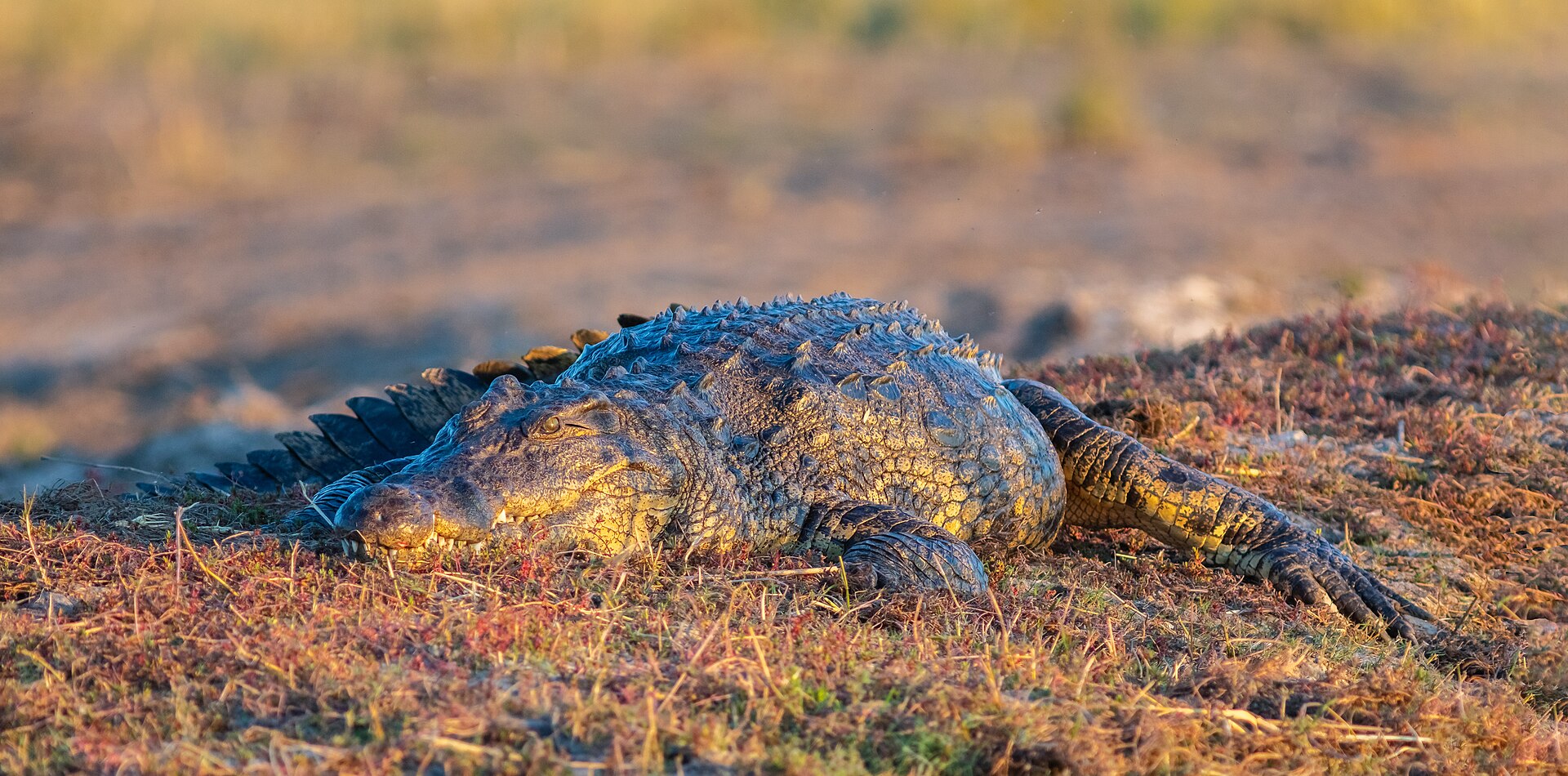
The Saltwater Crocodile has a massive, elongated, hydrodynamic body, perfectly adapted both to swimming and to ambushes in water. Length is its most impressive feature: adult males normally measure 4-5.5 metres, with documented specimens of over 7 metres (verified record: "Cassius", captive specimen at Marineland Melanesia, Queensland, of 5.48 m, 1,300+ kg; unverified historical record: 8.5 m). Females are significantly smaller (maximum 3-3.5 m). Weight easily reaches 1,000-1,300 kg in large adults, with a record of 2,000 kg. Sexual dimorphism is the most marked among crocodiles (males 2-3× females).
The skull is massive, wide and robust, with a broad, stocky muzzle (broader compared to the Nile crocodile). The jaw houses 64-68 conical teeth, replaceable: each lost tooth is replaced up to 50 times in the animal's life (over 3,000 total teeth!). The bite force is about 16,460 newtons (3,700 psi) scientifically measured — the strongest ever measured in a living animal. For comparison: lion 1,000 psi, white shark 4,000 psi. The eyes have a transparent nictitating membrane that protects underwater; night vision is excellent thanks to the tapetum lucidum (eyes that shine in the torchlight). The colour of adults is dark green-blackish above, yellow-white below, with dark transverse bands (fade with age). The young are bright yellow with black bands. The skin is covered with osteoderms (ossified scales) on the back, which act as armour but also as solar panels for thermoregulation. Unique feature: dermal pressure receptors (DPR) scattered throughout the body, sensitive to water vibrations, heat, salinity — the most sensitive among vertebrates. The tail is laterally compressed, powerful, represents 50% of the total length and is the main engine of swimming.
Behaviour and curiosities
The Saltwater Crocodile is a solitary, strongly territorial, hierarchical animal. Large males defend estuarine territories of 50-100 linear km and tolerate only females and non-breeding young. Territorial battles between males are spectacular and often fatal: they include head bites, loss of limbs/tail, drowning of the opponent. They communicate with vocalisations (low-frequency guttural roars, threatening hisses), posture (high head = dominance), water sprays with the jaws, and infrasounds underwater. Mother-young social life is instead surprisingly complex: the female shows parental care rare in reptiles. She builds a large nest on land (3 m in diameter, 1 m high, composed of fermenting vegetation), lays 40-90 eggs in August-September, and actively protects the nest for 80-90 days of incubation. At the time of hatching, the young emit calls that the mother recognises: she opens the nest with the mouth, gently picks up the young between the jaws (one at a time!) and transports them to the water. Maternal care continues for 1-2 years (unusual for a reptile).
Famous curiosities: the sex of the young depends on the incubation temperature (Temperature-dependent sex determination, TSD): 30°C produces only females, 32°C only males, 33°C mix. Climate change threatens to "defeminise" populations in some areas. Ethological curiosity: saltwater crocodiles are considered among the most intelligent animals in reptiles. They document behaviours such as: use of tools (they place sticks on their heads to attract birds looking for nesting material), cooperation between individuals to hunt large prey, long-term memory for fishing sites, learning ability (young raised in captivity learn their name). Historical curiosity: Australian Aborigines consider the "Buaja" (crocodile) a sacred being, present in many Dream Time legends. Record curiosity: the largest verified specimen was "Lolong" — a crocodile captured in the Philippines in 2011 after being suspected of having eaten a farmer and a girl. It measured 6.17 m and weighed 1,075 kg. He died in 2013 in captivity. Ecological curiosity: the saltwater crocodile is a keystone species of tropical estuarine ecosystems: it regulates fish and ungulate populations, recycles nutrients from carcasses, and physically modifies the environment by digging "gators" (depressions in swamps). Scientific curiosity: the blood of saltwater crocodiles contains antimicrobial peptides called "crocodilins" — effective against MRSA strains, HIV and resistant fungi. They have been under pharmaceutical study since 2005 for new generations of antibiotics. Danger to humans: saltwater crocodiles have caused the highest number of fatal attacks among all reptiles, with records in the Bangladeshi Sundarbans (50+ attacks/year) and in Borneo. The Australian Northern Territory applies the "Crocwise" public education programme: it is estimated that from 1980 to 2020 the 90 documented attacks have caused 35 deaths.
Pros
- Più grande rettile vivente al mondo (record 7+ m)
- Forza di morso più potente del regno animale (3.700 psi)
- Longevità eccezionale (70+ anni, 100+ in cattività)
- Sangue contiene 'crocodilins': antibiotici naturali contro MRSA
Cons
- Specie pericolosissima: 100+ attacchi mortali/anno (Asia/Australia)
- CITES Appendice II: detenzione privata vietata in quasi tutto il mondo
- Richiede acquari giganteschi e permessi speciali
- Cannibalismo: 50-70% dei giovani uccisi da adulti