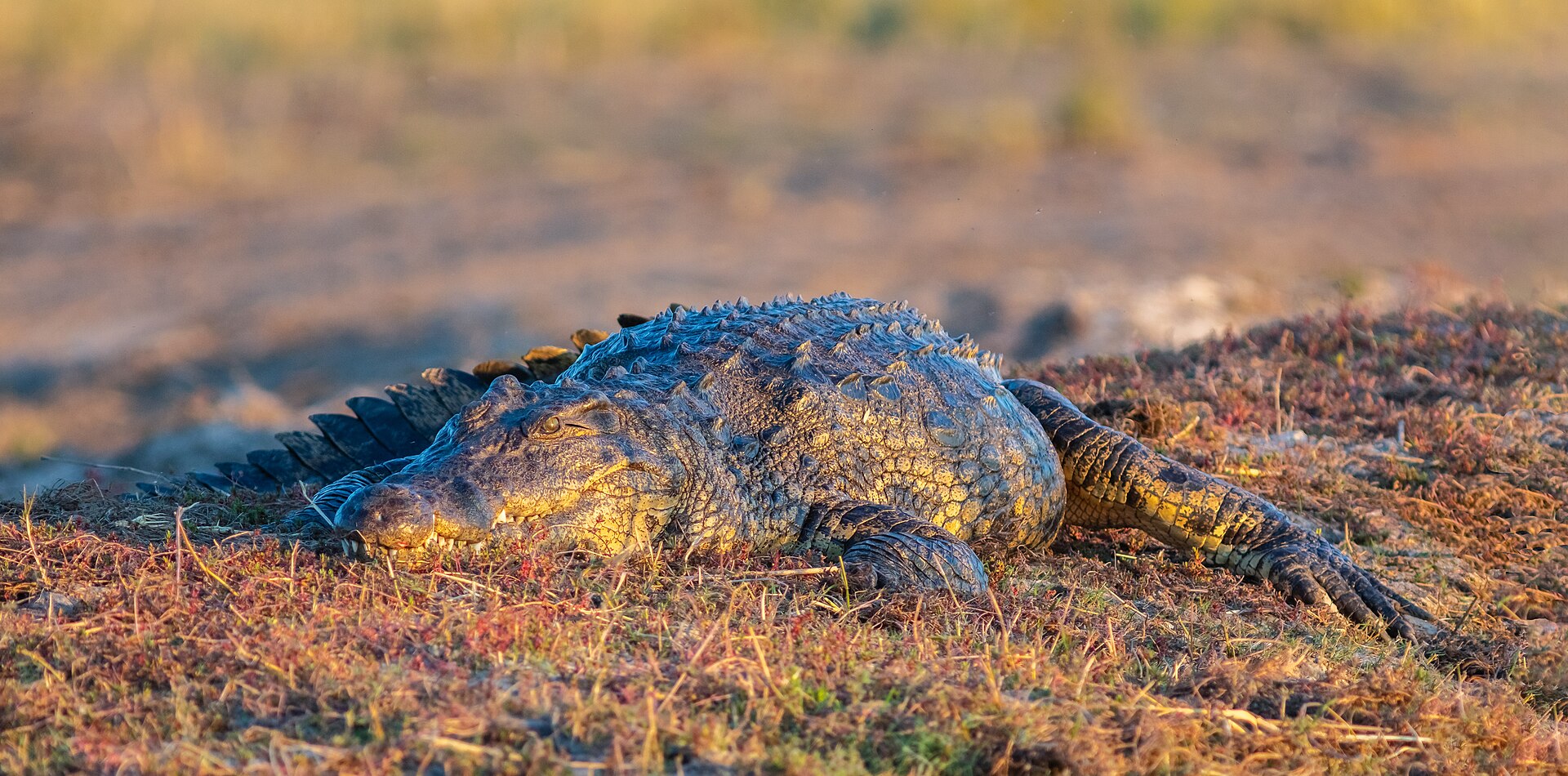
Nile Crocodile
Crocodylus niloticus
Characteristics
Temperament
Semi-aquatic apex predator. Territorial, hierarchical, surprisingly social. Females guard nest without eating for 90 days and carry newborns in mouth. Most powerful bite in the world (2,300 kg/cm²).
Diet
Apex predator carnivore: fish, waterbirds, antelopes, wildebeest, zebras, buffalo, occasionally lions and hippos. "Death roll" technique. Survives 1 year on a single large meal.
The Nile Crocodile (Crocodylus niloticus) is the largest African crocodile and the second-largest crocodile species in the world (after the Saltwater Crocodile, C. porosus). Apex predator of the rivers and wetlands of sub-Saharan Africa, it is a reptile with extraordinary biology: practically unchanged for over 200 million years, it is considered a "living fossil" that survived the extinction of the dinosaurs. Worshipped as a deity in Ancient Egypt and protagonist of millennia-old African legends, today it coexists in a delicate balance between conservation and conflict with riverine human communities.
Classification and category
The Nile Crocodile belongs to the order Crocodilia, family Crocodylidae, genus Crocodylus. The genus comprises 13 living species distributed across Africa, Asia, Australia and the Americas. C. niloticus is the reference African species. It is a huge reptile: average length of adults is 3.5-5 m, with documented record specimens over 6 m. Average adult weight is 225-750 kg, with records of 1,090 kg in specimens over 70 years old. Males are noticeably larger than females. The structure is typical of crocodiles: elongated, low body, long powerful tail, short but sturdy legs, massive skull.
Habitat and distribution
The natural habitat of the Nile Crocodile consists of rivers, lakes, swamps, mangroves and coastal wetlands of sub-Saharan Africa. It is particularly abundant in the Nile basin (hence the name), in the large lakes of the Rift Valley (Victoria, Tanganyika, Turkana), in the Okavango and Zambezi deltas, along the rivers of Tanzania, Kenya, Uganda and Sudan. It is a semi-aquatic reptile: it spends most of its time submerged, with only eyes, nostrils and parts of the head above water, but regularly comes ashore to thermoregulate in the sun.
The distribution today covers almost all of sub-Saharan Africa, from Egypt and Sudan in the north to South Africa, plus Madagascar (where it is considered a separate subspecies, C. n. madagascariensis). Introduced populations exist (probably from farm escapes) in Florida (USA). Conservation status is listed as Least Concern (LC) by the IUCN; however the species is included in CITES Appendix II (Appendix I for some vulnerable populations) and has been the subject of commercial breeding programmes (for skins and meat) in many countries.
Diet
The Nile Crocodile is an apex predator carnivore with a diet that changes drastically with age. Juveniles (under 1 metre) feed on insects, amphibians, small fish and crustaceans. Adults become opportunistic generalists: large fish (Nile perch, tilapia, percomorphs), waterbirds, drinking mammals (antelopes, wildebeest, zebras, buffalo, domestic ungulates) and occasionally carrion. Record specimens have been documented catching young giraffes, hippopotamuses and even lions during dry-season migrations.
The hunting technique is legendary: the "death roll", an explosive body rotation that tears chunks of meat from prey when it is too large to be swallowed whole. Bite force is 2,300 kg/cm² (the most powerful ever measured in a living animal), capable of crushing buffalo bones. The Nile Crocodile is famous for attacks on humans: it is responsible for hundreds of annual attacks in sub-Saharan Africa (estimates 200-500 fatal/year), far more than lions and hippopotamuses in some regions. Due to its metabolic capacity, it can survive on a single large meal for over a year.
Physical features
The Nile Crocodile has an elongated, low and powerful body, perfectly adapted to semi-aquatic life. The skin is covered with thick, hard cornified scutes, with rows of ossified dorsal scutes (osteoderms) that act as armour and body temperature regulators (microvessels within them transfer heat). Colour varies from olive green to dark brown in juveniles, to bronze-grey in adults, with yellowish belly. Tail scales form a double dorsal crest that becomes single in the distal part.
The head is massive and triangular, with a broad, rounded snout (unlike the sharper snout of the saltwater crocodile). The eyes, nostrils and ears are positioned on the upper part of the skull, a perfect adaptation to remain almost completely submerged while breathing and observing. It has a transparent third eyelid (nictitating membrane) to protect the eyes underwater. The mouth contains 60-68 conical teeth, which are continuously replaced (a crocodile can change over 3,000 teeth in its life). When the mouth is closed, the fourth lower tooth remains externally visible (diagnostic character vs alligators, where it stays hidden).
Behaviour and curiosities
The Nile Crocodile is a territorial, hierarchical and surprisingly social animal. It gathers in large concentrations in lakes and rivers during the dry season; during the rainy season it disperses to hunt. Sexual maturity is reached at 10-12 years (at 2.5-3 m in length). Mating takes place in water between August and September; the female lays 25-80 eggs in a hole dug in sand at 50 cm depth, where they are incubated for 80-90 days thanks to the heat of the ground.
The sex of the hatchlings is determined by incubation temperature (TSD): at 31-33 °C males are born; above or below this range, females are born. The female watches the nest throughout the incubation period (without feeding) and when she hears the chicks calling from inside the eggs, she digs out the den to free them. She transports the newborns in her mouth from the den to the river — a moving maternal behaviour for a "cold predator". Once in the water, however, maternal help ceases: juvenile mortality is 99% in the first year (predators, birds, other crocodiles, diseases). Those that survive can reach an exceptional lifespan of 70-100 years, making the Nile Crocodile one of the longest-lived vertebrates in the world. In ancient Egypt it was worshipped as Sobek, god of the Nile and fertility.
Pros
- Specie iconica della fauna africana
- "Fossile vivente": morfologia praticamente immutata da 200 milioni di anni
- Longevità eccezionale (70-100 anni)
- Venerato come Sobek nell'antico Egitto
Cons
- Specie selvatica EXTREMELY pericolosa, NON è un animale da compagnia
- Responsabile di 200-500 morti umane/anno in Africa
- Richiede pozze enormi e gestione professionale in cattività
- In conflitto con allevatori e pescatori