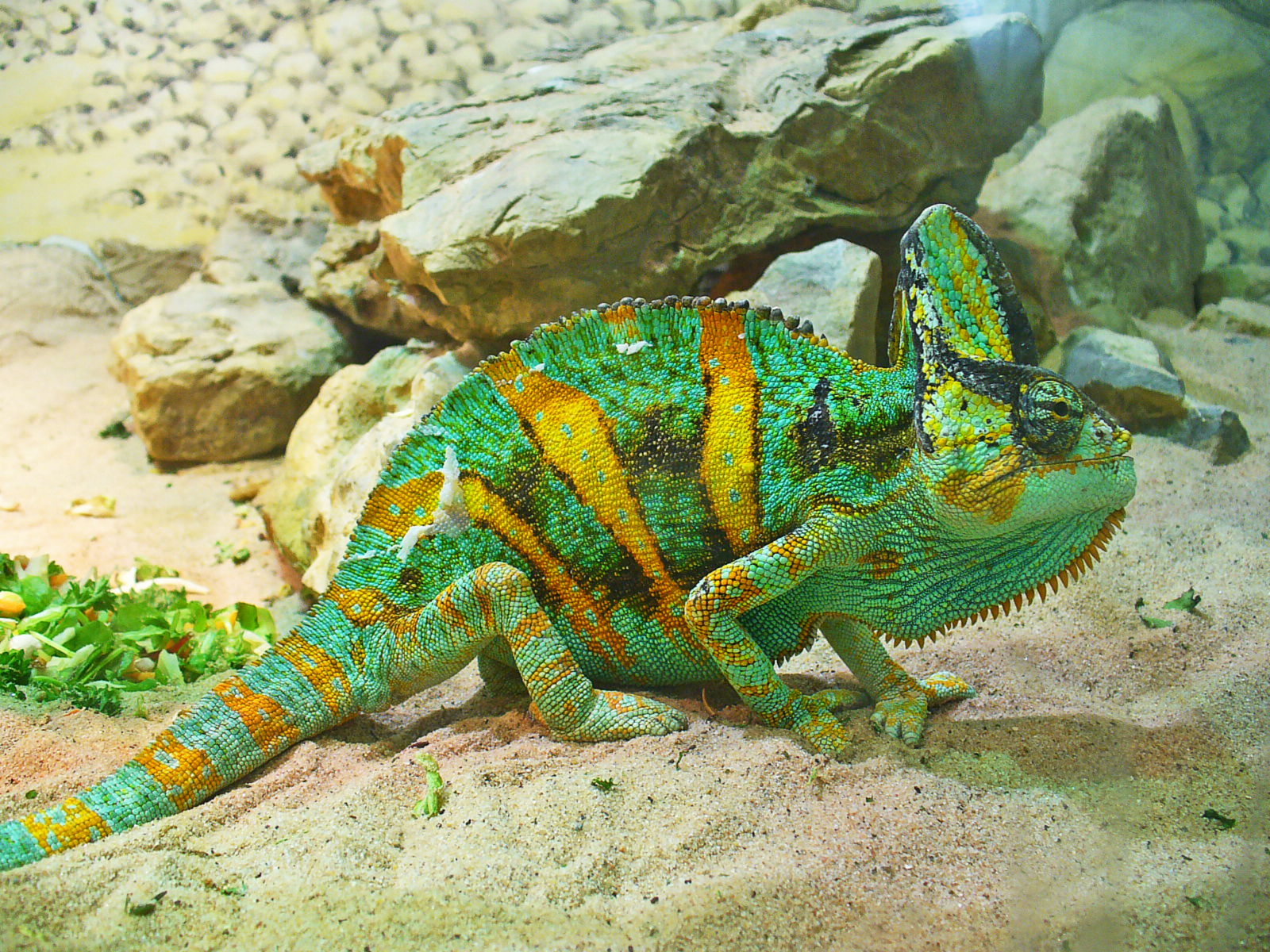
Veiled Chameleon
Chamaeleo calyptratus
Characteristics
Temperament
Solitary, territorial, diurnal. Changes colour to communicate (not for camouflage). Males do not tolerate other males. Stressed by excessive handling.
Diet
Insectivore with plant component: gut-loaded crickets, roaches, mealworms, supplemented with leaves and flowers. Water through misting on terrarium plants.
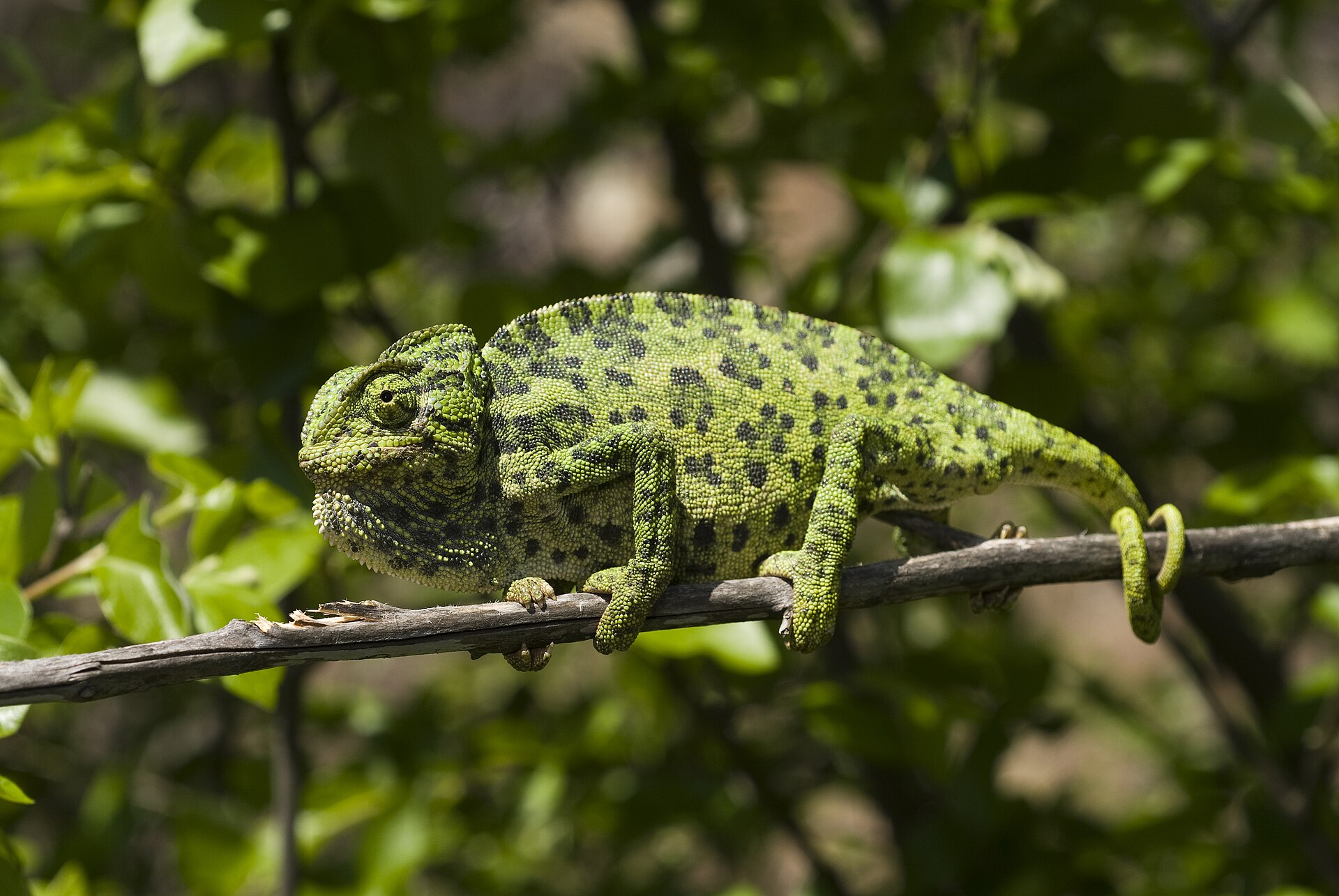
The Veiled Chameleon (Chamaeleo calyptratus) is a large arboreal lizard endemic to the southern Arabian Peninsula. Also known as the Yemen Chameleon or Casque-headed Chameleon, it owes its name to the cephalic crest ("casque" or "veil") that rises above the head, particularly prominent in adult males. It is one of the most widespread chameleons in herpetoculture worldwide thanks to its impressive size, vivid colours and good adaptability in captivity.
Classification and category
The Veiled Chameleon belongs to the order Squamata, suborder Sauria, family Chamaeleonidae. It is one of about two hundred existing species of chameleons, most of which are endemic to Madagascar; the Veiled is instead typical of Arabia, one of the few species distributed outside sub-Saharan Africa and southern Asia. It is a large species among chameleons: adult males can exceed 60 cm in total length, females remain smaller at around 30-35 cm. Average weight is 90-200 g, with males distinctly larger.
Habitat and distribution
The natural habitat of the Veiled Chameleon consists of the dry mesoteric plateaus of Yemen and south-western Saudi Arabia, between 500 and 2,800 metres of altitude. It lives in acacia woodlands, arid scrublands and rocky slopes with scattered vegetation, where daytime temperatures can reach 35-40 °C and nighttime ones drop to around 15 °C.
Introduced populations exist in Florida (USA) and Hawaii, where the species is considered invasive. Its conservation status is listed as Least Concern (LC) by the IUCN, but the species is included in CITES Appendix II to regulate its international trade. Virtually all specimens currently present in European terrariums come from captive breeding: reproduction is easy and prolific, and harvesting from natural populations has been substantially eliminated.
Diet
The Veiled Chameleon is a rare exception among chameleons: it is insectivorous with a significant plant component. In the wild it feeds on crickets, grasshoppers, cockroaches, flies, spiders, but also supplements its diet with leaves, flowers, fruit and shoots — a useful behaviour in an arid environment where free water is scarce. Leaves are in fact an important source of hydration.
In captivity, gut-loaded insects (fed with vegetables 24 hours before being offered) and dusted weekly with calcium and monthly with vitamins are recommended. The most suitable types are crickets, roaches, mealworms and superworms. Small amounts of edible vegetables (mulberry leaves, hibiscus flowers) can occasionally be added. Water must be provided through regular mistings on the terrarium plants: chameleons generally do not drink from bowls, but lick droplets from leaves.
Physical features
The Veiled Chameleon has a laterally compressed body and a very pronounced cephalic crest that gives it its unmistakable look: in adult males it often exceeds 7 cm in height. Colouring ranges from bright green to yellow and turquoise, with darker transverse bands; males are more vivid, females more discreet. Colour changes in response to emotional state, temperature and light — not, as commonly believed, primarily for camouflage: chameleons mainly use colour to communicate.
The eyes are among their most extraordinary features: they move independently, each with a 180° field of vision, providing complete panoramic sight. When a prey is spotted, the eyes converge, giving stereoscopic vision for distance calculation. The tongue is projectile: it is launched out of the mouth at speeds up to 26 body lengths per second, reaching a distance equal to twice the chameleon's body. The feet are zygodactyl — two toes opposed to two others — adapted for gripping branches; the tail is prehensile and acts as a fifth limb.
Behaviour and curiosities
The Veiled Chameleon is a solitary and territorial species. Males do not tolerate the presence of other males and engage in visual threats (body inflation, dewlap display, colour darkening). Even pairs cohabit poorly: the female must be separated from the male immediately after mating, otherwise she risks being disturbed to the point of lethal stress.
Females lay up to 40-80 eggs in a single clutch, digging a hole in the ground; incubation requires 6-9 months at controlled temperatures (28-30 °C). An interesting curiosity: females can lay eggs even without having mated (infertile eggs), a relatively common phenomenon in captivity that can lead to health problems if not managed correctly. Lifespan in captivity is 5-7 years in males, while females live on average 3-5 years due to reproductive stress. Correct management of UVB light, temperature, humidity and diet is essential to avoid metabolic bone disease, one of the most common pathologies of the species in captivity.
Pros
- Aspetto unico e spettacolare
- Cambia colore in modo affascinante
- Uno dei camaleonti più resistenti in cattività
- Facile da reperire da allevatori responsabili
Cons
- Maschi/femmine non vanno mai messi insieme
- Non si maneggia: stress letale
- Gestione tecnica complessa (UVB, temperatura, umidità)
- Femmine vivono meno per stress riproduttivo