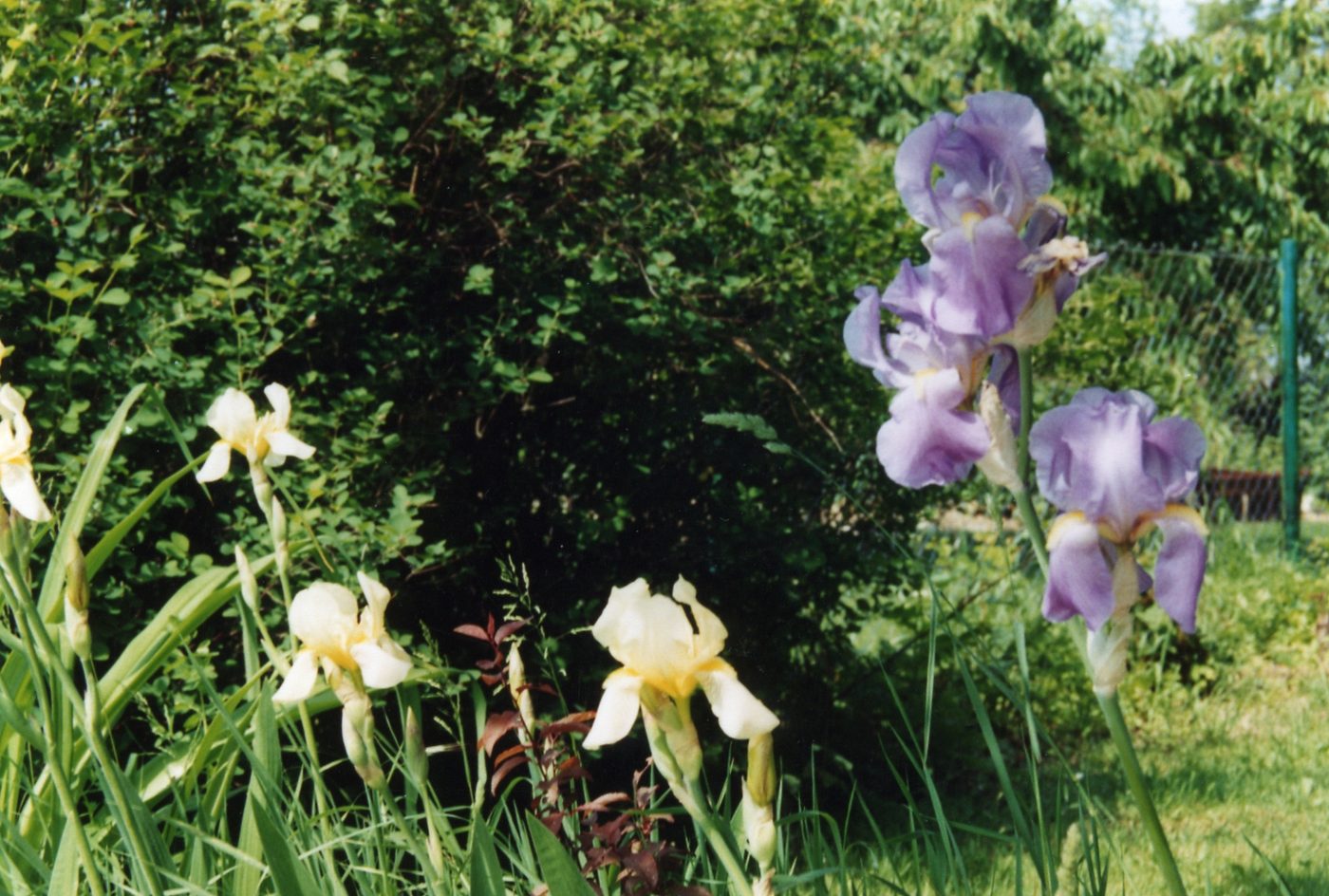
Photo: Wikimedia Commons · CC BY-SA 3.0
Bearded iris
Iris × germanica
With its large, elegant flowers in intense colours and its characteristic 'beard', the bearded iris is one of the most beloved and cultivated irises in gardens worldwide.
Characteristics
The large-flowered iris
The bearded iris is one of the most elegant and spectacular flowering plants in gardens. Its large, showy flowers have an unmistakable structure: three inner petals turned upward and three outer ones drooping, the latter adorned with a characteristic central down, the 'beard', from which the name bearded iris derives. Its colours range from intense purple to white, from yellow to blue, often with striking shades and combinations. Its leaves, green and sword-shaped, form upright tufts at the base of the plant.
Origin and spread
The bearded iris has been cultivated for centuries in Europe and the Mediterranean, where it has become a classic of gardens and flower beds. It is a hardy, resistant plant that adapts well to temperate climates. It grows from a fleshy rhizome that develops at the surface or just below the ground, from which the plant spreads to form broad clumps.
Cultivation and care
It is a relatively easy plant to grow, ideal even for less experienced gardeners. It loves full sun and well-drained soil: its main enemy is waterlogging, which can rot the rhizome. It should be watered moderately and requires no particular care once established. The rhizome should be positioned so that its upper part remains exposed to the sun, an important measure for good flowering. Every few years it is advisable to divide clumps that are too dense to reinvigorate the plant.
Curiosities
The iris has a long cultural history: the iris flower is at the origin of the famous heraldic symbol of the fleur-de-lis, present in coats of arms and flags. Some iris species are also grown for their rhizome, from which a fragrant substance used in perfumery is obtained, with a delicate violet scent.
Care in the garden
Thanks to its beauty and ease of cultivation, the bearded iris is perfect for borders, flower beds and rock gardens. It flowers between spring and early summer, giving for a few weeks a spectacular explosion of colour, and is also prized as a cut flower.
Flowering season
Practical tips
Water needs: Moderate, fears waterlogging — always check soil moisture before watering.
Prefers Full sun: provide the right light and rotate the plant for even growth.
Recommended soil: Well-drained, even calcareous. Refresh the substrate every 1-2 years.
Dust the leaves with a damp cloth to support photosynthesis.
Feed during the growing season (spring-summer) and stop in winter.
Pros
- Large, elegant and very colourful flowers
- Hardy and easy to grow
- Perennial, forms broad clumps over time
- Ideal for borders and flower beds
Cons
- Fears waterlogging
- Relatively short flowering
- Overly dense clumps must be divided periodically