Photo: Rasbak · CC BY-SA 3.0
Wood anemone
Anemonoides nemorosa
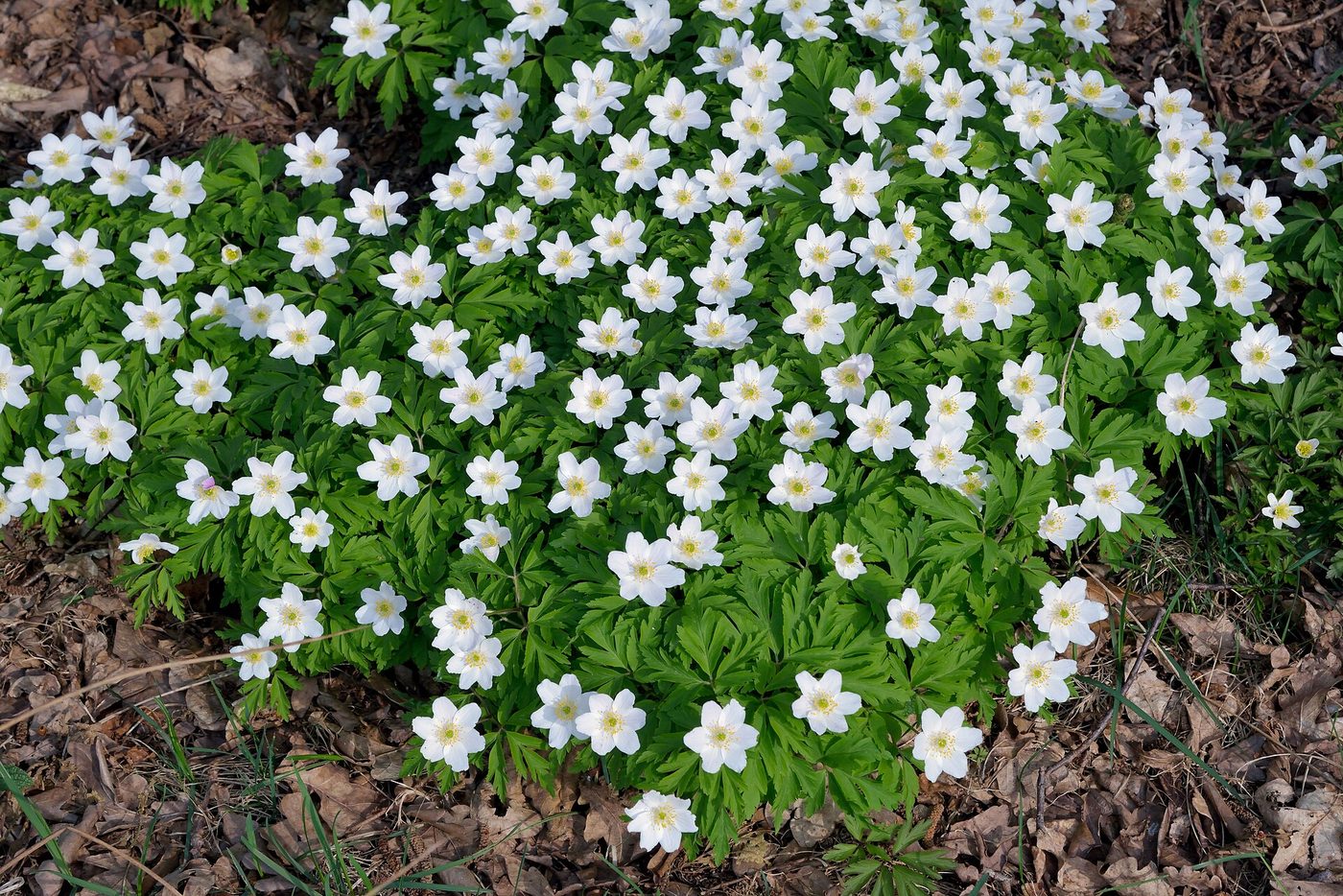
The wood anemone is a delicate spring perennial with star-shaped white flowers that carpets woodland floors before the trees come into leaf.
Characteristics
Description
The wood anemone is a small herbaceous perennial of the buttercup family, only 5-15 centimetres tall. From a slender creeping rhizome rises a single stem bearing one flower, made up of six or more white tepals, often flushed pink on the reverse, that open into a star. The deeply divided leaves form a whorl below the flower. It blooms in early spring.
Habitat and distribution
It is native to Europe, where it grows wild in broadleaf woodland, clearings and along hedgerows. It exploits the light reaching the ground before the trees leaf out: it therefore flowers early, then, with summer shade, the top growth withers and the plant goes dormant.
Cultivation
It is a lovely ground cover for shady and woodland gardens. It wants part shade or light shade and a cool, humus-rich, well-drained soil that mimics the forest floor. It spreads slowly by rhizome, forming broad flowery carpets. It should be left undisturbed: once established, it returns faithfully every spring.
- Plant the rhizomes in autumn, shallowly
- Do not disturb the soil once established
- Mulch with leaves to mimic the woodland floor
Did you know?
It is also known as windflower, from William Turner's interpretation of its Latin name. Like many buttercups, it is toxic if eaten fresh, due to irritant substances. It spreads very slowly: a broad carpet can indicate an ancient woodland.
Flowering season
Practical tips
Water needs: Moderate — always check soil moisture before watering.
Prefers Part shade or light shade: provide the right light and rotate the plant for even growth.
Recommended soil: Cool, humus-rich, well-drained. Refresh the substrate every 1-2 years.
Dust the leaves with a damp cloth to support photosynthesis.
Feed during the growing season (spring-summer) and stop in winter.
Pros
- Lovely early-spring flowering
- Ideal ground cover for shady gardens
- Hardy and faithful, returns every year
Cons
- Toxic if eaten fresh
- Very slow to spread
- Disappears in summer during dormancy