Photo: Meneerke bloem · CC BY-SA 3.0
Black bat flower
Tacca chantrieri
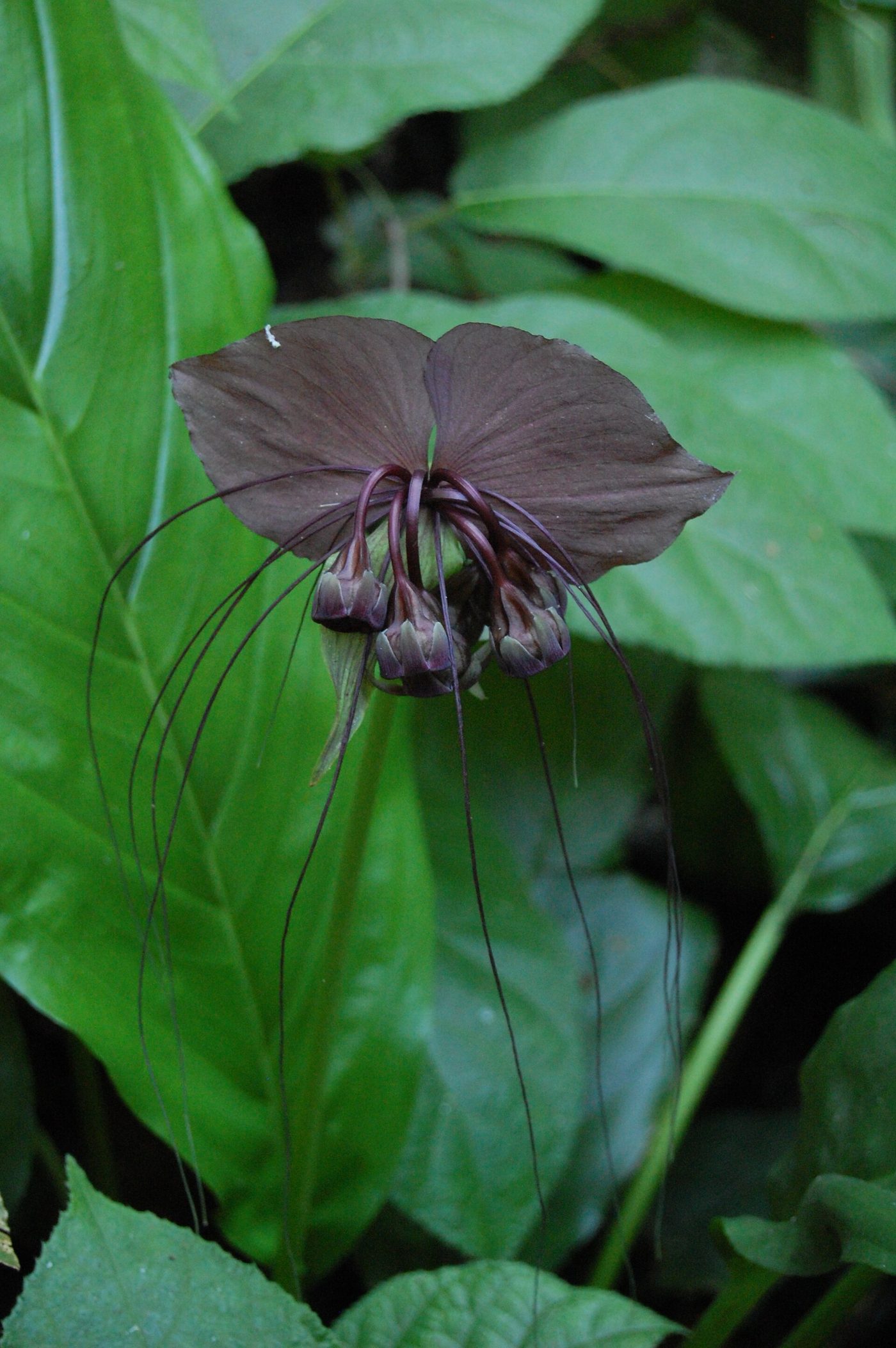
The black bat flower is a tropical plant with dark, unusual blooms, its bracts resembling a bat's wings and long dangling filaments like whiskers.
Characteristics
A flower of mysterious appearance
The black bat flower (Tacca chantrieri) is a perennial herbaceous plant of the yam family Dioscoreaceae, famous for its striking, almost eerie inflorescence. The flowers, a very dark brown-black-purple, are flanked by two large bracts that recall the outspread wings of a bat, while long dangling filaments (bracteoles) hang down like whiskers, up to 25 cm long. Hence its various folk names: bat flower, cat's whiskers, devil flower.
Origin and habitat
It is native to Southeast Asia — Thailand, Myanmar and adjacent regions of China — where it grows in the humid, shady understorey of tropical forests. It is cultivated and widely grown as an ornamental across many tropical areas.
Cultivation and care
It likes shade or partial shade, a rich, soft, well-draining humus soil, and high ambient humidity. It dislikes cold and frost: in temperate climates it is grown in a greenhouse or indoors, in a warm, bright spot but out of direct sun. Water it regularly, keeping the substrate moist without waterlogging. It flowers in the warm season.
Did you know?
Unlike many flowers that depend on insects, the black bat flower is largely self-pollinating. In traditional Chinese medicine the plant has long been used; its striking "gothic" beauty makes it much sought after today by collectors of tropical plants.
Conservation
It is not considered a threatened species and is widely cultivated. Like many understorey plants, however, it depends on the health of the rainforests of its native range.
Flowering season
Practical tips
Water needs: High, humid environment — always check soil moisture before watering.
Prefers Shade or partial shade: provide the right light and rotate the plant for even growth.
Recommended soil: Rich in humus, soft and well-draining. Refresh the substrate every 1-2 years.
Dust the leaves with a damp cloth to support photosynthesis.
Feed during the growing season (spring-summer) and stop in winter.
Pros
- Unusual, spectacular, almost 'gothic' flower
- Bat-wing bracts and long filaments
- Sought after by tropical-plant collectors
Cons
- Dislikes cold and frost
- Needs shade and high humidity
- Somewhat demanding indoors