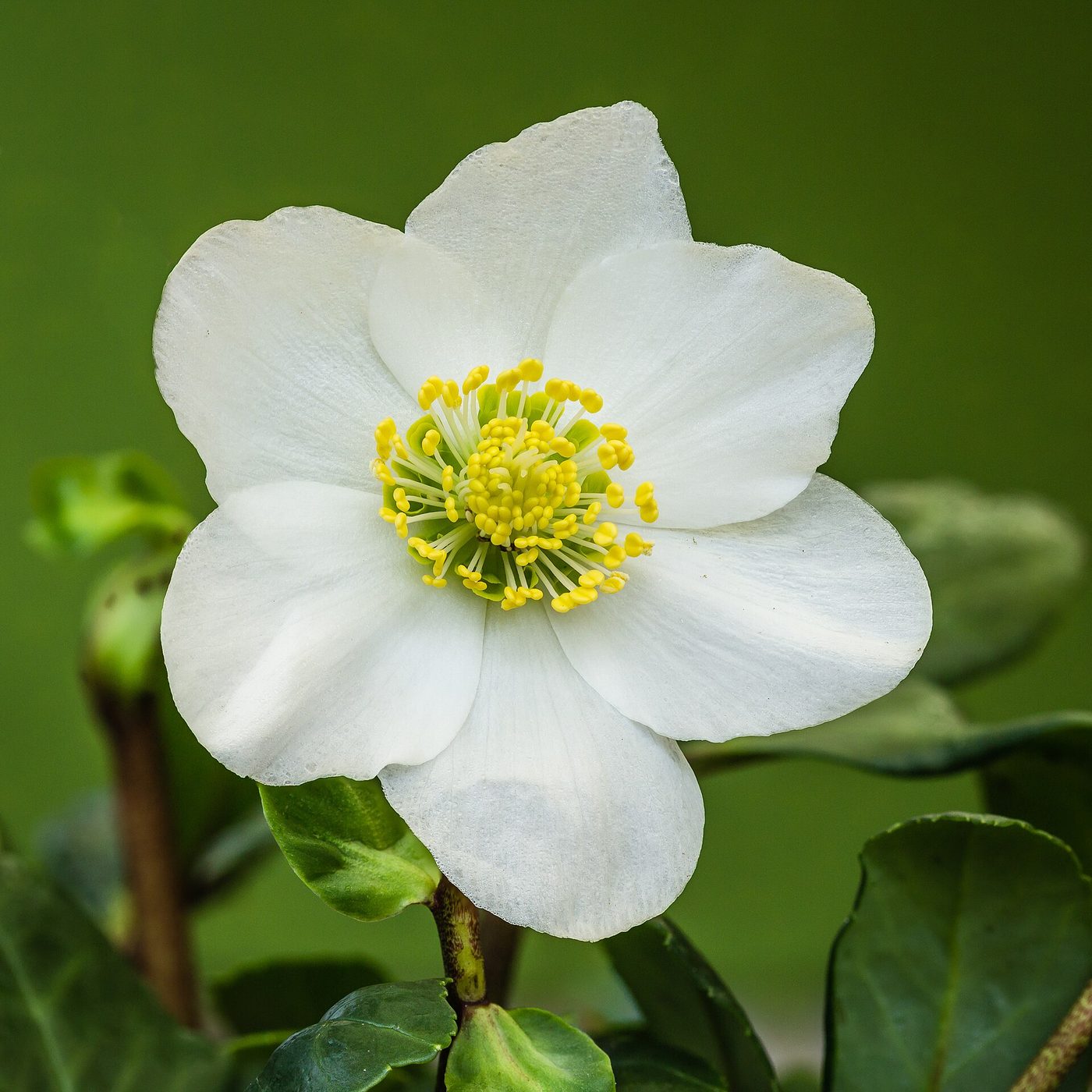
Photo: Dominicus Johannes Bergsma · CC BY-SA 4.0
Christmas rose
Helleborus niger
It blooms when everything else is resting: the Christmas rose, or hellebore, opens its pure white flowers in the heart of winter, defying snow and frost.
Characteristics
The flower that defies winter
The Christmas rose, whose scientific name is Helleborus niger, is a perennial plant famous for an almost miraculous feature: it blooms in the heart of winter, when almost all other plants are dormant. Its large flowers, of a pure white that may fade to pink over time, appear between December and the first months of the year, often surrounded by snow. The leaves are leathery, dark green, divided into segments. Despite the name, it is not related to true roses.
A precious flowering
The great merit of the Christmas rose lies precisely in its contrarian calendar. When gardens are bare, this plant offers generous and long-lasting blooms, bringing colour and life to the coldest season. The flowers are also an important resource for the few pollinating insects active in winter, such as some bumblebees that take advantage of the milder days.
Cultivation and care
The Christmas rose prefers partly shaded positions, like the bright understorey, and rich, cool, well-drained soils, preferably calcareous. It is a hardy, cold-resistant plant, but it fears summer drought and waterlogging. Once well established it needs little care and is very long-lived. It is perfect for shady corners of the garden, at the foot of trees and shrubs, where few other flowers manage to thrive in winter.
Caution: toxic plant
The Christmas rose is a poisonous plant in all its parts. It contains toxic substances that can be dangerous if ingested and irritating on contact with the skin. It should therefore be handled with care, using gloves, and kept out of reach of children and pets. Its beauty is to be admired, not tasted.
Conservation
The Christmas rose is widely grown as an ornamental plant. In the wild it grows in certain mountain areas of south-central Europe, where, like many wild species, it may suffer from over-collection and habitat loss. In the garden, however, it is a precious and sustainable choice to enliven the winter.
Flowering season
Practical tips
Water needs: Moderate, fears drought and waterlogging — always check soil moisture before watering.
Prefers Partial shade: provide the right light and rotate the plant for even growth.
Recommended soil: Rich, cool and well-drained, preferably calcareous. Refresh the substrate every 1-2 years.
Dust the leaves with a damp cloth to support photosynthesis.
Feed during the growing season (spring-summer) and stop in winter.
Pros
- Blooms in midwinter, when everything else rests
- Hardy and cold-resistant
- Long-lived and undemanding once established
- Ideal for shady corners of the garden
Cons
- Toxic in all its parts
- Fears summer drought and waterlogging
- Slow growth