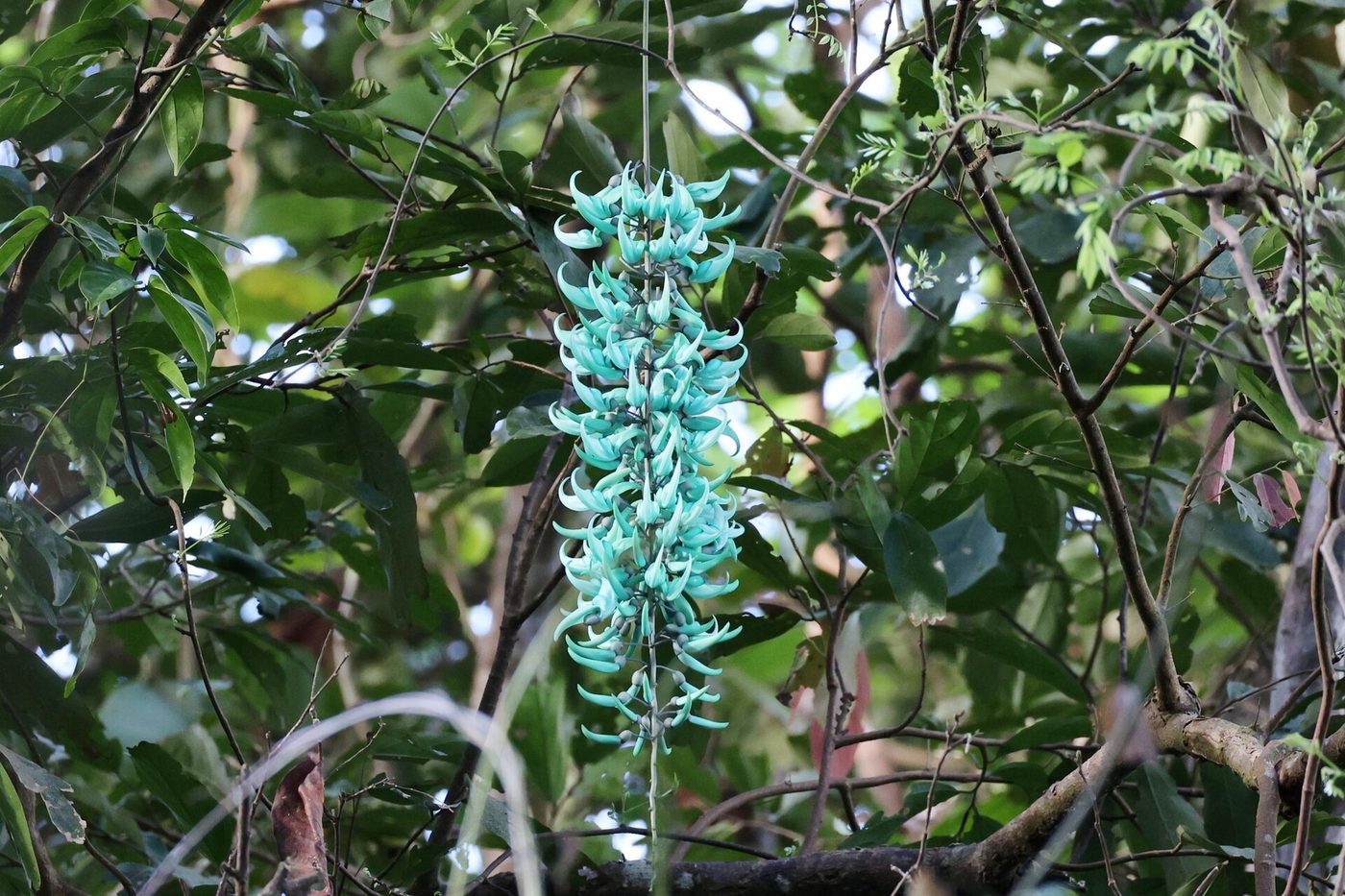
Photo: andrewholle · CC0
Jade vine
Strongylodon macrobotrys
The jade vine is a tropical climber from the Philippines, famous for its long hanging clusters of claw-shaped flowers in a rare turquoise colour.
Characteristics
The climber with jade-coloured flowers
The jade vine (Strongylodon macrobotrys) is a climbing plant of the pea family Fabaceae, endemic to the Philippines. It is famous for its long hanging clusters — which can exceed 90 cm — made up of dozens of claw- or beak-shaped flowers in a striking turquoise-green jade colour. This hue is one of the very few true blue-greens in the plant world, produced by a special combination of pigments; in the light it can seem almost luminescent.
Habitat and range
It grows in the rainforests of the Philippines, climbing over trees and letting its flowering clusters hang down into the understorey, where they are clearly visible to pollinators.
Pollination and cultivation
The flowers are pollinated mainly by bats, as well as by birds: the pale colour of the petals makes them visible in the gloom, and they are built to open at the animal's touch. In cultivation it needs a warm, humid tropical environment, filtered light and plenty of space, which is why it is a spectacular presence in conservatories and botanical gardens worldwide.
Did you know?
The turquoise of its flowers is among the most unusual colours in nature and is studied by botanists. In cultivation, without its natural pollinators, the flowers often have to be hand-pollinated for the plant to set seed.
Conservation
In the wild it is threatened by deforestation in the Philippines, which reduces its habitat. Its wide ornamental cultivation, however, helps conserve the species outside its native range.
Flowering season
Practical tips
Water needs: Plentiful, humid environment — always check soil moisture before watering.
Prefers Filtered light or partial shade; roots in shade: provide the right light and rotate the plant for even growth.
Recommended soil: Rich, fertile and well-draining. Refresh the substrate every 1-2 years.
Dust the leaves with a damp cloth to support photosynthesis.
Feed during the growing season (spring-summer) and stop in winter.
Pros
- Turquoise flower clusters unique in the world
- A spectacular climber in a conservatory
- Edible, non-toxic flowers
Cons
- Threatened by deforestation in the Philippines
- Needs a warm, humid tropical climate
- Often needs hand-pollination to set seed