Photo: Brian Gratwicke · CC BY 2.0
Queen Victoria agave
Agave victoriae-reginae
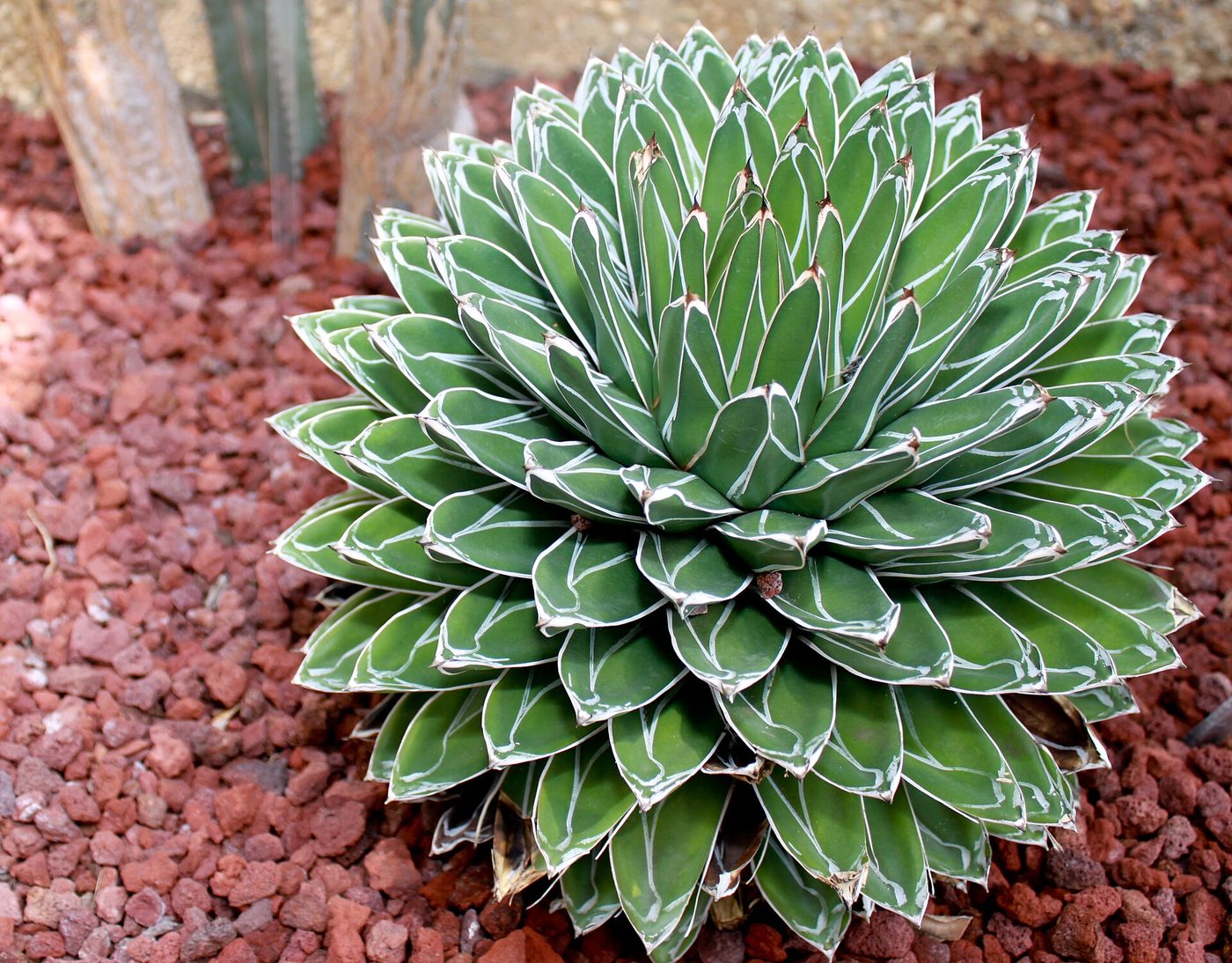
The Queen Victoria agave is a small Mexican succulent with a perfect geometric rosette of dark-green leaves marked by elegant white lines.
Characteristics
A geometric sculpture of leaves
The Queen Victoria agave is a small perennial succulent, among the most elegant and sought-after of the genus Agave. It forms a compact, almost spherical rosette of short, thick, stiff dark-green leaves, decorated with fine white lines that emphasise their geometric outlines. Each leaf ends in a small dark apical spine. The mature rosette reaches 30–50 cm across. The name honours Queen Victoria of England.
Origin and habitat
It is endemic to northern Mexico, where it grows in the Sierra Madre Oriental, on ridges and isolated hills, mostly on limestone substrates. It is adapted to an arid, hot, sunny climate with strong temperature swings.
Cultivation
It loves full sun or very bright light and a mineral, very free-draining, preferably chalky mix. Water it sparingly, letting the soil dry out well; in winter keep it almost dry. It is hardier than many agaves and tolerates light frost if the substrate drains well. Its growth is very slow, which makes it ideal for pot and collection culture.
Warning
Like all agaves, its sap can irritate the skin and eyes, and the apical spine of the leaves is sharp: handle it with care and place it away from busy paths.
Care and flowering
It needs very little attention. Like other agaves it is monocarpic: it flowers only once in its life, after many years, sending up a tall inflorescence, then dies leaving any offsets. Its slow growth means flowering comes only in very old specimens.
Flowering season
Practical tips
Water needs: Low, very drought-resistant — always check soil moisture before watering.
Prefers Full sun or very bright light: provide the right light and rotate the plant for even growth.
Recommended soil: Very free-draining, mineral and chalky. Refresh the substrate every 1-2 years.
Dust the leaves with a damp cloth to support photosynthesis.
Feed during the growing season (spring-summer) and stop in winter.
Pros
- Geometric rosette of great elegance
- Very drought-resistant
- Compact, ideal for pot and collection
Cons
- Very slow-growing
- Irritant sap and sharp apical spine