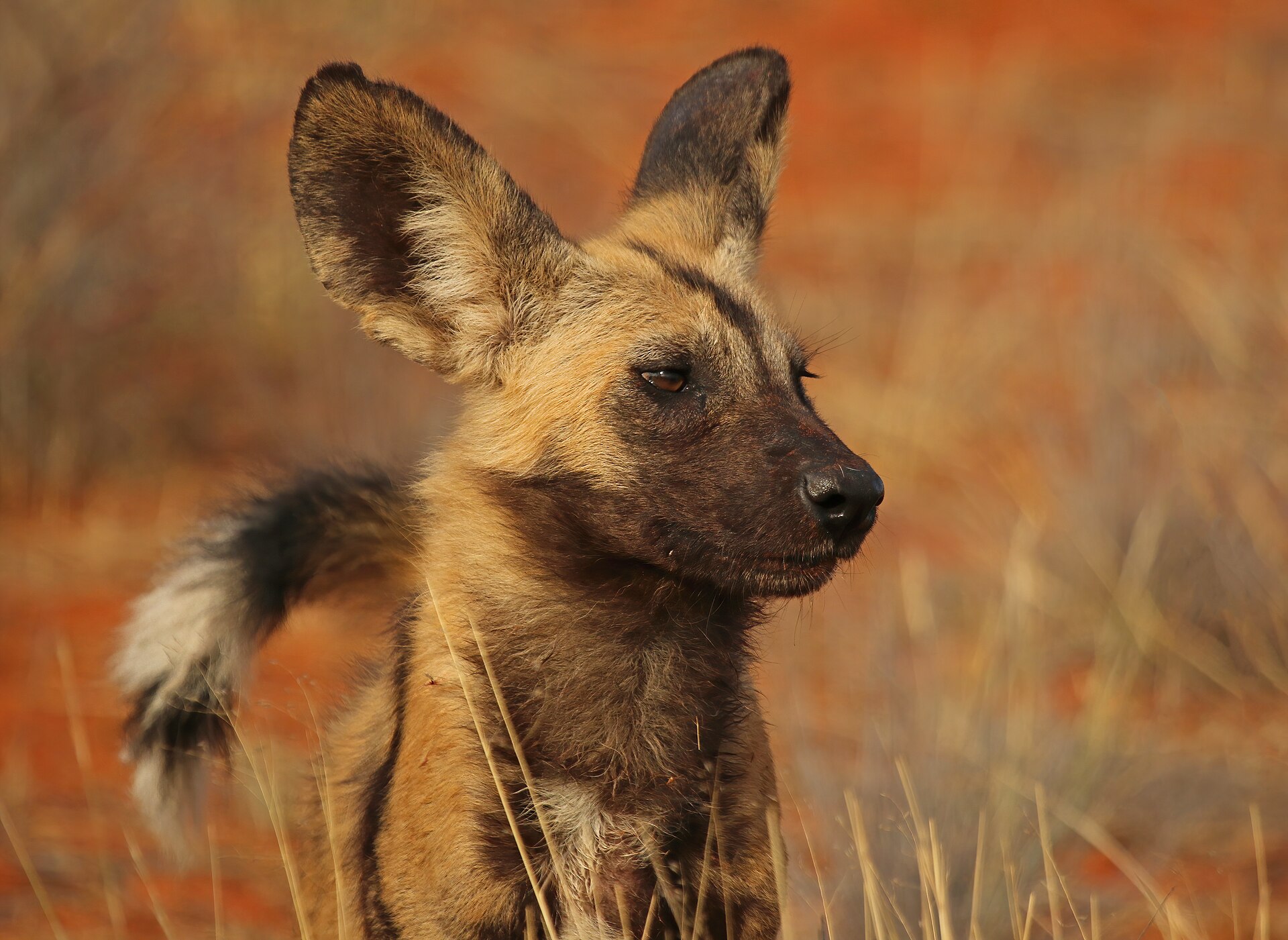
African Wild Dog
Lycaon pictus
Characteristics
Temperament
Highly social (packs of 6-30 matriarchal individuals with monogamous alpha pair). 80% HUNTING SUCCESS world record among large predators. VOTES with SNEEZES to decide when to hunt. Collective pup care with regurgitation. UNIQUE coat pattern each individual. ONLY 4 FRONT TOES (diagnostic). Endemic sub-Saharan Africa. Endurance running 60 km/h for 4-5 km. "Twitter" + "hoo-calls" 5+ km vocalisations.
Diet
Social hypercarnivorous carnivore. Medium antelopes 50-70% diet (kudu, impala, hartebeest, springbok, gazelles), small antelopes 20%, large antelopes 5-10%, warthog 5%, hares 5%. Coordinated pack hunt with 80% success (world record). Endurance running 4-5 km at 60 km/h. Prey devoured in 5-10 min, no leftovers. Pre-digested meat regurgitation for cubs + nursing mother.
The African Wild Dog (Lycaon pictus), also known as the Painted Dog, is one of the most social and fascinating canids in the world. Endemic to sub-Saharan Africa, famous for:
- 80% hunting success: highest among all large predators (lions 30%, cheetahs 50%, leopards 38%, spotted hyenas 50%) — efficiency from coordinated pack hunting
- Highly social packs: 6-30 individuals, matrilineal structure with monogamous alpha pair
- "Voting" by sneezing: before starting a hunt, pack members "vote" by sneezing — more sneezes = more likely to hunt (Walker et al., 2017)
- Unique mosaic coat: every individual has an absolutely unrepeatable pattern of black, brown, white, yellow patches — natural "fingerprints"
- Only 4 front toes: all other canids have 5 — diagnostic feature
- Collective pup care: entire pack contributes to raising the cubs
- Long-distance hunter: chases prey for 4-5 km at 60 km/h
IUCN status: Endangered (EN), global population estimated 6,600 mature individuals in 39 fragmented subpopulations. Trend: declining. Historically present throughout sub-Saharan Africa, now reduced to isolated populations.
Classification and category
Order Carnivora, family Canidae, subfamily Caninae, genus Lycaon (monotypic). Closest relatives: Dhole (Cuon alpinus, Asia) and Bush Dog (Speothos venaticus, South America). Three genera form the tribe Cynopharaonini — highly social predatory canids genetically distinct from Canis (wolves, jackals, coyotes). All three have only 4 front toes (lost forefoot thumb evolutionarily). Diverged from Canis ~5-7 Mya.
Etymology: "Lycaon" from Greek "lykáon" (wolf-dog), name of the mythological Greek king transformed into a wolf by Zeus. "Pictus" from Latin "pictus" (painted) — reference to mosaic coat. Described scientifically by Temminck in 1820.
Morphological parameters: Weight 18-36 kg (record 40 kg). Head-body 75-110 cm. Shoulder height 60-75 cm. Tail 30-45 cm with white tip. Longevity: 10-12 years natural, 15-17 captive. Sexual maturity 12-18 months (only alpha pair breeds). Gestation 69-73 days. Litter 6-16 cubs (record among canids: avg 10, max 19!). 1 litter/year.
Habitat and distribution
Endemic to sub-Saharan Africa. Historic range: 39 countries; current fragmented. Main populations: Botswana (~1,500-2,500), Zimbabwe (~700-1,000), Tanzania (~800), South Africa (~500 reintroduced), Mozambique (~300), Kenya (~400), Zambia (~300), Namibia (~150). Habitats: open savannas (main), Miombo woodland, semi-arid areas, mountain forests up to 3,000 m. Avoids dense rainforests, extreme deserts, urban areas. IUCN: Endangered since 1994, declining ~5%/year. Threats: livestock conflict (poison main cause), viral diseases (rabies, canine distemper from domestic dogs), road accidents, habitat fragmentation, commercial hunting, dog packs. CITES: Appendix II.
Diet
Obligate carnivore, hypercarnivore, social. Diet: medium antelopes (50-70% — kudu, impala, hartebeest, wildebeest young, springbok, Thomson/Grant gazelles), small antelopes (20% — duiker, dik-dik), large antelopes (5-10% — adult kudu, wildebeest), warthog (5%), hares (5%), occasional livestock, rare carrion. 80% hunt success rate — highest among large predators. Pack hunts at dawn/twilight with vocal coordination, 4-5 km chase at 60 km/h endurance pace. Prey killed by tearing/eviscerating in 5-10 min.
Physical features
Slender athletic silhouette. Coat UNIQUE to each individual: irregular mosaic patches of black, dark brown, light brown, white, yellow — natural fingerprint. White tail tip (visual signal during hunt). "Pictus" = painted. Head: ENORMOUS rounded ears (15-20 cm) for thermoregulation + acute hearing, short robust muzzle, amber/yellow eyes, very powerful jaws (can break bones). Body: only 4 FRONT TOES (unique among canids — diagnostic), long muscular legs, small pads for hard-ground running, white-tipped tail, large heart (5% body weight). Speed: cruise 60 km/h for 4-5 km, sprint 75 km/h. Vocalisations: "twitter" (8-12 kHz, hunt comms), "hoo-call" (long-distance ululation 5-7 km audible), "greet-yelp" (greetings), SNEEZES (hunt voting).
Behaviour and curiosities
MOST SOCIAL canid in the world. Pack 6-30 (max historical 100+) with matriarchal structure: alpha pair monogamous (lifelong) + subordinates (parents, siblings). Alpha pair monopolises breeding (~99% of litters). Dispersal at 2-3 years (usually females). Territory ENORMOUS 200-2,000 km² per pack. Marking: urine, faeces, long-distance "hoo-calls". Collective pup care: entire pack regurgitates pre-digested meat for cubs and nursing mother. Cubs reach 30% adult weight in 6-8 weeks.
Famous curiosities: "voting by sneezes". Walker et al. 2017 (Proc Royal Society B): pack members literally sneeze to vote whether to start a hunt. Alpha sneezes count 3× as much as subordinates. ~3 alpha sneezes or ~10 subordinate sneezes triggers a hunt. First documented "democratic vote" in mammals. 80% hunt success = world record among terrestrial predators, due to perfect pack coordination. Unique mosaic coat: every individual identifiable by photo. 4 front toes (unique among canids). Largest canid litters: avg 10 cubs, record 19. "Twitter" vocalisation: 8-12 kHz coordination during hunts. "Hoo-calls": 5-7 km audible. Enormous ears: thermoregulation + hearing. "Pack without alpha violence": most cooperative carnivore — no dominance fights. Canine distemper epidemics: Serengeti 1991 lost 70% to disease from village dogs. South African reintroduction: 0 to ~500 individuals since 1990. "Wild dog" misnomer: NOT closely related to domestic dogs (Canis); separated 5-7 Mya. "Democratic vote" research: model species for cooperation studies.
Pros
- Tasso di caccia 80% — il più alto tra grandi predatori
- Canide più sociale al mondo (branchi 6-30 cooperativi)
- Mantello a mosaico unico (impronta digitale naturale)
- Voto democratico con starnuti — comportamento eccezionale
Cons
- IUCN Endangered, ~6.600 individui in declino
- Vulnerabile a malattie virali da cani domestici
- Conflitto con bestiame causa morte adulta
- Frammentazione habitat critica (territori enormi richiesti)