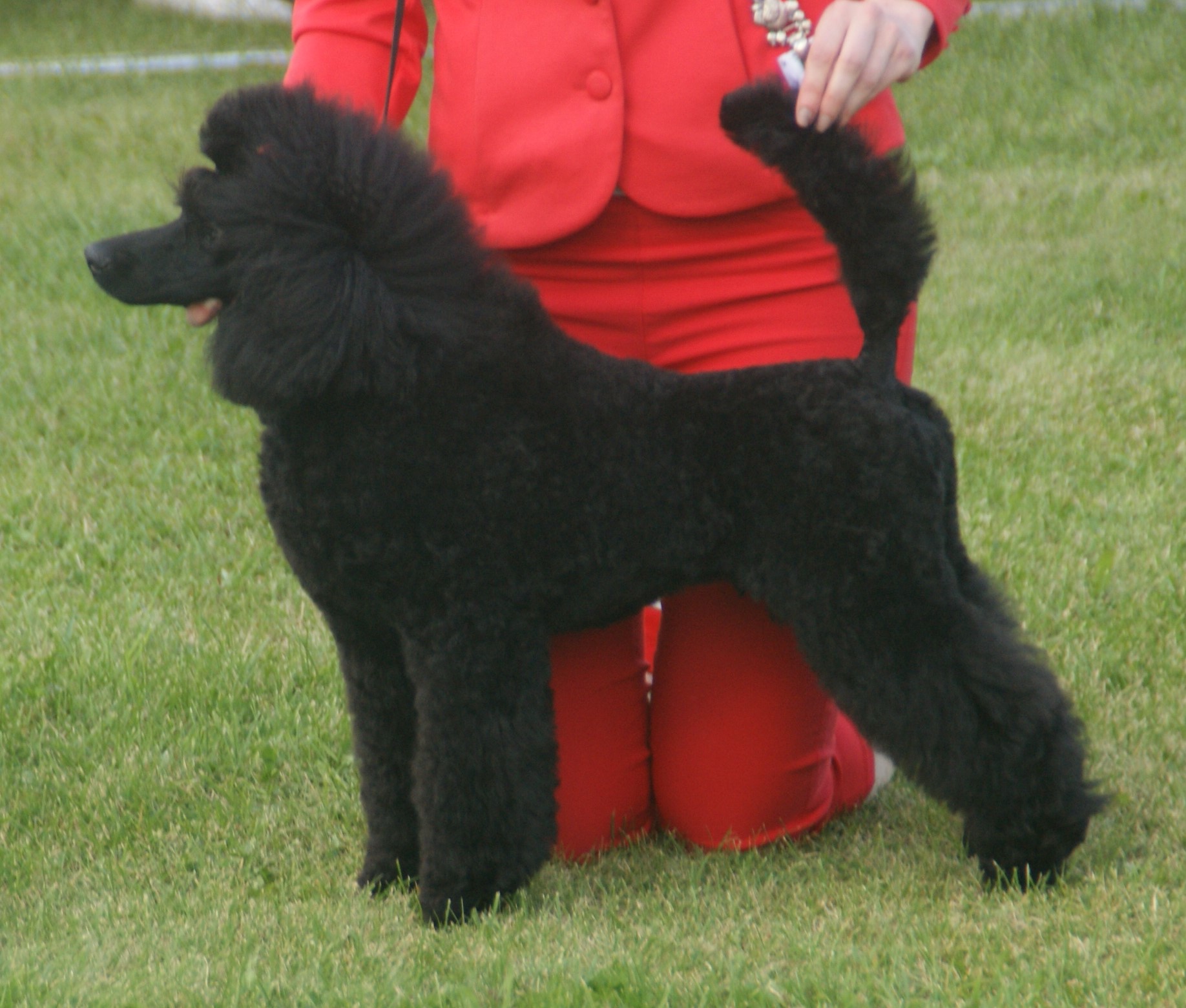
Poodle
Canis lupus familiaris
Characteristics
Temperament
A lively, affectionate, sensitive and extraordinarily intelligent dog, considered the second most "trainable" dog in the world. It is deeply attached to its family, playful and generally excellent with children, but can be reserved with strangers and serve as an attentive alarm dog. It has a great need for company and mental stimulation: it gets bored if left alone or under-occupied. Docile and eager to please, it learns easily and excels in obedience, agility and many tasks; suited both to active families and, in the small sizes, to flat living.
Diet
An omnivore with a carnivorous bent, like all dogs: it needs a good-quality complete, balanced food (dry and/or wet), suited to size, age and activity level, with fresh water always available. Rations must be carefully proportioned, since the breed ranges from a few kilos (Toy) to 20-30 kg (Standard): there is no single dose. The small sizes tend to gain weight if over-spoiled with treats, while sporting and working Poodles need the right energy intake.
The Poodle (Italian "Barboncino") is one of the most beloved, refined and brilliant dog breeds in the world. Often associated with a "lapdog" image, it is in fact a sporting, versatile and extraordinarily intelligent dog. Famous for:
- Exceptional intelligence: it is considered the second most intelligent dog in the world, right after the Border Collie
- A curly coat that doesn't shed: the dense, frizzy coat sheds very little, making it a popular choice for allergy sufferers
- Four sizes: from the tiny Toy to the Miniature, the Medium and the large Standard Poodle
- A passion for water: it was bred as a water retriever for hunters
- Elegance: a proud bearing and spectacular grooming make it a show-ring star
- The "ancestor of the doodles": it is crossed with many breeds to obtain low-shedding dogs
The Poodle is a pedigree domestic dog and enters this portal among the companion dogs (the group that brings together the companion breeds in the international classification). Behind its groomed appearance hides an intelligent, tireless working dog: one of the most complete and adaptable breeds in existence.
Classification and category
The Poodle is a pedigree domestic dog (Canis lupus familiaris), and in the portal it is classified among the companion dogs, alongside breeds such as the Pug, French Bulldog and Cavalier King Charles Spaniel. In the international canine classification (FCI) it belongs to Group 9 — Companion dogs, despite its working past. A peculiar feature of the breed is the existence of four size varieties, identical in type and character but very different in size: the Standard Poodle (the largest, about 45-60 cm; the original working form); the Medium Poodle (intermediate, about 35-45 cm); the Miniature Poodle (small, about 28-35 cm); and the Toy Poodle (the tiniest, under 28 cm). Etymology and origin: the English name "Poodle" comes from the German Pudel ("to splash"); the breed's origins are debated between Germany and France (where it is the Caniche, the duck-hunting dog); today the official standard is French, and the Poodle is effectively a national dog of France. Parameters (very variable by size): Height from under 28 cm (Toy) up to 60 cm (Standard). Weight from about 2-4 kg (Toy) up to 20-30 kg (Standard). Longevity good, generally 12-15 years; the smaller varieties (Toy and Miniature) are often particularly long-lived, up to 15-18 years.
Habitat and distribution
As a domestic breed, the Poodle has no wild range: it lives everywhere alongside humans and is widespread and loved all over the world. It does, however, have a precise geographical history, tied to Europe (Germany and France) and to work in water. Ideal living environment — it is among the most adaptable of all dogs: the home and family (it adapts very well both to a flat, especially the small sizes, and to a house with a garden); active, present people (it needs company, mental stimulation and exercise; it does not like prolonged solitude); and families, singles, the elderly (the range of sizes makes it suited to very different lifestyles). Its incredible versatility is one of the breed's strengths: the same dog, in different sizes, can be the lively handbag companion or the athletic retriever and sporting dog. Wherever it lives, however, the Poodle needs to keep its mind busy: a bored, under-stimulated Poodle can become hyperactive or develop unwanted behaviours.
Diet
Like all dogs, the Poodle is an omnivore with a carnivorous bent and needs a complete, balanced diet tuned to its size and energy. As a domestic dog: good-quality complete dog foods, suited to size, age and activity level; proportionate rations (very different between a Toy of a few kilos and a large Standard); and fresh water always available. Particular care: weight control (the small sizes, if over-spoiled with treats, gain weight easily); active dogs, suitable diet (sporting and working Poodles need the right energy intake); and dental health (in the Toy and Miniature varieties the teeth need careful attention, as in many small dogs). Crucially, given the wide range of sizes, there is no "one dose" for the Poodle. The diet must always be adapted to the individual dog — a common mistake is to treat a Toy Poodle like a large dog in miniature, getting the quantities wrong.
Physical features
An elegant, harmonious, proud-looking dog, instantly recognizable by its coat. The coat — the real distinguishing trait: curly (or corded), dense and woolly, single-layered, growing continuously; it sheds very little (dead hairs get caught in the coat instead of falling, hence the "hypoallergenic" reputation); but it requires regular brushing and grooming to avoid matting; many solid colours are allowed: black, white, apricot, brown, grey, fawn/red. The body: a lean, athletic, well-proportioned build, with a springy gait; a fine, elongated head, with long, pendulous, hair-covered ears; an upright, proud bearing. Performance: an excellent swimmer (a legacy of its water-retriever past); great agility and stamina, especially in the larger sizes; and very fast learning (it learns new commands in very few repetitions).
Behaviour and curiosities
The Poodle is a lively, affectionate, sensitive dog, very attached to its family. It is playful and sociable, generally excellent with children, but can be a little reserved with strangers and proves an attentive "alarm bell". Its intelligence, combined with a desire to please, makes it one of the easiest and most rewarding dogs to train.
The second most intelligent dog: in the famous canine intelligence rankings drawn up by psychologist Stanley Coren, the Poodle takes second place overall, just behind the Border Collie — it can often learn a new command in fewer than five repetitions and obey on the first attempt in the vast majority of cases; this brilliance explains its historical success in circuses, obedience, agility and many assistance roles. The true water dog: behind the elegant, city image, the Poodle was bred as a sturdy water retriever, used by hunters to recover ducks shot over ponds; even the famous "lion clip", with tufts of hair on the legs and chest and shaved parts, has a practical origin: it freed the limbs for swimming while protecting the joints and vital organs from the cold of the water. The "hypoallergenic" dog: no dog is truly 100% hypoallergenic, but the Poodle comes closer than many others — its continuously growing curly coat traps dead hairs and much of the dander instead of dispersing them, reducing the allergens in circulation; this is why it is one of the breeds most recommended for people with dog allergies, provided it is groomed regularly. The ancestor of the "doodles": the recent fashion for low-shedding hybrid dogs comes almost entirely from the Poodle — crossing it with other breeds has produced the famous doodles: the Labradoodle (with the Labrador), the Goldendoodle (with the Golden Retriever), the Cockapoo (with the Cocker) and many more; the aim was to combine the character of other breeds with the Poodle's low-allergen coat, though the results, being crossbreeds, are never entirely predictable. Four sizes, one dog: a peculiarity of the Poodle is that it exists in four different sizes — Standard, Medium, Miniature and Toy — which, however, share the same breed standard, the same type and the same character; it is, in practice, the same dog "printed" in different formats, from the pocket companion of a few kilos to the athletic Standard; this makes it suited to a range of owners and homes that is hard to match. The truffle hunter: thanks to its excellent sense of smell and its intelligence, in some regions the Poodle (and its crosses) has also been used as a truffle dog; its docility and ease of training make it suited to this patient, precise work, further proof of the breed's great versatility.
Pros
- Intelligentissimo e facilissimo da addestrare (2° nelle classifiche dopo il Border Collie)
- Pelo che perde pochissimo: tra le razze più adatte agli allergici
- Quattro taglie: si adatta a famiglie, single, anziani, appartamento o casa
- Affettuoso, giocoso, versatile: ottimo compagno e cane sportivo
Cons
- Il manto riccio richiede spazzolature e tolettature regolari (e costose)
- Molto intelligente e attivo: si annoia e ne soffre se lasciato solo o poco stimolato
- Può essere sensibile e un po' diffidente con gli estranei
- Alcune varietà sono soggette a problemi ereditari (articolazioni, occhi, denti)