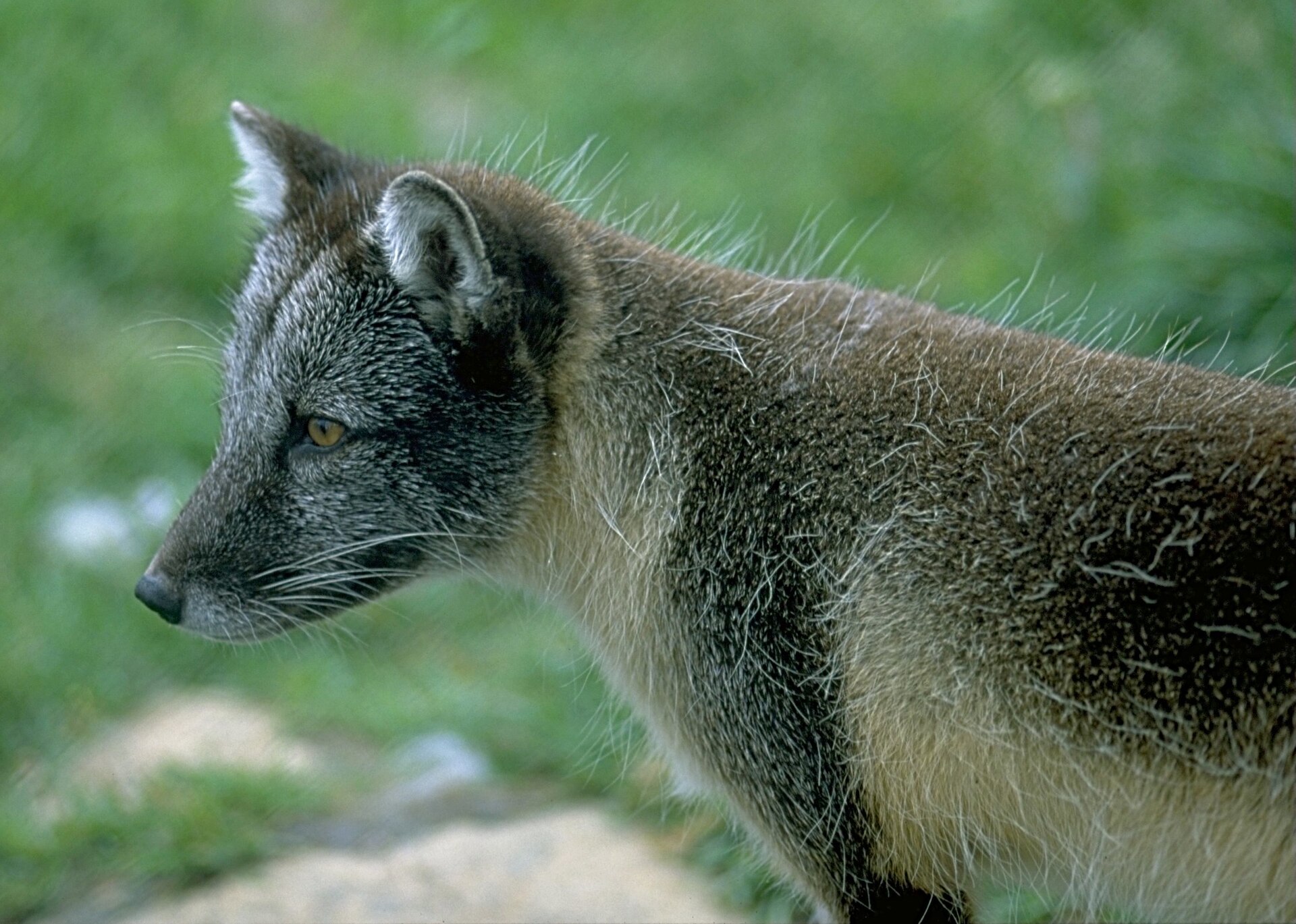
Arctic Fox
Alopex lagopus
Characteristics
Temperament
Solitary, monogamous, mainly nocturnal-crepuscular. MOST COLD-RESISTANT CANID: tolerates -70°C without shivering, -50°C without increasing metabolism (absolute record among mammals). DENSEST fur among canids (200% more than Fennec). 2 colour morphs: white morph (90%) changes white-brown seasonal; blue morph (10%) grey-blue all year. Litter 5-10 cubs (record 16 — highest canid). Only native mammal of Iceland.
Diet
Opportunistic carnivore. Lemmings main prey (50-80% diet) — 4-year cycles boom/crash. Also voles, birds, eggs, POLAR BEAR CARRION (follows bears for seal remains). Legendary "diving" technique: 1.5 m vertical jump, snow landing for lemming. Uses MAGNETORECEPTION to orient jump. Caching: hides 200+ eggs in snow for winter.
The Arctic Fox (Vulpes lagopus, also known as Alopex lagopus) is a small wild canid (weight 3-9 kg, head-body length 45-75 cm + tail 25-43 cm) distributed throughout the circumpolar Arctic: from Siberian Russia to Arctic Canada, Alaska, Iceland, Greenland, Scandinavia, Svalbard. It is the most cold-resistant canid in the world: tolerates temperatures of -70°C without shivering and does not increase its basal metabolism until ambient temperature drops below -50°C (absolute record among mammals!). The most iconic feature is the seasonal coat variation: in winter it is snow white to camouflage with ice, in summer it becomes brown-grey to blend with the rocky tundra. There are also 2 colour morphs: the "white morph" (90% of population, classic two-colour) and the "blue morph" (10%, mainly in coastal populations — remains grey-blue all year). Has the densest fur among all canids — more than 200% denser than that of the Fennec (its desert "cousin"!). Unique adaptations: furry paws, short rounded ears, short nose, and a countercurrent vascular system in the paws to reduce heat dispersion. Strictly depends on lemmings as main prey — Arctic Fox populations follow the 4-year cycles of lemming populations (boom/crash). IUCN status: Least Concern (LC) globally, but the Scandinavian population is Critically Endangered (only ~120 individuals in Norway/Sweden).
Classification and category
The Arctic Fox belongs to the family Canidae, subfamily Caninae, tribe Vulpini (foxes), genus Vulpes. Initially classified in a genus of its own (Alopex lagopus) for its unique features, it was reclassified in Vulpes in 2017 (Heptner & Naumov) based on deeper genetic analyses. It is very closely related to:
- Vulpes vulpes — Red Fox (in catalogue)
- Vulpes zerda — Fennec (in catalogue) — its desert "cousin"
- Vulpes corsac — Corsac Fox (Central Asia)
- Vulpes ferrilata — Tibetan Fox
- Vulpes velox — Swift Fox (North America)
Etymology: Vulpes lagopus from Latin "vulpes" (fox) + Greek "lagopus" (lago = hare, pous = foot) = "hare-footed fox", referring to the furry paws like those of an arctic hare.
There are 4 recognised subspecies (Hill 2014, IUCN):
- V. l. lagopus — Nominate subspecies, continental Eurasia
- V. l. innuitus — Inuit Arctic Fox (Canada, Greenland)
- V. l. fuliginosus — Icelandic Arctic Fox (~10,000 individuals)
- V. l. beringensis — Bering Arctic Fox (eastern Russia, Alaska)
The morphological parameters:
- Weight: 3-9 kg (M slightly larger than F, record 9.4 kg)
- Head-body length: 45-75 cm (record 80 cm)
- Tail: 25-43 cm (bushy, "cushion-like" — fat reserves, insulating, covers the body during sleep)
- Height at withers: 25-30 cm
- Ears: 3-6 cm — short and round (opposite to the giant ears of the Fennec)
Longevity: 3-6 years in nature, up to 16 years in captivity. Sexual maturity: 10-12 months. Gestation: 51-58 days; litter of 5-10 cubs (record 16 — the largest number of offspring among canids!). Mothers can nurse up to 22 cubs simultaneously.
Habitat and distribution
The Arctic Fox is a specialist of arctic and sub-arctic environments. Ideal habitat:
- Arctic tundra: main environment — icy plains with low vegetation, lichens, mosses
- Pack ice (sea ice): active hunting surface, often follows polar bears for carrion
- Arctic coasts: rocky or sandy, important for "blue morph" populations
- Boreal forests: only southern margins of distribution
- Arctic islands: Svalbard, Greenland, Iceland, Novaya Zemlya, Wrangel
- Altitude: 0-3,000 m (Scandinavian Alps)
Does NOT tolerate: temperate forests, warm climates, temperate urban environments. It is strictly Arctic: dies in heat.
Geographical distribution:
- Russia: all the Arctic coast and islands (Wrangel, Novaya Zemlya, Severnaya) — main population, millions of individuals
- Canada: all Arctic Canada (Nunavut, NWT), Arctic islands (Banks, Victoria, Baffin)
- Alaska (USA): Arctic coast and islands (Pribilof)
- Greenland: all the coast, especially eastern
- Iceland: only native terrestrial mammal (~10,000 individuals, stable population)
- Scandinavia: Norway, Sweden, Finland — Critically Endangered population (~120 individuals)
- Svalbard: 2,000-3,000 individuals
Estimated global population: several million (IUCN). Global IUCN status: Least Concern (LC). However:
- Scandinavia: Critically Endangered (population collapsed in the 1900s due to commercial hunting, today only 120 individuals)
- Mednyi Island (Russia): endangered endemic subspecies, ~100 individuals
Threats:
- Climate change: main long-term global threat — reduction of sea ice cover, decline of lemmings, expansion of Red Fox northward (in competition and preying on Arctic Fox cubs)
- Commercial hunting: historically decimated for fur (1700-1950) — millions of specimens killed/year. Today banned in many countries, but persists in some areas
- Pollution: bioaccumulation of mercury and PCBs from the marine food chain
- Red Fox expansion: the Red Fox (larger, more aggressive) is expanding into the Arctic thanks to warming — kills Arctic Fox cubs and occupies their dens
- Accidental poisoning: rodenticides spread to control mice in human areas
CITES: not listed. Conservation: the "Arctic Fox Conservation Program" in Scandinavia has reintroduced Arctic Foxes raised in captivity in areas historically inhabited by the species. Limited success due to competition with the Red Fox.
Diet
The Arctic Fox is an opportunistic carnivore, with a diet strictly dependent on Arctic prey. Diet varies seasonally and geographically:
- Lemmings (Lemmus, Dicrostonyx): main prey — 50-80% of diet in continental zones. The Arctic Fox is strictly dependent on lemmings: its populations follow 4-year cycles in synchrony with those of lemmings (boom/crash)
- Voles, tundra mice: 10-20% of diet
- Birds and eggs: chicks, seabirds, eggs of gulls, ducks, Arctic terns — especially in summer
- Carrion left by polar bears: the Arctic Fox often follows a polar bear for days, eating the remains of its prey (seals, whale carcasses)
- Fish: from active fishing (rare) or from fishermen
- Fruits: berries, arctic blueberries, fox grapes — in short summer
- Insects: summer, supplement
- Young seals: rare, but documented
The Arctic Fox's lemming hunting technique is extraordinary. The Arctic Fox's "mousing":
- Listening: the fox locates a lemming under the snow thanks to exceptional hearing (can hear lemmings 1+ m under the snow cover)
- Pinpoint: uses the head to "triangulate" the exact position of the prey
- Calculation: estimates the depth of the lemming under the snow
- Vertical jump: jumps vertically into the air (record 1.5 m high!), spinning mid-air
- Frontal landing: lands paws-first, with the muzzle piercing the snow cover
- Capture: catches the lemming under the snow with the teeth
This "diving" into the snow is one of the most spectacular hunting techniques in the animal kingdom, documented in numerous documentaries (BBC Planet Earth, Frozen Planet).
Caching (storage): the Arctic Fox hides excess food in the snow (low temperatures preserve it for months). A single fox can accumulate 200+ eggs and thousands of prey in "arctic fox larder" caches.
Physical features
The Arctic Fox has an anatomy perfectly optimised for extreme cold. Unique adaptations among mammals:
ULTRA-DENSE fur — the densest among all canids:
- Density: 50,000-60,000 hairs/cm² (more than Fennec, double the Red Fox, 4× of the domestic dog)
- Structure: double layer — dense insulating "down" undercoat + long water-repellent guard hairs
- Thickness: 4-7 cm in winter (doubles compared to summer)
- Function: extraordinary insulator — the Arctic Fox can lie on snow at -50°C without moving for hours
2 colour morphs and seasonal change:
- White morph (90% population): winter pure white for snow camouflage, summer brown-grey speckled
- Blue morph (10% population, mainly coastal and Iceland): grey-blue or dark brown all year (coastal camouflage with black rocks)
- Moult period: 2 moults/year — spring (April-May) and autumn (September-October). Gradual colour change in a few weeks
- Trigger: moult is driven by photoperiodicity (day length), not by temperature — Arctic Foxes in captivity in temperate regions moult at the correct times
"Anti-cold" anatomy:
- Furry paws: foot pads are covered with dense fur (like Fennec, but much denser) — insulate from ice and snow
- Short rounded ears: 3-6 cm (vs 10-15 cm of the Fennec!) — less surface = less heat dispersion
- Short stubby nose: less exposure to cold
- Compact body shape: minimum surface/volume ratio to reduce heat loss (Bergmann's rule)
- Fat layer: 4-7 cm in winter (doubles from summer) — energy reserve and insulator
- Countercurrent vascular system in the paws: hot arteries from the inside wrap around cold veins from the surface, exchanging heat — the paws can be at 0°C while the body is at 38°C (no freezing, no energy loss)
- High basal metabolism: ~150% of other foxes per weight
- Bushy tail: 25-43 cm — used as a "blanket" during sleep (the fox wraps the tail around its muzzle)
The eyes are medium, brown-black, with excellent night vision (but arctic days are 24h summer light, 24h winter darkness — the Arctic Fox has great sensory flexibility). Hearing is exceptional: can hear a lemming under 1 metre of snow.
Behaviour and curiosities
The Arctic Fox is a solitary, monogamous, mainly nocturnal-crepuscular animal in summer (due to 24h light), more diurnal in winter (little light). Territory: 6-30 km² per couple, marked with urine and secretions of anal glands. Underground dens are complex: multi-tunnel gallery systems with 4-100 entrances, 1-2 m depth. Some dens are used for generations (hundreds of years!), passed down from foxes to their descendants.
Reproductive behaviour: monogamy for life. Mating season: March-April. Gestation 51-58 days. Massive birth: 5-10 cubs (record 16!) — the highest number among canids. Females can nurse up to 22 cubs simultaneously. Survival rate: only 30-50% reaches summer. The massive production of cubs is a strategy to compensate for high juvenile mortality.
The cubs: born blind, dark (brown-grey), weighing 50-80 g. Open their eyes at 14 days, leave the den at 3-4 weeks, independent at 6 months. Unique feature among canids: in some cases the "sister wives" help the main mother raise the cubs (multiple females live in the same den). Blue morph cubs are always dark brown-grey at birth; white morph cubs are brown-grey, they will change to white with the first autumn moult.
Famous curiosities: the "diving in the snow". The lemming hunting technique is one of the most filmed in the animal world. The Arctic Fox jumps vertically up to 1.5 m high and lands paws-first, piercing the snow with the muzzle. 2014 studies (Cherry, Cziko) discovered that the fox uses the Earth's magnetic field to orient the jump: always jumps north-east, where magnetic triangulation is optimal to estimate the depth of the lemming. It is one of the rare mammals with documented magnetoreception.
Cold tolerance curiosity: the Arctic Fox is the most cold-resistant mammal in the world. Physiological studies (Scholander 1950, classic) have shown that:
- Does not increase basal metabolism up to -50°C
- Does not shiver up to -70°C
- Can briefly survive at -80°C
- For comparison: humans shiver below +10°C, go into hypothermia below -10°C without clothes
"Desert cousin" curiosity: Arctic Fox and Fennec are close relatives in the same genus Vulpes, but represent the extremes of thermal adaptation in the canid kingdom: Fennec specialised for +50°C, Arctic Fox for -70°C. 120°C difference in thermal tolerance! Mirror anatomy: Fennec has giant ears (15 cm) to dissipate heat, Arctic Fox has small ears (3-6 cm) to minimise loss. Same ultra-dense fur, but for opposite reasons (insulation + albedo).
"Iceland's only native mammal" curiosity: the Arctic Fox is the only native terrestrial mammal of Iceland. Arrived on the island about 12,000 years ago crossing the sea ice. All other mammals (reindeer, mice, horses, sheep) have been introduced by man. It is protected by law in Iceland, population stable at ~10,000 individuals.
"Follow the bear" curiosity: in winter the Arctic Fox often follows a polar bear for days or weeks, keeping 200-300 m of distance. When the bear kills a seal and finishes eating, the fox approaches and consumes the remains. This "commensalism" is important for survival in winter when lemmings are scarce. "Sister wives" curiosity: in some populations, 2-3 adult females share a den and cooperate in raising the cubs — a rare social behaviour among foxes (usually solitary). Perhaps an adaptation to extreme cold (more adults = more body heat). "Fox jewelry" curiosity: Arctic Fox fur was traditionally the most valued in the world. In the 1900s-1950s, astronomical prices (equivalent to today's $5,000-10,000 per skin). Millions of foxes killed for "stoles" and coats. Today banned in many countries, but the illegal market persists. "Red Fox competition" curiosity: climate change allows the Red Fox (larger, more aggressive) to expand northward into the Arctic Fox range. The Red kills Arctic cubs and occupies their dens. Studies predict the Arctic could disappear from Scandinavia within 50 years if warming continues. "Vulpes vs Alopex" curiosity: from 1854 it was in the genus Alopex (monotypic) for its unique features. Since 2017 (Heptner & Naumov), genetic analyses have shown close kinship with other Vulpes — reclassified. Now it is Vulpes lagopus. "Frost-resistant blood" curiosity: Arctic Fox blood contains antifreeze proteins and a low concentration of water — just like Antarctic fish. Allows survival of extreme temperatures without tissue freezing. "Longest fast" curiosity: in winter with scarce lemmings, the Arctic Fox can fast for up to 2 weeks without serious problems — record for a canid. Fat reserves accumulated in summer. "Smallest paws" curiosity: the Arctic Fox's paws have the smallest surface/weight ratio among canids — less exposed surface = less heat dispersed. Combined with plantar fur, the paw is "thermally insulated" from the frozen ground.
Pros
- Adattamento termico estremo (-70°C senza tremare)
- Pelliccia più densa di tutti i canidi (50.000+ peli/cm²)
- Magnetorecezione per orientare il salto di caccia
- Unico mammifero nativo di Islanda
Cons
- Popolazione scandinava Critically Endangered (~120 individui)
- Vulnerabile al cambiamento climatico (espansione Volpe Rossa)
- Mortalità giovanile 50-70%
- Historically decimata per pelliccia (milioni uccisi nel 1900-1950)