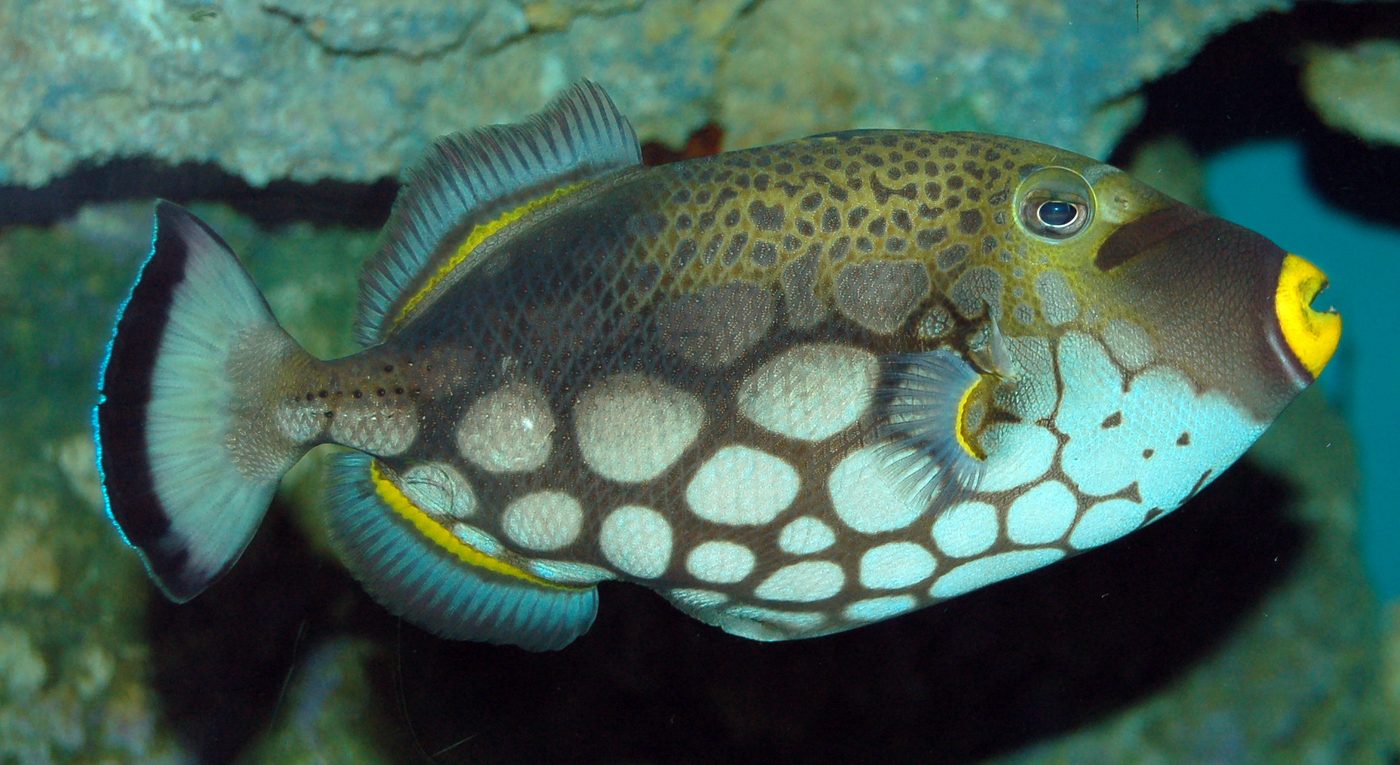
Clown triggerfish
Balistoides conspicillum
With its dark coat dotted with large white spots and its yellow-rimmed mouth, the clown triggerfish is one of the most striking and curious fish of the coral reefs.
Characteristics
Temperament
Solitary, territorial, bold
Diet
Carnivore: sea urchins, molluscs, crustaceans
A fish of unmistakable colours
The clown triggerfish is one of the most spectacular and recognisable reef fish. Its coat is a masterpiece of colours and patterns: the lower half of the body, dark, is scattered with large rounded white spots, while the back shows a lighter reticulated pattern, like embroidery. Around the mouth stands out a striking yellow-orange ring, and other yellow bands cross the snout. The body is tall, laterally compressed and sturdy, suited to manoeuvring precisely among the corals.
Habitat and distribution
It lives in the warm, clear waters of the Indo-Pacific, along coral reefs and rocky walls rich in crevices. It is a demersal fish, that is, tied to the bottom, frequenting above all the outer walls of the reefs, where it finds food and hiding places. Adults tend to be solitary and territorial, while the young live more hidden in sheltered areas.
Behaviour and feeding
The clown triggerfish has a sturdy, powerful set of teeth, with which it crushes hard-shelled prey: it feeds on sea urchins, molluscs, crustaceans and other invertebrates. It is known for its bold, territorial character: during breeding, when it defends the nest laid on the bottom, it can become aggressive even towards animals much larger than itself, including divers who come too close.
The trigger mechanism
The name triggerfish comes from a curious defence mechanism shared by the fish of its family. On its back it has a first, sturdy dorsal spine which, when the animal slips into a crevice, can be raised and locked in an upright position by a second, smaller spine that works like a trigger. Wedged in this way, the fish becomes almost impossible for a predator to pull out.
Conservation
The clown triggerfish is classified as a species of least concern. It is much sought after in marine aquariums for its beauty, but in the wild its populations are not considered threatened. The health of the coral reefs, however, remains essential for its future and for that of all the wildlife living there.
Pros
- One of the reef's most spectacular coats
- Curious trigger-based defence mechanism
- Populations not threatened in the wild
- Sturdy and adapted to life among corals
Cons
- Aggressive, territorial character
- Depends on the health of coral reefs
- Heavily collected for the aquarium trade