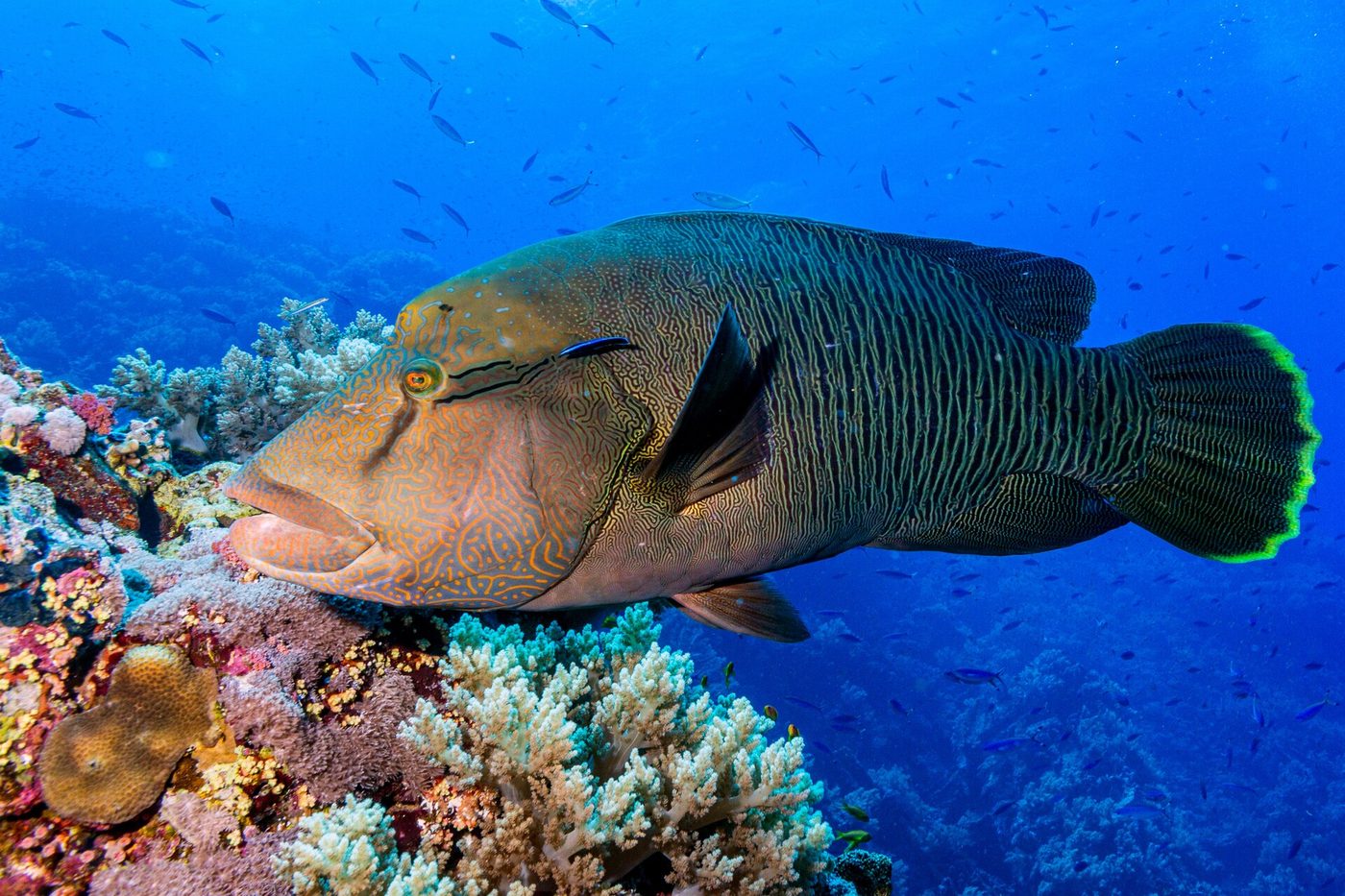
Photo: R Vasconcellos · CC BY 4.0
Humphead wrasse
Cheilinus undulatus
The humphead wrasse is the largest of all wrasses: a giant of Indo-Pacific coral reefs, easily recognised by the bulging hump on its forehead.
Characteristics
Temperament
Diurnal, solitary and curious; often unafraid of divers in reserves.
Diet
Carnivorous: molluscs, urchins, crabs, crustaceans and hard or toxic prey.
A giant of the reef
The humphead wrasse (Cheilinus undulatus) is the largest member of the wrasse family. The biggest individuals can exceed two metres in length and approach 190 kg in weight. It is unmistakable: adults develop a prominent fleshy hump on the forehead and thick, protruding lips, while the greenish-blue body is covered in dense, maze-like wavy lines, especially around the eyes. That forehead "crown" gave rise to its other name, the Napoleon wrasse, after the emperor's distinctive hat.
Habitat and range
It lives on the coral reefs of the tropical Indo-Pacific, from the Red Sea and the coasts of East Africa to Polynesia, and north to the Ryukyu Islands. It frequents steep reef slopes, lagoons and coral-rich channels, usually down to around a hundred metres, and often returns to the same shelters.
Behaviour and diet
It is a diurnal, solitary predator that feeds mainly on hard-shelled invertebrates — molluscs, sea urchins, crabs and crustaceans — as well as dangerous prey such as crown-of-thorns starfish and certain toxic molluscs. It is a hermaphrodite: many individuals are born female and may later change into males, which take on more intense colours. Growth is slow and sexual maturity comes late.
Did you know?
It is a long-lived, curious fish, often unafraid of divers in protected areas. Its flesh is highly prized in the live-fish markets of East Asia, where it fetches very high prices — which is exactly what has made it a target of overfishing.
Conservation
The IUCN lists it as Endangered. Overfishing — often illegal and sometimes using cyanide — combined with slow growth and late reproduction, has drastically reduced its populations. It is protected in many countries and listed on Appendix II of CITES.
Pros
- The largest fish in the wrasse family
- Helps control crown-of-thorns starfish
- Long-lived and confiding in protected areas
Cons
- Endangered due to overfishing
- Slow growth and late maturity
- Very sensitive to coral-reef degradation