Ribbon eel
Rhinomuraena quaesita
The ribbon eel is a slender, elegant moray of the Indo-Pacific, brightly coloured with leaf-like nostrils, that changes both sex and colour as it grows.
Characteristics
Temperament
Solitary and cryptic; an ambush predator from its burrow.
Diet
Carnivorous: small fish and crustaceans caught by ambush.
A moray as thin as a ribbon
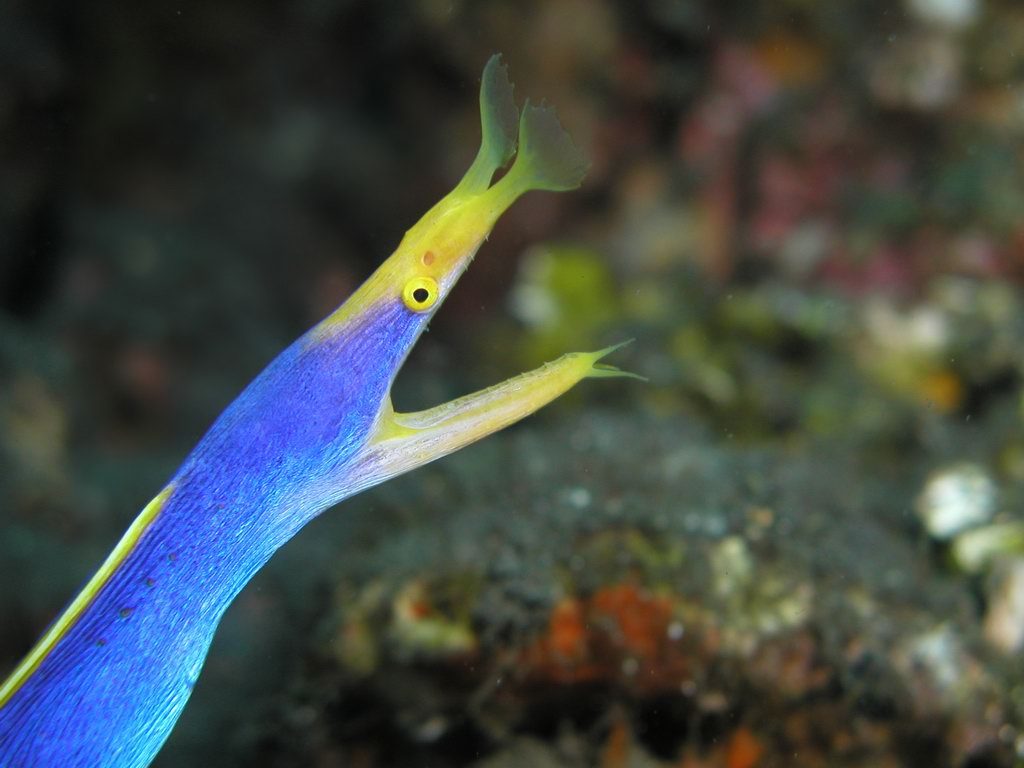
The ribbon eel (Rhinomuraena quaesita) is a moray with an extremely slender, elongated body, the only species of the genus Rhinomuraena. Besides its ribbon-like shape, its most striking features are its front nostrils, expanded into elegant leaf-shaped flaps, and its lower jaw adorned with barbels. It holds its mouth constantly open — a pose that looks threatening but mainly serves to pass water over its gills to breathe.
Habitat and range
It lives on coral reefs and sandy bottoms of the Indo-Pacific, from East Africa to Polynesia. It spends most of its time tucked into a burrow in the sand or among rocks, with only its head and the front of its body protruding, swaying in the current.
Behaviour and diet
It is an ambush predator: it waits motionless in its burrow and seizes small fish and crustaceans that pass within reach. Its biology is extraordinary: it is a sequential hermaphrodite that changes sex and colour with age. Juveniles are black with a yellow dorsal fin, adult males turn electric blue with a yellow snout, and finally the oldest individuals become entirely yellow females.
Did you know?
Its dramatic colour change long led people to believe the three phases were different species. In German it is also called the "ghost moray" for its ethereal, swaying appearance.
Conservation
The IUCN lists it as Least Concern. It is sometimes collected for the marine aquarium trade, where it proves very delicate; healthy coral reefs remain vital to the species.
Pros
- Vivid colours and a very elegant form
- A hermaphrodite that changes sex and colour
- Least Concern, widespread
Cons
- Delicate and hard to keep in aquariums
- Dependent on healthy coral reefs
- Often mistaken as aggressive for its open mouth