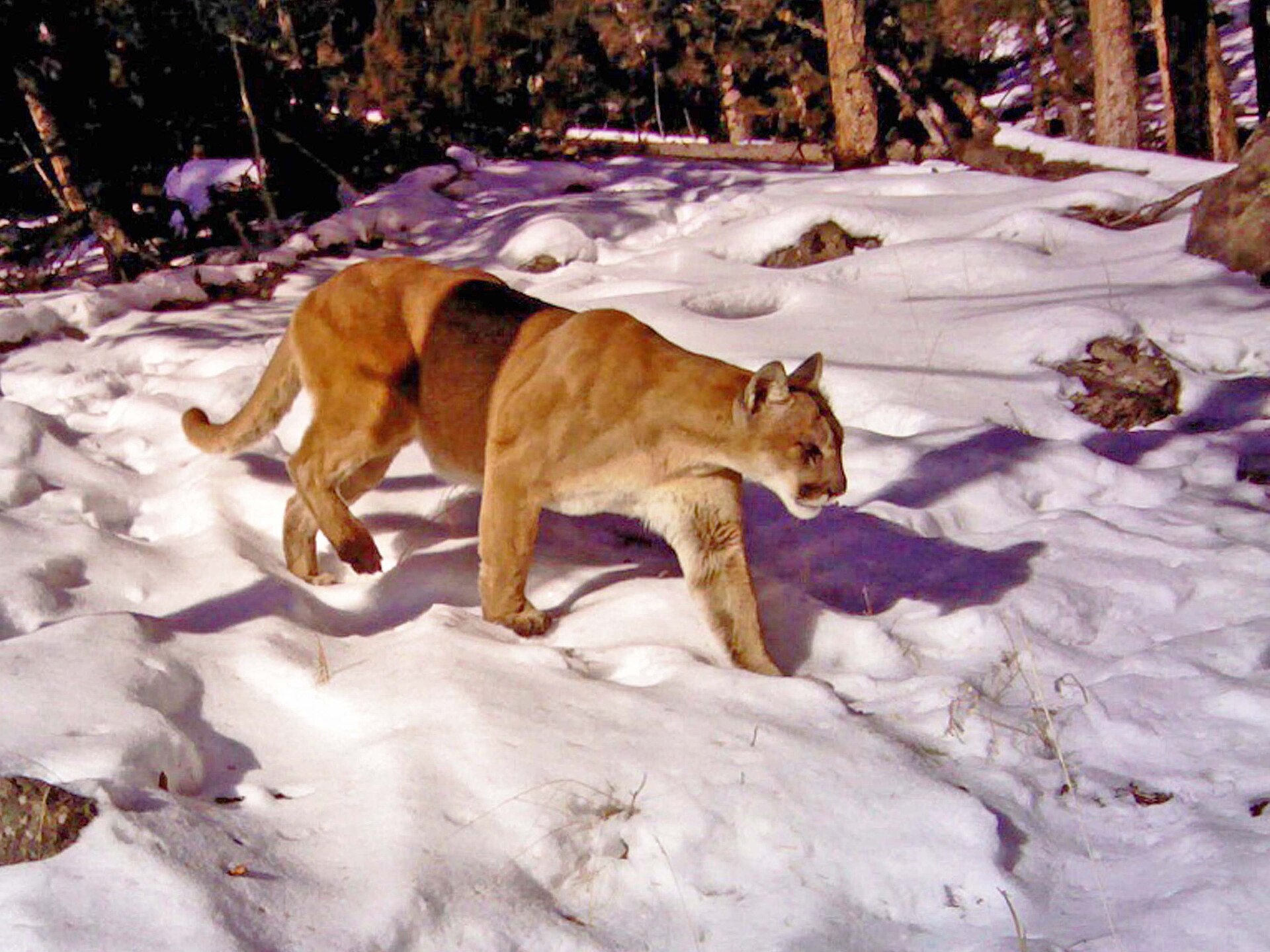
Cougar
Puma concolor
Characteristics
Temperament
Solitary, territorial, crepuscular-nocturnal. LARGEST FELINAE (not Pantherinae!). Does NOT roar — PURRS like domestic cat. VERTICAL JUMP RECORD among felids: 5.5 m. Widest distribution Americas (>110 degrees latitude). 40+ popular names (Guinness "animal with most names in world"). Closest relative: CHEETAH. Florida Panther subpopulation CR.
Diet
Hypercarnivorous carnivore. Deer 60-80% diet (North), guanaco/peccary (South). Hunts by "stalking + leap + killing bite + caching". Success 80-85% (one of highest among felids). 1-2 large prey/week. Drags 70 kg prey for 350 m record! Hides with leaves, eats 3-7 days. Sub-apex: subordinate to Jaguar, grizzly, wolves.
The Cougar (Puma concolor), also known as Puma, Mountain Lion, Panther, Catamount, Painter, is the largest felid of the Felinae subfamily (not Pantherinae!), the fourth largest felid in the world (after tiger, lion and jaguar) and the felid with the widest distribution in the New World: from Arctic Canada (Yukon) to Chilean Patagonia, from the Pacific to the Atlantic. It is a true "alpine generalist": lives in forests, deserts, mountains, swamps, from sea level to the peaks of the Andes (5,800 m record). Imposing measurements: weight 35-100 kg (M 60-100 kg, F 35-65 kg), head-body length 1-1.5 m + tail 60-95 cm. It is morphologically a giant "Felinae": although as large as small tigers/lions, it does NOT belong to the Pantherinae and therefore does NOT roar. Instead, it purrs like a domestic cat (diagnostic feature of Felinae!), meows, and emits prolonged unsettling cries ("screams"). Holds the vertical jump record among all felids: 5.5 m (in some reports up to 7 m!), horizontal jump 12 m, sprint 80 km/h. The Cougar has more than 40 popular names in the Americas — registered by Guinness as the "animal with the most names in the world". IUCN status: Least Concern (LC) globally, but several subpopulations are at risk (Florida Panther Critically Endangered, ~200 individuals).
Classification and category
The Cougar belongs to the family Felidae, subfamily Felinae (NOT Pantherinae!), tribe Pumini, genus Puma. Key feature: Felinae are distinguished from Pantherinae by the rigid hyoid bone — this allows them to purr but not roar. The Pantherinae (tiger, lion, leopard, jaguar, snow leopard) have a flexible hyoid bone that allows roaring but not purring. The Cougar is therefore a "giant Felinae": grows to the size of a small Pantherinae but maintains the anatomy/biology of an enlarged domestic cat.
The genus Puma comprises 2 living species:
- Puma concolor — Cougar (subject of this entry)
- Puma yagouaroundi — Jaguarundi (Tropical Americas, smaller, reddish-brown)
Closest relatives: the Cheetah (Acinonyx jubatus) is the closest genetic relative of the Cougar! The three species (Cougar, Jaguarundi, Cheetah) form the "Pumini clade", diverging from other Felinae about 6-8 million years ago. The Cougar is genetically closer to the African cheetah than to any American lion.
Etymology: "Puma" derives from the Peruvian Quechua "puma" (feline). "Cougar" derives from a Tupi tribe of Brazil via Portuguese. "Concolor" from Latin "single colour" — reference to the uniform coat (devoid of spots or stripes). The species was scientifically described by Linnaeus in 1771.
Historically 32 subspecies were recognised (1946, Goldman). Modern genetic analyses (Culver et al., 2000) have drastically reduced this to 6 subspecies:
- P. c. concolor — South American Cougar
- P. c. costaricensis — Central American Cougar
- P. c. capricornensis — Cougar of southern Brazil/Argentina
- P. c. cabrerae — Argentine Cougar
- P. c. couguar — North American Cougar
- P. c. puma — Andean Cougar
A further reduced subspecies from recent analyses (Caragiulo et al., 2014) considers only 2 subspecies: North American and South American, separated by Panama.
The morphological parameters:
- Weight: M 60-100 kg (record 120 kg, Idaho); F 35-65 kg
- Head-body length: 1-1.5 m (M), 0.9-1.3 m (F); record 1.7 m
- Tail: 60-95 cm (50% body length)
- Height at withers: 60-85 cm
Longevity: 8-13 years in nature, up to 20 years in captivity (record 23). Sexual maturity: 2-3 years. Gestation: 90-96 days; litter of 1-6 cubs (average 2-3). Reproduction every 2 years.
Habitat and distribution
The Cougar is the felid with the widest distribution in the Americas, covers over 110 degrees of latitude:
- Yukon, Canada (60° N) → Patagonia, Chile (52° S)
- Pacific (Alaska to Chile) → Atlantic (New Brunswick to Argentina)
Preferred habitats — all, it is a generalist:
- Temperate forests: deciduous, coniferous forests (Rocky Mountains, Cascade)
- Tropical forests: Amazon, Central America
- Deserts: Sonoran, Mojave, Atacama
- Mountains: Andes up to 5,800 m (altitude record), Rocky Mountains
- Prairies: Argentine pampas
- Swamps: Pantanal, Everglades (Florida Panther)
- Scrubland: California chaparral
Does NOT tolerate: dense tropical rainforest (replaced by Jaguar), arctic tundra. The Cougar has withdrawn from most of North America after European colonisation (hunted as "livestock predator"). Today:
- Eastern USA: EXTINCT since 1900 (except isolated Florida Panther — ~200 individuals)
- Western USA: 20,000-40,000 individuals, recovering
- Canada: 3,500-5,000 individuals (BC, Alberta)
- Mexico: 5,000+ individuals
- Central America: fragmented populations
- South America: main population, hundreds of thousands of individuals
Estimated global population: 50,000-100,000 mature individuals (IUCN). Global IUCN status: Least Concern (LC) since 2008. However:
- Florida Panther (P. c. couguar Florida subpopulation): Critically Endangered — only ~200 isolated individuals, inbreeding problems
- Eastern Puma (Eastern USA): declared EXTINCT in 2018 (US Fish & Wildlife Service)
- Costa Rica, Honduras: declining sub-populations
Threats:
- Hunting: legal in many US states (~3,000 cougars killed/year just in American "trophy hunts")
- Livestock conflict: retaliatory killings by ranchers
- Habitat fragmentation: roads, urbanisation
- Road accidents: main cause of death in Florida (Florida Panther)
- Prey hunting: decline of deer/elk reduces feeding
- Mortality persecution: targeted as a "predator"
CITES: Appendix II (P. concolor), Appendix I (Florida Panther + Costa Rica sub-populations). Conservation: the "Florida Panther Recovery Plan" (US Fish & Wildlife) saves the critical subpopulation with crosses with Texas cougars to reduce inbreeding.
Diet
The Cougar is a generalist hypercarnivorous carnivore. Opportunistic hunter, eats practically any mammal of the right size. Main diet:
- Deer and elk: preferred prey — constitutes 60-80% of diet in North America. Species: white-tailed deer, mule deer, elk, moose (occasional)
- Guanaco and vicuña: in South America (Patagonia, Andes)
- Peccaries: in Central/South America
- Large rodents: beaver, giant squirrel, capybara (in South America)
- Hares and rabbits: 5-15% diet in arid zones
- Small mammals: raccoons, opossums, polecats
- Livestock: sheep, calves, chickens (cause conflicts with ranchers)
- Reptiles/birds: occasional
- Fish: rare, but documented
The hunting technique is elegant and precise:
- Stalking: silently approaches the prey, exploiting vegetation and topography. Average approach distance: 5-15 m
- Leap: spectacular final leap — record 5.5 m vertical, 12 m horizontal
- Killing bite: lethal bite to the nape (cervids) or throat (smaller prey), breaks the neck
- Caching: after the kill, drags the prey up to 350 m (record!) to a hiding place. Covers with leaves/branches
- Consumption: returns to eat for 3-7 days (can fast up to 2 weeks between prey)
Feature: the Cougar is a "cache predator" — kills large prey, hides it, returns to eat for days. A deer prey (50-70 kg) sustains an adult cougar for 10-15 days. Hunting success rate: 80-85% (one of the highest among felids thanks to patience and technique). Quantity: 1-2 large prey/week.
Notable: the Cougar is NOT apex in many habitats. It is subordinate to:
- Jaguar (Central/South America)
- Grizzly bear (North America) — can steal prey from it
- Wolves (North America) — packs can hunt cougars
Coexists with other large predators by exploiting different habitats (cougar in rockier/steeper areas, where others cannot follow it).
Physical features
The Cougar has a slender, muscular, athletic body, perfectly adapted for pursuit and jumping. Physical features:
Coat:
- Base colour: uniform tawny-grey (concolor!) — varies from light grey (North) to brown-reddish (South)
- Chin, throat, belly: cream-white
- Behind ears: black
- Tail tip: black
- Cubs (under 6 months): with dark spots and blue eyes — camouflage adaptation
- Variant: "Black cougars" never scientifically documented (myth) — melanism in New World felids is exclusive to jaguar and leopard, NOT cougar. Alleged photos of "black panthers" are confused with other species
The head is small compared to the body (diagnostic feature). The face has:
- Massive jaws for its size
- Eyes large, yellow-green, frontal
- Ears small, rounded, dorsally black
- Nose pink
- Facial fur: white-cream around mouth/chin
Athletic anatomy:
- Hind legs: long, muscular — responsible for jump records (5.5 m vertical!)
- Claws: retractable, very strong (5-7 cm) — also for climbing trees
- Tail: long (60-95 cm, 50% body), bushy — balance during jumps and climbs
- Vertebrae: 30 (vs 28-29 of other felids) — more flexibility
- Foot pads: large, anti-noise for stalking
Physiological features:
- Does NOT roar: rigid hyoid bone (Felinae) prevents roaring but allows purring
- PURRS: like a domestic cat, even as an adult (feature shared with all Felinae)
- Vocalisations: meows, hisses, growls, purrs, and the unsettling female "screams" (prolonged mating calls — described as "screaming woman" or "crying baby")
- Sprint speed: 80 km/h (for short distances)
- Endurance: moderate — no long runs, but sprint-ambush
- Vision: excellent night vision (6× more sensitive than humans), limited good colour vision
Behaviour and curiosities
The Cougar is a solitary, territorial, crepuscular-nocturnal animal. Except during the breeding season, lives completely isolated. Territory: M 200-1,000 km² (one of the largest among felids), F 100-500 km²; male territories overlap with those of 2-5 females. Territorial marking: scratches on trunks, urine, "scrapes" (scratches in the ground with feces on top).
Social behaviour: monogamy no; males mate with any female in estrus. Reproduction: season all year in the tropics, spring-summer in temperate areas. Gestation 90-96 days. Litter: 1-6 cubs (average 2-3). Cubs are altricial: blind, dark spotted, weighing 300-700 g. Open eyes at 10-14 days. Growth: at 6 weeks they eat meat, at 6 months they hunt with the mother, at 12-18 months they become independent, at 2-3 years they are sexually mature. The mother raises the cubs alone — the male does not participate (can also kill cubs of other males for reproduction, "sexual infanticide").
Defensive behaviour: the Cougar is relatively shy towards humans. Attacks on man are rare (~125 documented in the last 100 years in North America, of which ~25 fatal). Most are by young hungry or disoriented cougars, or by specimens accustomed to human presence. The Cougar almost always flees, preferring to climb trees.
Famous curiosities: the record of names. The Cougar has more than 40 popular names in the Americas, recognised by Guinness World Records as the "animal with the most names in the world". Some:
- Spanish: Puma, León americano, León de montaña, León colorado, León del monte
- Portuguese: Onça-parda, Suçuarana
- English: Cougar, Mountain lion, Catamount, Panther, Painter, Puma, Mountain screamer, Florida panther, Ghost cat, Shadow cat
- Native languages: Mishibijiw (Algonquin), Tabbycats (Cherokee), Mishipeshu (Ojibwe)
Record jump curiosity: the Cougar holds the vertical jump record among all living felids — 5.5 m officially documented, with reports of 7 m vertical jumps. Horizontal jump can reach 12 m. For comparison: tiger 3-4 m vertical, lion 2-3 m, cheetah 2 m, leopard 3 m. The Cougar can jump on an 18 m tree in 3-4 leaps.
"Mountain Lion" curiosity: the most common name in North America is "Mountain Lion" — but the Cougar is NOT a lion. Completely different anatomy, biology and genetics. The name derives from a superficial resemblance (large body, uniform coat) and from the error of the first European settlers. True lions are Pantherinae, live in Africa/Asia and make social groups. The Cougar is solitary and Felinae.
Purring curiosity: like all Felinae, the Cougar can purr (continuously, both inhaling and exhaling) — like a domestic cat. It is the only "big cat" that purrs. The Pantherinae (tiger, lion, leopard, jaguar, snow leopard) cannot purr, but can roar. The difference is anatomical: the hyoid bone. Felinae = rigid hyoid = purr; Pantherinae = flexible hyoid = roar.
"Female scream" curiosity: during mating, the female cougar emits prolonged cries ("screams") very unsettling — described as "screaming woman" or "crying baby". Historically it has terrorised explorers, settlers and indigenous people of the Americas. Many legends of "ghosts in the forests" originated from female cougar screams.
Native American culture curiosity: the Cougar is a sacred animal for many tribes:
- Aztecs: the cougar represents Mixtli, deity of rain and darkness. The "cougar warriors" were the military elite along with the jaguar warriors (Ocēlōtl)
- Inca: Cuzco (capital of the empire) was designed in the shape of a cougar — viewed from above the city has the shape of the feline
- Apache: the cougar is "elder brother" who teaches the art of hunting
- Cherokee: the cougar is a "helper" of shamans
Florida Panther curiosity: the Cougar subpopulation in Florida (P. c. couguar) has been genetically isolated from the rest of North America since 1900. Counts only ~200 individuals — one of the rarest felids in the world. Suffers from severe inbreeding problems: cardiac malformations, male infertility. In 1995, 8 Texas cougar females were introduced for "genetic rescue" — successful operation, population in slight recovery. Florida Panther is the state animal of Florida.
Distribution curiosity: the Cougar is the felid with the widest distribution in the New World, and one of the widest among all terrestrial mammals (>110 degrees of latitude). Competes in versatility only with man, the grey wolf (in North America) and the red fox (Eurasia). Genetic kinship curiosity: the closest genetic relative of the Cougar is the Cheetah! DNA analyses (Johnson et al., 2006) have shown that Cougar, Jaguarundi and Cheetah form the "Pumini clade" — a genetically unique group. The separation between Cougar and Cheetah is about 6-8 Mya. Speed curiosity: the Cougar can reach 80 km/h in short sprints (50-100 m). For comparison: cheetah 110 km/h (closest relative!), leopard 60 km/h, lion 80 km/h, tiger 65 km/h. The Cougar is particularly good at jumping and climbing. Longevity curiosity: the oldest documented Cougar was "Scratch", resident at Big Cat Rescue in Florida — lived 23 years (1990-2013). "Caching" curiosity: the Cougar is the felid most efficient at "caching" — can drag a prey of 70 kg for 350 m (record!), then cover it with leaves/branches. The hidden prey can be consumed for 7-10 days. "Black Cougar" curiosity: contrary to popular belief, "black panther" cougars do NOT exist! Melanism is documented only in the jaguar (in catalogue) and leopard. Alleged photos of "black panthers" in North America are confused with: escaped zoo leopards, very rare melanics (zero documented), or photographic tricks. The Cougar is ALWAYS "concolor" colour (uniform tawny). "P-22 of Los Angeles" curiosity: the famous male Cougar P-22 lived for 12 years in Griffith Park of Los Angeles (12 km² urban!), becoming a local celebrity. Tracked from 2012 to 2022, was euthanised in December 2022 after being hit by a vehicle. He had crossed 2 highways with 8-10 lanes to reach Griffith Park — one of the most extraordinary feats of urban survival of a large predator. "Bigfoot" curiosity: many "Bigfoot sightings" in American forests are actually cougars. Large felids travel silently, leave huge footprints, and female "screams" resemble human cries. The Cougar is one of the most "ghostly" animals in North America. "Eastern Cougar" curiosity: the Eastern Cougar subspecies (P. c. couguar) was declared EXTINCT by the US Fish & Wildlife Service in 2018. Last documentation: 1938 (Maine). However, occasional cougar sightings in Eastern USA (Connecticut 2011, etc.) are of isolated individuals coming from the West.
Pros
- Distribuzione più ampia tra felidi del Nuovo Mondo
- Record salto verticale tra felidi (5,5 m)
- Unico 'grande felino' che fa le fusa (Felinae)
- Parente più stretto del Ghepardo (clade Pumini)
Cons
- Florida Panther sottopopolazione Critically Endangered (~200)
- Eastern Cougar dichiarato ESTINTO 2018
- Caccia legale in molti stati USA (~3.000 uccisi/anno)
- Vulnerabile a investimenti stradali e perdita habitat