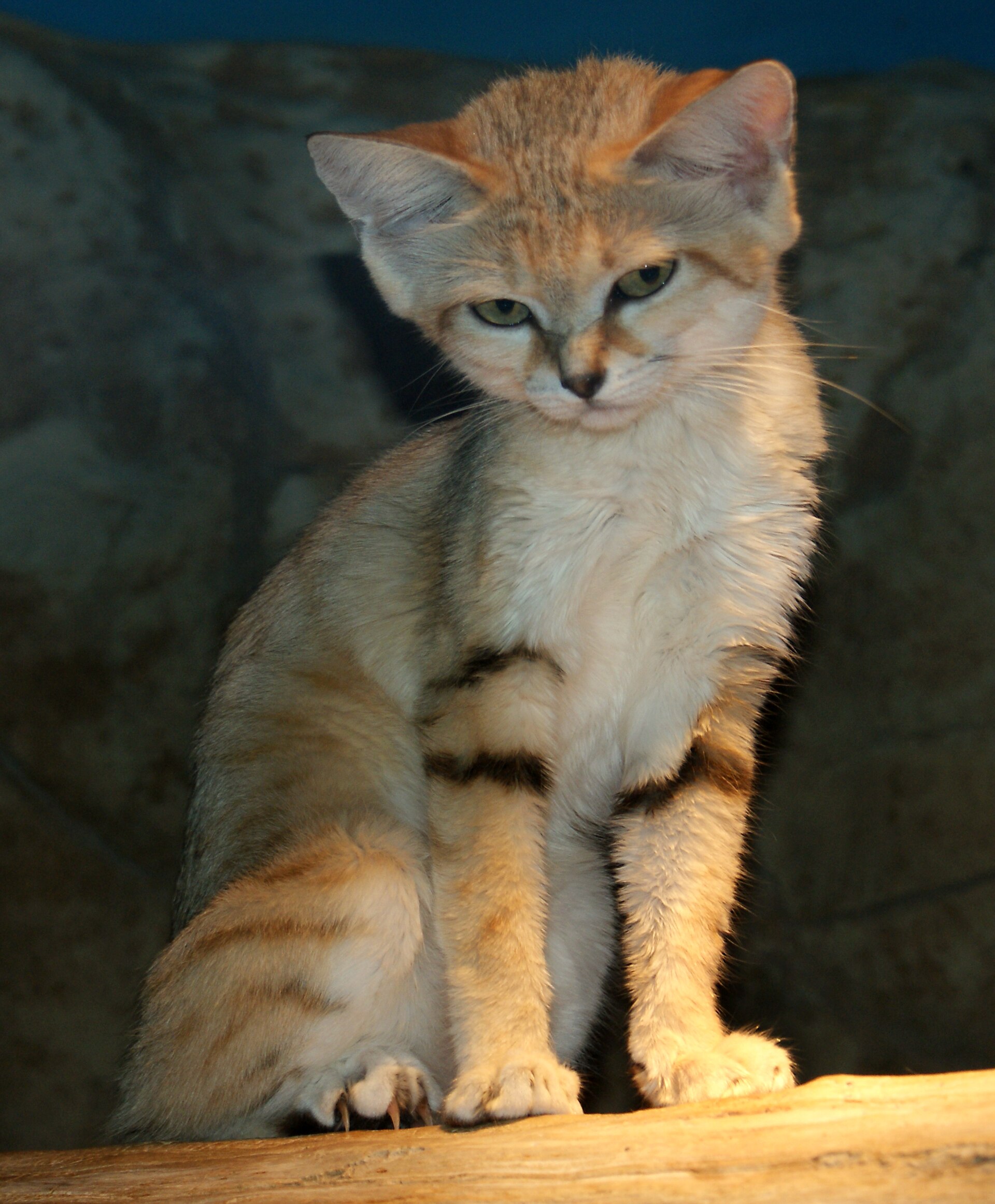
Sand Cat
Felis margarita
Characteristics
Temperament
Solitary, nocturnal, territorial. ONLY true DESERT felid in the world. FUR-COVERED PAWS (sand-heat protection + sand snowshoes + track-hiding). GIANT LOW-SET EARS (exceptional hearing, detects prey under sand). SURVIVES WITHOUT DRINKING (metabolic hydration from prey). Tolerates -5°C to +52°C. Hunts venomous snakes. "Eternal kitten" look. Closes eyes when torchlit (crypsis). IUCN Least Concern.
Diet
Desert carnivore. Desert rodents (main: gerbils, jerboas, sand mice), lizards, snakes (incl. VENOMOUS vipers), birds, insects, occasional hares. Nocturnal hunt 5-10 km/night + ultra-sensitive hearing (detects rodents UNDER sand) + rapid digging + ambush. DOES NOT DRINK: metabolic hydration from prey (highly efficient kidneys). 250-500 g prey/day. Caches surplus prey.
The Sand Cat (Felis margarita) is the ONLY true desert felid in the world — the only cat species that lives exclusively in true deserts. Endemic to the deserts of North Africa, Arabia, and Central Asia, famous for:
- ONLY TRUE DESERT CAT: the only felid adapted to live exclusively in arid sandy deserts
- FUR-COVERED PAWS: paw pads covered with dense fur that (1) protects from scorching sand, (2) distributes weight on soft sand, (3) hides tracks
- GIANT EARS: large, triangular, set low — exceptional hearing (detects prey under the sand) + thermoregulation
- SURVIVES WITHOUT DRINKING: gets all needed water from prey (metabolic hydration) — can live months without free water
- Extreme thermal tolerance: survives -5°C to +52°C
- Venomous snake hunter: kills and eats desert vipers
- "Eternal kitten" appearance: round broad face, large eyes — looks like a kitten even as adult
IUCN status: Least Concern (LC), but hard to study and census (nocturnal, shy, low densities in remote habitats). Distribution: Sahara, Arabian Peninsula, Central and southwestern Asia.
Classification and category
Order Carnivora, family Felidae, subfamily Felinae, genus Felis ("true small cats"): F. margarita (Sand Cat), F. silvestris (European Wildcat), F. lybica (African Wildcat — ancestor of domestic cat), F. catus (Domestic Cat), F. chaus (Jungle Cat), F. nigripes (Black-footed Cat), F. bieti (Chinese Mountain Cat). Several subspecies across deserts. NOT closely related to domestic cat (which descends from F. lybica). Etymology: "Felis" Latin "cat". "Margarita" honors French general Jean Auguste Margueritte (not "pearl"). Described by Loche 1858. Parameters: Weight 1.5-3.5 kg. Head-body 39-57 cm. Tail 28-35 cm (black tip). Longevity 8-10 years natural, 13-15 captive. Gestation 59-67 days. Litter 2-5 cubs.
Habitat and distribution
Only truly desert felid, in three disjunct regions: Sahara (Morocco, Algeria, Niger, Chad, Egypt, Sudan), Arabian Peninsula (Saudi Arabia, Oman, UAE, Jordan), Central/SW Asia (Iran, Pakistan, Turkmenistan, Uzbekistan). Habitats: sandy deserts (dunes — main), stony deserts (hammada), arid steppes, semi-arid zones. Prefers sparse vegetation (prey) + diggable ground (dens). Avoids hyper-arid deserts without prey, wetlands, forests, high mountains, urban. Digs dens (or uses abandoned ones) to shelter from daytime heat (up to 52°C surface), emerging at night. IUCN: Least Concern since 2016. Threats: habitat degradation, prey decline, hunting/pet trade, road accidents, traps. CITES: Appendix II.
Diet
Carnivorous predator adapted to desert scarcity. Diet: desert rodents (main — gerbils, jerboas, sand mice), lizards (geckos, agamas, skinks), snakes (incl. VENOMOUS desert vipers — Cerastes, Echis), birds (desert larks, ground birds), insects, occasional hares, eggs. Hunting: nocturnal patrol (5-10 km/night) + ultra-sensitive hearing (giant ears detect rodents UNDER the sand) + rapid digging + ambush + lightning strike. For venomous snakes: rapid head blows with paw + lethal nape bite at distance. KEY: DOES NOT DRINK — gets all water from metabolic hydration (prey moisture). Highly efficient kidneys (concentrated urine). Shared adaptation with Kangaroo Rat (in catalogue). 250-500 g prey/day.
Physical features
Distinctive "kitten-like" appearance — low stocky body, broad head, round face. Coat: sand/pale fawn/grey-beige (perfect desert camouflage), faint dark bands on legs/tail, BLACK tail tip + 2-3 dark rings, reddish cheek stripes, dense thick fur (insulates from desert cold/heat), longer winter coat. Head: BROAD FLAT head (distinctive), GIANT EARS (large triangular, set LOW on sides — exceptional hearing via expanded auditory bulla, thermoregulation, low position protects from windblown sand), large yellow-green eyes (nictitating membrane for sand), round "kitten" face, long white whiskers. Body: low stocky compact, SHORT legs with FUR-COVERED PADS (black dense fur — heat protection, "sand snowshoes", track-hiding), 28-35 cm tail. Thermal tolerance -5°C to +52°C, water conservation, exceptional hearing, excellent night vision. Distinctive "bark" vocalization in breeding season.
Behaviour and curiosities
Solitary, nocturnal, territorial. Very large territory for size (up to 16 km²). Moves 5-10 km/night. Polygamous. Female emits loud "bark" during estrus to attract males across the desert. Gestation 59-67 days. 2-5 cubs in den, grow very fast (eyes open day 14, independent 3-4 months — harsh-environment adaptation). Defense: extremely shy/cryptic, CLOSES EYES when torchlit (hides eye-shine) and freezes — nearly invisible. Predators: large raptors, owls, big snakes, jackals.
Famous: "cat that doesn't drink" — survives without free water via metabolic hydration (gerbil ~70% water), highly concentrated urine; colonizes the most arid deserts. "Furry paws": black dense pad fur — thermal protection (sand 70-80°C at noon), "sand snowshoes", hidden tracks. "Giant ears": exceptional hearing (rodents under sand) via expanded auditory bulla, thermoregulation, sand protection. "Viper hunter": hunts venomous desert snakes (paw blows + nape bite at distance). "Eternal kitten": kitten-like face even as adult (internet star, illegal pet trade target — NOT a pet!). Thermal tolerance -5°C to +52°C. "Eye-closing": closes eyes under torchlight to hide. Late discovery: first wild Sahara photo only 2015, first wild cubs filmed 2017. "Bark": dog-like call for long-distance desert communication. Longevity: 8-10 years natural, 13-15 captive.
Pros
- Unico vero felino desertico al mondo
- Adattamenti estremi (zampe pelose, idratazione metabolica)
- Udito tra i più acuti tra felini (orecchie giganti)
- IUCN Least Concern, ampia distribuzione
Cons
- Cattura illegale per pet trade (faccia 'da cucciolo')
- Difficilissimo da studiare/censire (notturno, mimetico)
- Vulnerabile a degradazione habitat e declino prede
- Riproduzione impegnativa in cattività (alta mortalità neonatale)