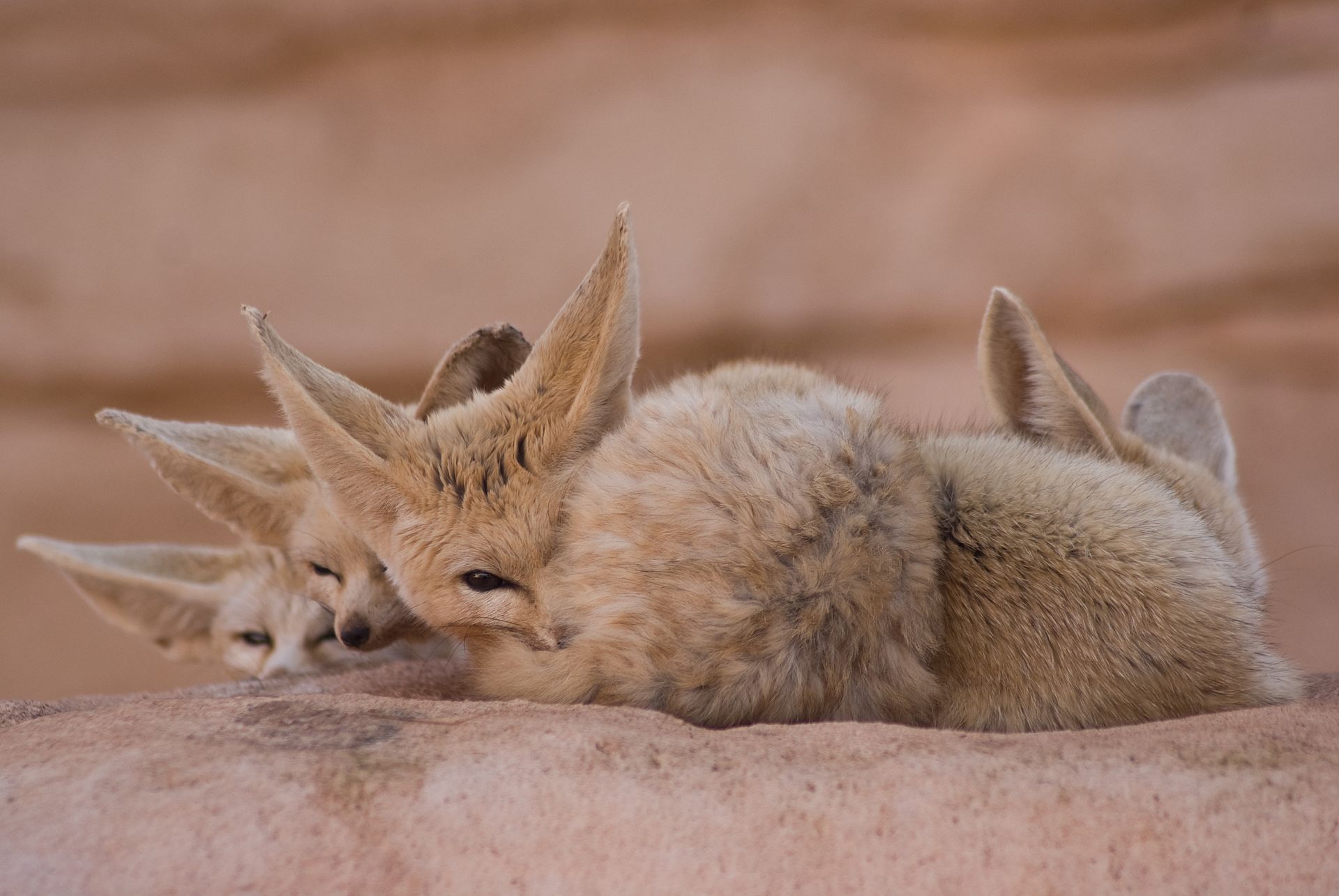
Fennec Fox
Vulpes zerda
Characteristics
Temperament
Nocturnal, social (family groups 5-10), monogamous for life. THE SMALLEST CANID in the world (0.7-1.6 kg). GIANT ears (10-15 cm = 1/3 body) — proportionally the largest among terrestrial mammals. Triple function: thermal radiator, sound amplifier, thermoregulator. NEVER drinks water. Algeria symbol "Les Fennecs". Inspired the Little Prince fox.
Diet
Opportunistic omnivore. Insects (50%), jerboas, gerbils, lizards, eggs, small birds, fruits. Hunts using ears as "radar" for underground insects. Success 60-70%. NEVER drinks water: hyper-concentrating kidneys (5× more than human), metabolic hydration + from food. 50-100 g/day.
The Fennec (Vulpes zerda), also known as desert fox or fennec fox, is the smallest canid in the world. Endemic to the deserts of North Africa (Sahara, Sahel, Sinai deserts and Arabian Peninsula), it is unmistakable for its extreme physical features: weight of only 0.7-1.6 kg, head-body length 35-40 cm, and enormous ears of 10-15 cm in height — proportionally the largest among all terrestrial mammals (1/3 of body length). The giant ears are not just an aesthetic detail but a masterpiece of evolutionary engineering: they serve as (1) thermal radiators to dissipate body heat in the 50°C of the Saharan desert, (2) sound amplifiers capable of detecting insects and rodents under 30 cm of sand, and (3) thermoregulators cooling blood before it reaches the brain. Extraordinarily adapted to the desert: NEVER drinks water, obtaining all hydration from food. Sand-cream coloured fur with black tips on the tail. Nocturnal and social (lives in family groups of 5-10 individuals), digs underground burrows up to 10 m long. IUCN status: Least Concern (LC), but illegal "exotic pet" trade and fragile habitat make it vulnerable. National symbol of Algeria: the national football team is called "Les Fennecs".
Classification and category
The Fennec belongs to the family Canidae, subfamily Caninae, tribe Vulpini (foxes), genus Vulpes. Important: fennecs are true foxes, close relatives of the Red Fox (Vulpes vulpes) but in a separate evolutionary line from the Sahara about 3-5 million years ago. Etymology: the name "fennec" derives from Arabic "فنك" (fanak), meaning "fox" or "lynx"; scientific name "zerda" from Greek "xeros" (dry), referring to its desert habitat.
The genus Vulpes comprises 12 fox species distributed in Eurasia, Africa, and North America. The Fennec is the smallest and most specialised. Close relatives:
- Vulpes vulpes — Red Fox (closest relative, already in the catalogue)
- Vulpes lagopus — Arctic Fox (Arctic)
- Vulpes rueppellii — Rüppell's Fox (Sahara, larger than fennec)
- Vulpes pallida — Pale Fox (Sahel)
The species was scientifically described by Zimmermann in 1780, with the original name "Canis zerda". More recently, some studies (Bardeleben 2005, Lindblad-Toh 2005) have suggested that the Fennec is in a genus of its own (Fennecus zerda), but the most recent classification keeps it in Vulpes.
The morphological parameters:
- Weight: 0.7-1.6 kg (M 1.2-1.6 kg, F 0.7-1.2 kg)
- Head-body length: 35-40 cm (record 47 cm)
- Tail: 18-30 cm (50-75% of body length)
- Height at withers: 18-22 cm
- Ears: 10-15 cm (record 15.2 cm — proportionally the LARGEST among living terrestrial mammals)
Longevity: 10-12 years in nature, up to 16-18 years in captivity (record 18 years). Sexual maturity: 9-12 months. Gestation: 50-52 days; litter of 2-5 cubs (record 6). The pair is monogamous for life — feature shared with most foxes and wolves.
Habitat and distribution
The Fennec is a specialist of the Saharan and North African desert. Distribution:
- Sahara: Morocco, Algeria, Tunisia, Libya, Egypt, Mauritania, Mali, Niger, Chad, Sudan — main population
- Sahel: drier zones at the Sahara's border
- Sinai Peninsula (Egypt): local population
- Arabian Peninsula: Saudi Arabia, Kuwait — fragmented population
- Israel and Jordan: small populations
Total geographical area: over 10 million km². The Fennec is one of the most extreme desert-adapted mammals:
- Temperatures: tolerates extremes from -10°C (desert nights) to +50°C (days)
- Preferred substrates: fine sand dunes, rocky deserts with sparse vegetation (acacias, annual grasses)
- Altitude: 0-1,500 m
- Underground burrows: fundamental — digs complex systems 1-2 m deep, 5-10 m long, with 2-15 multiple entrances
- Vegetation: prefers areas with sparse bushes providing shade and easy burrows
Does NOT tolerate: tropical forests, tundras, humid climates, urban environments. Estimated population: hundreds of thousands of individuals (IUCN, latest estimate 2015). IUCN status: Least Concern (LC), population apparently stable or slightly in decline.
Threats:
- Illegal "exotic pet" trade: the Fennec is one of the most desired exotic pets in the world, price $1,500-4,000 per specimen. Illegal trade from North Africa is growing
- Traditional hunting: some Saharan tribes hunt the Fennec for skin and traditional medicine
- Road accidents: in areas with roads through the Sahara
- Climate change: desert expansion and precipitation variations alter the habitat
- Introduced predators: feral cats and dogs in some areas
CITES: Appendix II (regulated). In Europe, ownership is subject to special permits. In USA and UAE it is popular as an exotic pet — generally discouraged by veterinarians (requires constant attention, is nocturnal, needs large spaces, can be destructive).
Diet
The Fennec is an opportunistic omnivore, with a diet variable according to season and availability:
- Insects (50% diet): beetles, locusts, grasshoppers, ants — hunts with smell and hearing amplified by the ears
- Small mammals: jerboas (relatives of the kangaroo rat!), gerbils, desert mice — underground hunting
- Lizards: geckos, agamas, small monitors
- Bird eggs: during the nesting season
- Small birds: sparrows, desert larks
- Wild fruits: acacia berries, cactus fruits when available
- Green leaves: as a source of hydration, from succulent plants
- Carrion: occasional, from animals dead in the desert
The hunting technique is remarkable. The Fennec uses its giant ears as "sonic radars":
- Listening: the Fennec tilts its head and rotates its ears independently to locate prey (insects, rodents digging under the sand). The ears have 20 muscles that rotate them 180°
- Triangulation: compares the arrival times of sound between the two ears to estimate depth under the sand
- Quick digging: uses powerful front legs (strong claws, robust fingers) to dig in the sand, reaching the prey in a few seconds
- Capture: quickly bites the emerging prey
An extraordinary physiological feature: the Fennec is one of the few mammals that can live without drinking water. It obtains all hydration from food (in particular insects contain 70-80% water, lizards 65-70%). Its kidneys are hyper-specialised: they produce ultra-concentrated urine (5× more concentrated than human urine, similar to kangaroo rat). Furthermore, its breathing is optimised to minimise water loss (nostrils have "counter-current" structures that recover moisture from exhaled air). Food quantity: 50-100 g/day (5-10% body weight). Foraging: 6-8 nocturnal hours. Hunting success: 60-70% (high, thanks to exceptional hearing).
Physical features
The Fennec has an optimised anatomy for survival in the desert. The most surprising features:
Giant ears (10-15 cm): proportionally the largest among terrestrial mammals. Multiple functions:
- Thermal radiator: rich network of blood capillaries; when the Fennec is hot, vessels dilate and dissipate heat (heat loss: 5-10× more efficient per gradient). When cold, vessels contract to conserve heat
- Acoustic amplifier: surface 5× larger in proportion than other foxes, captures more frequencies (10 Hz-50 kHz, beyond the ultrasound of bats and rodents)
- 3D localisation: the ears rotate 180° independently, allowing precise triangulation of prey under sand
- Visual display: ear postures communicate emotional state (up = curious, back = aggressive)
The coat is the typical desert colour: cream-sand or light amber, cream-white belly, black tail tips. Double layer: dense undercoat (insulation from cold nights -10°C) + guard hairs (reflect solar heat by day). The coat changes slightly with the seasons — lighter in summer, denser in winter.
The legs have unique adaptations:
- Foot pads covered with dense fur: unique feature among foxes — protects from scorching sand (up to 70°C) and provides grip on sandy dunes
- Strong claws, robust fingers: to dig quickly in the sand
- Speed: can reach 40 km/h in sprints
The eyes are large, dark (brown-black), with exceptional night vision (6× more sensitive than humans). The nose is black, smell is excellent. The whiskers are long, important tactile sensors in total darkness.
The sexual dimorphism is minimal: males 25-30% larger than females. Cubs at birth weigh 50-70 g (microscopic!), are blind and naked; in 10-12 days they open their eyes, in 4-5 weeks they leave the burrow.
Behaviour and curiosities
The Fennec is a nocturnal, social, monogamous animal. Social: lives in small family groups of 5-10 individuals (rare among foxes that are usually solitary). A group includes the dominant pair (male and female, monogamous for life), the cubs of the current year, and sometimes juveniles from the previous year who help care for new cubs ("helper" behaviour). Burrows: the pair digs a main underground burrow (depth 1-2 m, length 5-10 m, 2-15 entrances, with multiple chambers: nesting room, pantry, "living room"). Burrows are found under bushes or among rocks.
The territorial behaviour: adult males defend a territory of 3-8 km², couples partially overlap. Territorial marking: urine on bushes, secretions from the supracaudal gland, scratches in the sand. Vocalisation: the Fennec is the most "talkative" among foxes. Distinctive sounds:
- "Yip": short, high — greeting between family members
- "Bark": repeated barking — alarm
- "Wail": prolonged lament — courtship
- "Purr": low vibration — satisfaction
- "Chatter": chatter — family communication
More than 20 distinctive vocalisations documented — one of the most "vocal" canids.
Reproduction: season January-February (austral winter). After mating, gestation 50-52 days, birth in spring (March-April). The female gives birth to 2-5 cubs (record 6) in the underground burrow. Unique feature: during gestation and the first 30 days of cub life, the male brings food to the female (she does not leave the burrow for 1 month). Parental care: both parents, and sometimes "helpers" (juveniles from the previous year). The cubs leave the burrow at 4-5 weeks, independent at 3 months, sexually mature at 9-12 months.
Famous curiosities: the Fennec as a national symbol. The Fennec is considered a cultural and national symbol of Algeria: the Algerian national football team is called "Les Fennecs" since the 1960s. They won the Africa Cup in 1990 and 2019. Furthermore, the Fennec appears:
- On the 5 Algerian dinars coin
- On stamps of Algeria, Tunisia, Morocco
- In the Telecom Algeria logo
- As an official mascot of the 2010 World Cup in South Africa for the Algerian team
"The Little Prince" curiosity: the Fennec inspired the fox of "Le Petit Prince" by Antoine de Saint-Exupéry (1943) — in the book, the fox says: "tu deviens responsable pour toujours de ce que tu as apprivoisé" ("You are forever responsible for what you have tamed"). Saint-Exupéry wrote the book in Tunisia, where fennecs were common; many subsequent illustrators depict the fox as a Fennec. The phrase is quoted by millions of readers of The Little Prince.
"Smallest canid" curiosity: the Fennec is the smallest canid in the world. For comparison:
- Fennec: 1-1.5 kg
- Red Fox: 4-7 kg (4-7× larger)
- Wolf: 30-50 kg (30-50×!)
- Jackal: 8-15 kg
- Cane Corso: 40-50 kg
Extraordinary hearing curiosity: the Fennec has the most sensitive hearing among canids. Can detect an insect walking on sand from 10+ metres away. Studies on the fennec's ear have influenced the design of modern high-sensitivity acoustic devices. "Social" burrows curiosity: fennec burrows are often "shared" by different families — a rare case of sociality among foxes (most are solitary). The burrows often have "common rooms" where adults meet. Cubs curiosity: fennec cubs are the most "cute" in the animal kingdom according to popular opinion — they have disproportionately large ears even as newborns, and an adorable expression. They are frequently protagonists of viral videos. Furry foot pads curiosity: the Fennec is the only canid with foot pads completely covered in dense fur. Function: (1) protection from scorching sand (50-70°C), (2) noise damping during hunting, (3) improved grip on dunes. Exotic trade curiosity: the Fennec is one of the most desired exotic pets. In the USA, some states allow it ($1,500-4,000); in others it is illegal. It is discouraged as a pet: nocturnal, vocal (noisy), territorial (marks with urine), requires special diet, can live 16+ years in captivity. "Fennec without water" curiosity: experimental studies have shown that an adult Fennec can live 6+ months without drinking water, obtaining all hydration from food. Hyper-concentrating kidneys produce urine of 5,000 mOsm/L (vs 1,200 in humans). Digging speed curiosity: the Fennec can dig up to 1 metre in a few seconds to catch a jerboa or escape a predator. The front legs are like "biological drills". "Fennec dance" curiosity: during courtship, the male performs a bizarre ballet: vertical jumps, rapid turns, high-pitched vocalisations — behaviour well documented in captivity but rarely observed in nature. Genetics curiosity: the Fennec genome was sequenced in 2014, showing specific genes for thermoregulation, water conservation, and developed hearing — key adaptations to desert life. "Eustachian tube" ears curiosity: in addition to thermoregulation, the giant ears have specialised Eustachian tubes to balance pressure during rapid altitude changes (jumping from high dunes).
Pros
- Il canide più piccolo al mondo (0,7-1,6 kg) — unicum biologico
- Orecchie giganti proporzionalmente le più grandi tra mammiferi terrestri
- Adattamento estremo al deserto: vive senza mai bere acqua
- Simbolo nazionale Algeria, ispirò Piccolo Principe
Cons
- Commercio illegale come 'exotic pet' (CITES Appendice II)
- Vulnerabile al cambiamento climatico (espansione deserto)
- Sconsigliato come animale domestico (notturno, territoriale, vocale)
- Declini in alcune zone per perdita habitat e caccia tradizionale