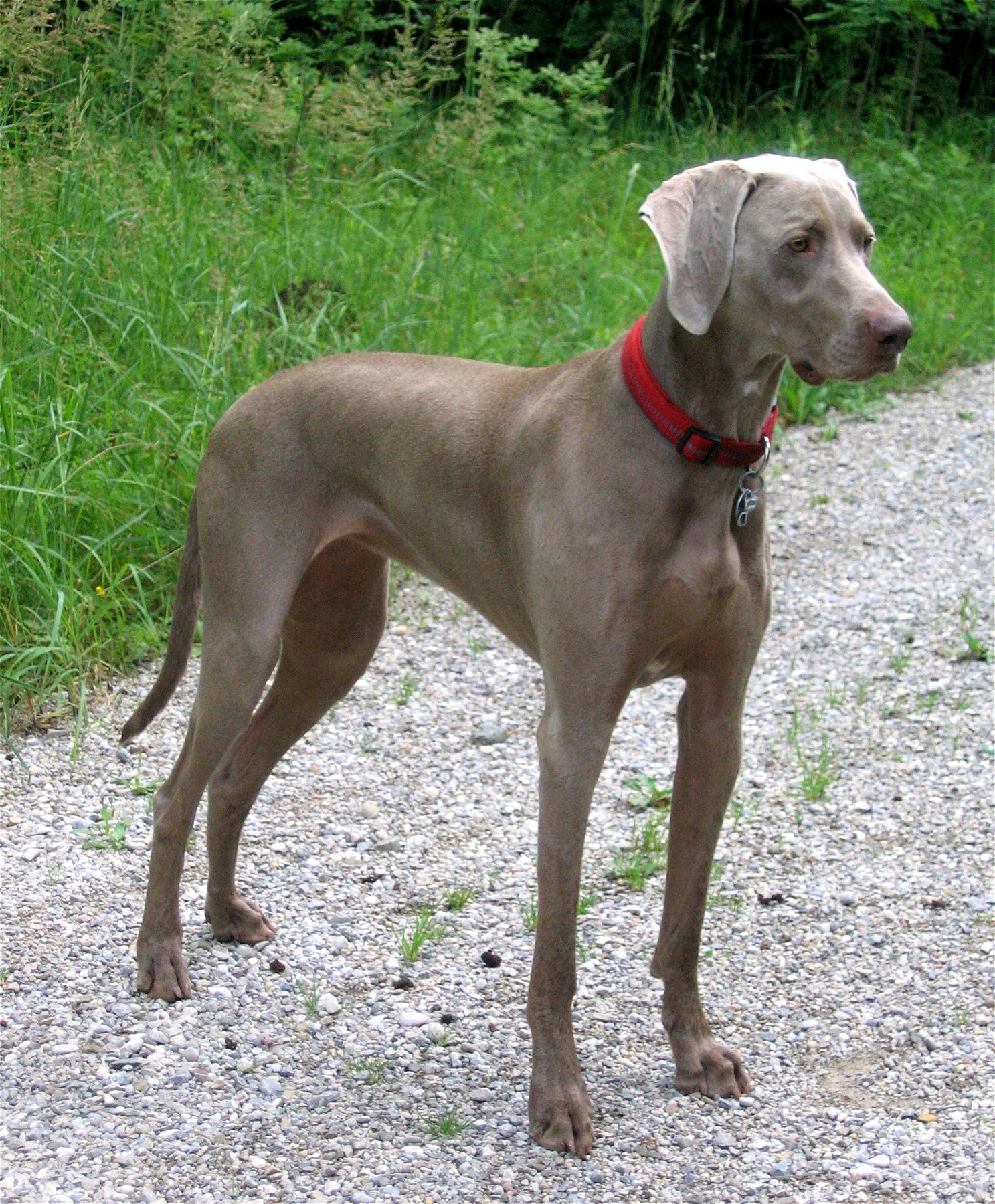
Weimaraner
Characteristics
Temperament
A pointing dog that is energetic, intelligent, brave and strongly bonded to its owner. It is affectionate, sensitive and eager to be always with its family, to the point of being called a "velcro dog": for this it suffers greatly from loneliness and can develop separation anxiety if left alone for long. It retains a strong hunting instinct and a great need for "work", exercise and mental stimulation. It is NOT a couch dog nor for sedentary owners: it does best with active, present people, able to offer it exercise, company and consistent, patient guidance.
Diet
A large, athletic, very active dog, it requires a complete, balanced diet for active large-breed dogs, with an adequate energy and protein supply to support musculature and stamina. In the puppy, controlled growth without excess is preferred. Being deep-chested, it is particularly exposed to the risk of gastric dilatation/torsion: it is prudent to split the ration into several meals and avoid intense exercise just before and after meals. It should be kept lean and muscular, never overweight, with always-fresh water and a diet balanced against the high energy expenditure.
The Weimaraner is one of the most elegant and recognizable hunting dogs in the world: an athletic German pointing dog wrapped in a splendid silvery-grey coat that seems almost luminous. Famous for:
- The silvery-grey coat: from mouse-grey to silver-grey, a unique livery that earns it the name "grey ghost"
- The penetrating eyes: amber or blue-grey, with an intense gaze
- Athletic elegance: a slender, muscular body, of a tireless working dog
- The extreme bond with humans: it is a "velcro dog", always wanting to be with its family
- Inexhaustible energy: it needs a great deal of exercise and mental stimulation
- Hunting versatility: it hunts, points and retrieves, on fur and feather
It enters the portal as the first pointing dog, inaugurating the category of pointing dogs (the hunting dogs that locate game and freeze in a "point" to signal it to the hunter): a group until now not represented among the portal's many breeds.
Classification and category
The Weimaraner is a Canis lupus familiaris, a German breed of (continental) pointing dog, developed from the 19th century, tied to the court of Weimar. In the portal it opens the new category of pointing dogs, the hunting dogs specialized in locating prey and "pointing" it motionless, awaiting the hunter. It is useful to tell it apart from other hunting dogs and similarly coloured dogs: the "Weimar pointer" is simply the alternative name of the Weimaraner itself; the Hungarian Vizsla — another elegant single-coloured pointing dog, but of a warm rust-gold colour, not grey; other pointers and setters — pointing dogs of different colours and types (often patched), without the characteristic silvery coat; the sighthounds (such as the Afghan, in the portal) — running dogs of an entirely different function, though sometimes as slender as the Weimaraner. Etymology: the name comes from the city of Weimar, in Germany, at whose court the breed was selected and prized; the nickname "grey ghost" celebrates its unique coat and its silent, fluid way of moving. Parameters: Height at the withers roughly 59-70 cm (males taller). Weight roughly 25-40 kg. Build large, slender, muscular and harmonious, athletic. Longevity: on average 10-13 years. There are two coat varieties: short-haired (by far the most common) and the rarer long-haired. Reproduction: the puppies are often born with darker shades and blue eyes, which shift as they grow.
Habitat and distribution
The Weimaraner is a domestic breed: its "habitat" is life beside people, as a hunting, working and companion dog. Some notes on origin and spread: origin Germany (the Weimar region), where it was selected as a versatile hunting dog, first on big game and then on fur and feather; current spread worldwide as a hunting dog and, increasingly, as an elegant sporting and companion dog for active people. The ideal environment for this dog: space and plenty of exercise (running, long walks, dog sports; it adapts poorly to a sedentary life); mental stimulation (training, search work and "jobs" to occupy its brilliant mind); and constant closeness to the family (it wants to live in close contact with its people and suffers greatly from loneliness). Bred as a versatile hunting dog, the Weimaraner retains a strong hunting instinct, great stamina and a very strong bond with its handler. This heritage translates, in everyday life too, into a dog that needs a "job" and guidance, doing its best with active, present owners. Status: a well-established domestic breed; there are no conservation issues, but it is essential to choose serious breeders and, above all, to assess honestly whether one can meet its high needs for exercise and company.
Diet
The Weimaraner is a large, athletic, very active dog, and its feeding must be calibrated accordingly. In general: a complete, balanced diet for active large-breed dogs, suited to age, weight and intense activity level; the right energy and protein supply, to support musculature and stamina; and controlled puppy growth (as with all large dogs, avoiding too rapid growth that overloads bones and joints). Important practical tips: attention to gastric torsion (being a large, deep-chested dog, it is prudent to split the ration into several meals and avoid intense exercise just before and after eating — risk of stomach dilatation/torsion); keep ideal weight (a Weimaraner must stay lean and muscular, never heavy); and always-fresh water and a regular diet, in balance with the high energy expenditure. Crucially, for such an athletic dog, diet and exercise must be thought of together. The precautions against gastric torsion are particularly important in this deep-chested breed.
Physical features
A large, elegant, high-impact dog, made unmistakable by its colour. The coat — the distinguishing trait: a silvery-grey colour, from mouse-grey to silver-grey, often with paler shades on the head and ears; short, dense and smooth hair in the most common variety; there is also a long-haired variety; a "luminous", almost metallic appearance, hence the "grey ghost" nickname. The eyes and head: amber or blue-grey eyes, with an intense, penetrating gaze (blue in puppies); a noble head with long, pendulous, well-carried ears. The structure: a slender, muscular and harmonious body, of a hardy athlete; a fluid, elastic, highly efficient gait; and low-to-moderate shedding (in the short-haired variety), with relatively simple coat care.
Character, curiosities and care
The Weimaraner is famous for being an intelligent, energetic, brave dog with a very strong bond to its owner. It is affectionate, sensitive and eager to be always in its people's company, to the point of being nicknamed a "velcro dog". This very need for closeness makes it a wonderful companion for those who can devote time to it, but also a dog that suffers deeply from loneliness.
The "grey ghost": the nickname celebrates at once the Weimaraner's unique colour and its fluid, silent way of moving; few dogs have such a distinctive and immediately recognizable livery, which has made it a much-loved subject of photographers and artists too. The big-game hunter: originally the Weimaraner was not a mere bird dog; it was selected as a versatile, brave hunting dog, used on big game too (boar, deer and, by tradition, even large predators); only later did it establish itself mainly as a pointer-retriever on fur and feather; this heritage explains its boldness and grit. The "velcro dog": the Weimaraner is famous for its almost absolute attachment to its human; it wants to take part in every family activity and follow its owner everywhere; the downside is a tendency to separation anxiety: left alone too long or under-stimulated, it can become destructive, noisy and unhappy; it is a dog that demands presence. The changing eyes: Weimaraner puppies are born with a darker-shaded coat and striking blue eyes; as they grow the eye colour often shifts towards the amber or blue-grey of adults, while the coat takes on the characteristic silvery tone. The photography icon: thanks to its scenic appearance, the Weimaraner has become a real star of the visual imagination, the protagonist of famous photographic series and of advertising; its grey coat and expressive gaze make it one of the most "photogenic" and recognizable dogs. Practical care: the Weimaraner needs a great deal of physical exercise (running, sport, long outings), mental engagement (training, search, activities), constant company and consistent, patient guidance. It is not suited to those seeking a quiet dog or who are often away from home. To those who can offer it an active, stimulating existence, however, it returns total devotion and an enthusiastic, tireless companionship.
Pros
- Cane di straordinaria eleganza, dal manto argenteo unico e dallo sguardo intenso
- Intelligente, versatile e molto addestrabile: eccellente cane sportivo e da lavoro
- Devotissimo e affettuoso, fortemente legato alla famiglia
- Pelo corto (varietà più comune): cure del mantello semplici
Cons
- Energia altissima: NON adatto a chi cerca un cane tranquillo o è spesso fuori casa
- Forte ansia da separazione: soffre molto la solitudine
- Forte istinto venatorio e bisogno di guida: richiede esperienza e impegno
- Cane grande e a torace profondo: attenzione al rischio di torsione gastrica