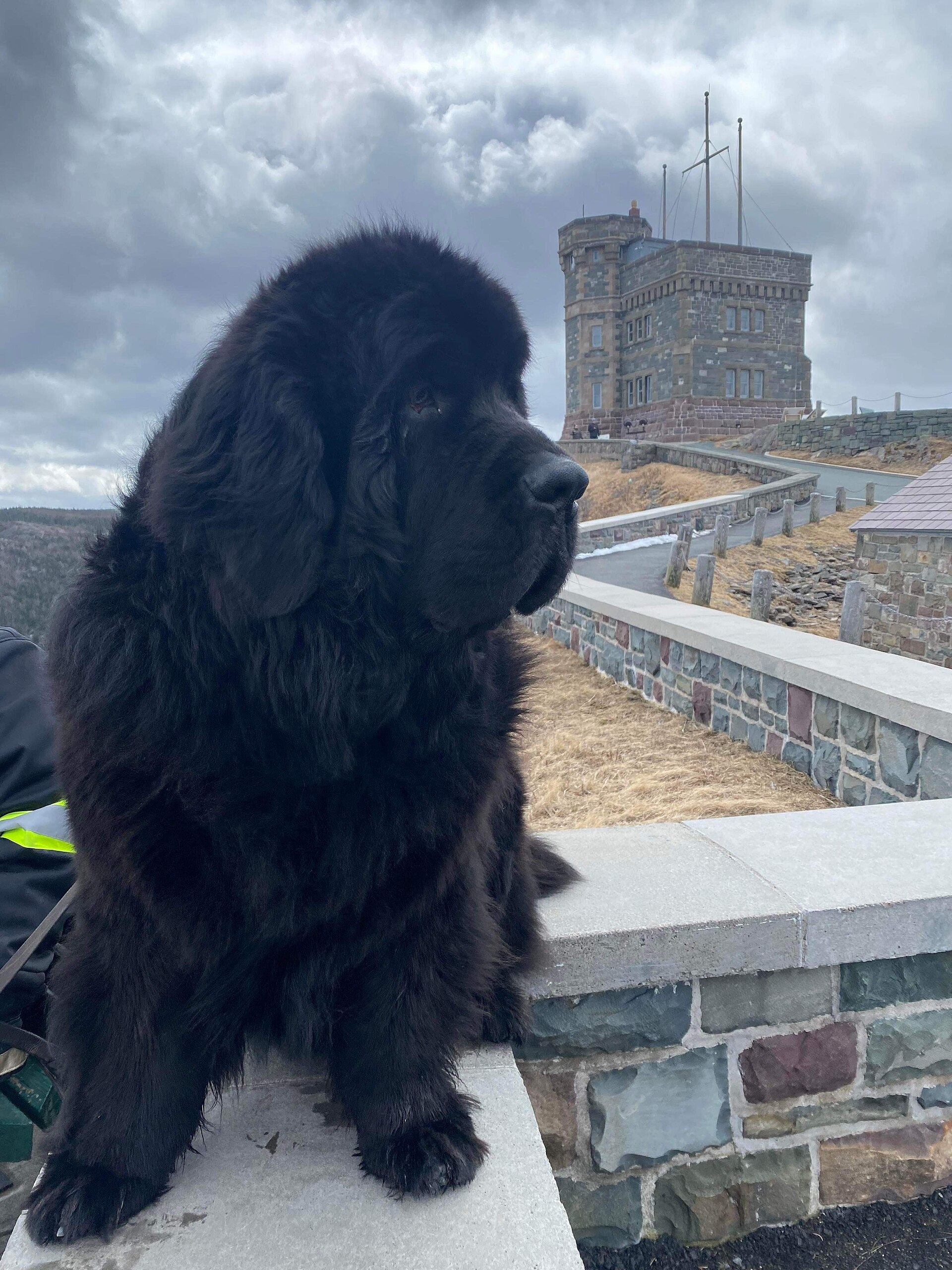
Newfoundland
Canis lupus familiaris
Characteristics
Temperament
The quintessential "gentle giant": sweet, calm, patient and deeply devoted, with an extraordinary aptitude for relationships with children, hence its reputation as a "nanny dog". Despite its imposing size and great strength, it is balanced, tolerant and rarely aggressive. It is intelligent and eager to cooperate, and has an innate water-rescue instinct: it dives in without hesitation to save those in difficulty. It loves to swim and is happy when it can be with its family, to which it is deeply attached. It suffers from heat and copes poorly with isolation. It requires space, moderate exercise (swimming is ideal), regular grooming and attentive care, given the relatively short life typical of giants.
Diet
A giant-sized domestic carnivore: the diet must be based on quality animal proteins (meat) to support the great muscle mass, with a careful balance of calcium and phosphorus especially in puppies, for correct bone development and avoiding too rapid growth (which favours dysplasia and joint problems). As in other deep-chested giant dogs, managing the gastric-torsion risk is crucial: split food into several meals and avoid intense effort on a full stomach. Foods formulated for large/giant sizes are used, calibrated to age and growth, avoiding overweight. Fresh water always available and a diet followed with the vet.
The Newfoundland is one of the largest, strongest and gentlest dogs in existence: a good giant, inseparably tied to water and rescue. Native to the island of Newfoundland, in Canada, it is famous for:
- Water rescue: it is the lifeguard dog par excellence, with an innate instinct to save those in difficulty
- The webbed feet: toes joined by membranes make it an exceptional swimmer
- The water-resistant coat: thick and double-layered, it protects it in cold water
- The giant size: massive and powerful, it can exceed 60 kg
- The "gentle giant": sweet, calm, patient and devoted, excellent with children
- The working strength: bred to help fishermen haul nets and tow loads
It enters the portal among the working dogs, alongside the Bernese Mountain Dog and the Dalmatian: with them it enriches the group of breeds selected for practical tasks alongside humans, of which the Newfoundland is the great water specialist.
Classification and category
The Newfoundland is a breed dog (Canis lupus familiaris), a large working dog of the mountain/water type. In the portal it is placed among the working dogs, the category of breeds selected to perform practical tasks (hauling, rescue, guarding, lifesaving). It is useful to tell it apart from other large dogs with which it can be confused: the St. Bernard — also giant, but tied to Alpine rescue, with a shorter, white-and-red coat; the Newfoundland is instead the rescuer of the water, with a black (or other-coloured) water-resistant coat; the Bernese Mountain Dog — also a large mountain working dog, but smaller and tricolour (black-white-brown); the Newfoundland is recognized by its imposing size, thick water-resistant coat, webbed feet and "teddy bear" gentle-giant look. The combination of giant size + water-resistant coat + webbed feet + aptitude for swimming and rescue is the Newfoundland's "identity card". Etymology: the name comes directly from the island of Newfoundland, in Canada, where the breed developed in the service of fishermen. Parameters: Height at the withers about 66-71 cm (males), a little less for females. Weight usually about 50-68 kg, with males able to exceed that. Appearance a giant, massive, powerful dog with heavy bone. Longevity: unfortunately relatively short, as for many giant breeds: on average about 8-10 years. Health: because of its size it is predisposed to joint problems (dysplasia), heart problems and, due to its deep chest, to gastric torsion; it requires controlled growth as a puppy.
Origin and ideal environment
The Newfoundland is not a wild animal, but a domestic breed with a history deeply tied to the sea: its origin is the island of Newfoundland (Atlantic Canada), where it was selected as a fishermen's dog; its historical use was helping to haul nets, retrieve objects and fish fallen into the water, tow loads and boats, and save people at sea; today it is a beloved companion and family dog, still used in water-rescue dog units. Its ideal "habitat" reflects its nature as a calm aquatic giant: adequate space and a cool climate (given its size and heavy coat, it suffers from heat and needs space); water (it loves to swim, and is happy if it can; swimming is also excellent low-impact exercise for its joints); and the family (it is a dog deeply tied to people, that wants to live alongside them and not in isolation). The Newfoundland has an exceptionally sweet, calm and patient temperament. Its reputation as a "nanny" and reliable giant is well-earned: it is tolerant, balanced and protective, and rarely aggressive. It is a dog that combines remarkable strength with extraordinary gentleness, loved and widespread worldwide as a family companion and tireless rescuer.
Diet
The Newfoundland is a giant-sized domestic carnivore, and its diet requires particular care, especially during growth: quality animal proteins (meat as the basis, to support the great muscle mass); a balance of calcium and phosphorus (crucial in giant puppies for correct bone development); and slow, controlled growth (in puppies, too rapid growth, which favours joint problems, is avoided). Key practical guidance: split meals and attention to gastric torsion (as in other deep-chested giant dogs, it is prudent to split food and avoid intense effort on a full stomach); food for giant sizes (foods formulated for large dogs, calibrated to age and growth stage); and weight control (avoiding overweight, which would further strain joints and heart). As with every dog, fresh water always available and a diet followed with the vet, particularly important for such a large and only partly long-lived breed.
Physical features
The Newfoundland is a dog of powerful, reassuring appearance, built for strength and for water. The aquatic adaptations — the distinguishing trait: webbed feet (toes joined by membranes make it a powerful swimmer); a double-layered, water-resistant coat (it retains heat and repels water, protecting it in the cold); a sturdy tail, used as a rudder in water. The size and structure: a giant, massive body, heavy-boned and very strong; a broad head with a sweet, mild expression. The coat and colours: long, thick, soft hair; colours most often black, but also brown, grey and the black-and-white called "Landseer".
Curiosities and behaviour
The Newfoundland is one of the most loved and celebrated breeds for its gentle heroism: a giant that has saved countless lives and embodies the very idea of the faithful, altruistic dog.
The lifeguard dog: the Newfoundland is the water-rescue dog par excellence; thanks to its strength, water-resistant coat, webbed feet and an innate instinct, it can tow a person in difficulty to shore or even a small boat; it is still trained and used in water-rescue dog units today, and dives into the water without hesitation to rescue those in danger. The swimmer with the special style: unlike most dogs, which "doggy-paddle", the Newfoundland uses a wider, more powerful stroke, almost a kind of breaststroke, that lets it move in water with great efficiency and tow considerable weights; the webbed feet complete this champion-swimmer adaptation. The gentle giant and "nanny": the Newfoundland is famous for its sweetness and patience, so much so that it has earned the reputation of a "nanny dog", reliable and protective with children; it is no coincidence that in the story of Peter Pan, the family dog "Nana" is often depicted as a Newfoundland: the image of the good giant watching over the little ones. The heroic dogs of history: numerous Newfoundlands have entered history and legend for rescue feats; the breed has always been associated with courage and devotion; even the famous poet Lord Byron deeply loved his Newfoundland, Boatswain, to whom he dedicated a moving epitaph: testimony of the special bond these dogs create. The "Landseer": the black-and-white variety of the Newfoundland is called "Landseer", after the painter Edwin Landseer, who portrayed it in famous paintings of rescue dogs; in some countries the Landseer is considered a separate breed, but it remains closely related to the classic Newfoundland. Behaviour and responsible care: the Newfoundland is a wonderful but demanding companion; its size entails important costs and responsibilities: it needs space, suffers from heat, sheds a lot and requires regular grooming, as well as careful veterinary checks for the typical giant-breed predispositions (joints, heart) and management of the gastric-torsion risk; in return it offers absolute devotion and unmatched gentleness; those who choose a Newfoundland welcome not just a dog, but a tireless, affectionate guardian of the family.
Pros
- Cane da soccorso in acqua per eccellenza, con istinto salvavita innato
- Temperamento dolcissimo, calmo e paziente: il vero 'gigante gentile'
- Ottimo cane di famiglia, affidabile e protettivo con i bambini
- Intelligente e desideroso di collaborare, ottimo nuotatore
Cons
- Vita relativamente breve (~8-10 anni), tipica delle razze giganti
- Predisposto a displasie, problemi cardiaci e torsione gastrica
- Soffre il caldo; perde molto pelo e richiede toelettatura regolare
- La mole comporta spazio, costi elevati e tanta bava