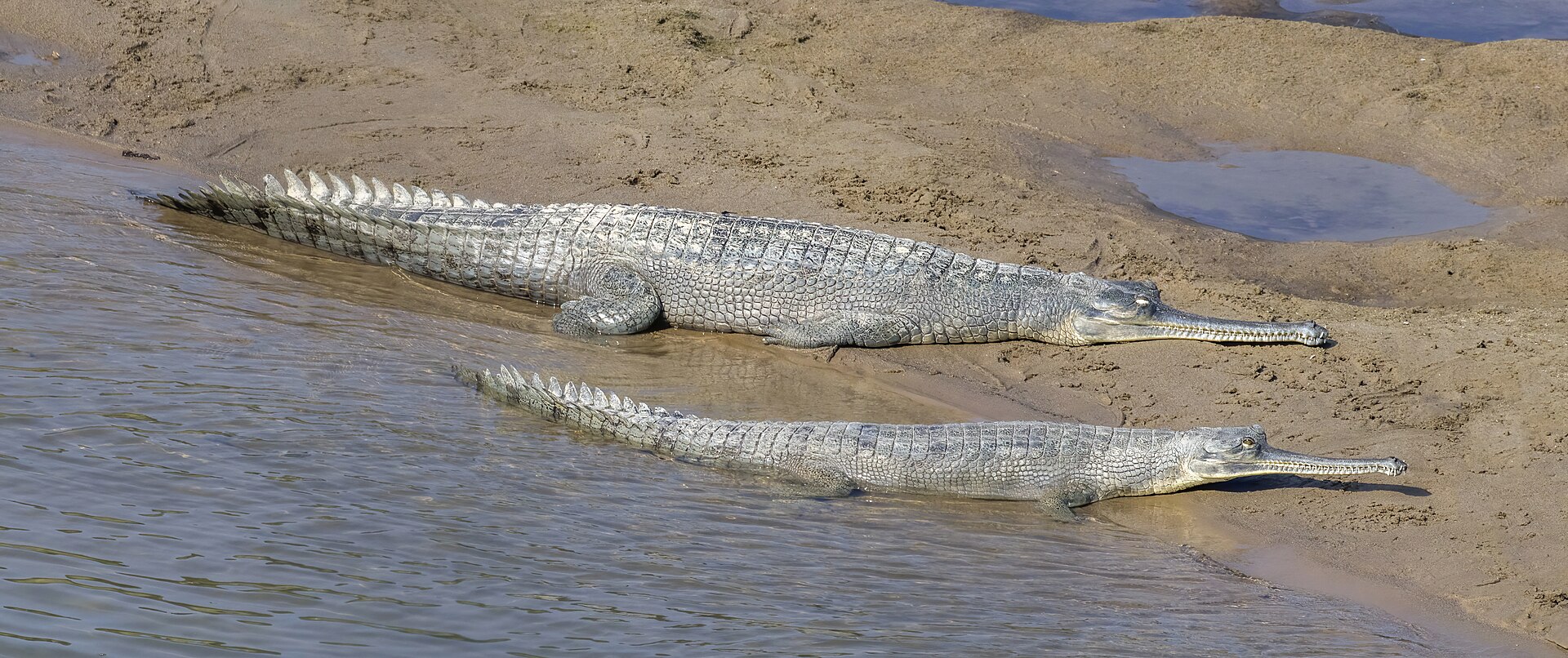
Gharial
Gavialis gangeticus
Characteristics
Temperament
Aquatic, solitary, social only in breeding season. IUCN Critically Endangered (650 mature). Extremely narrow snout unique among crocodilians. Adult males have "ghara" (unique cartilaginous acoustic resonator). 110+ teeth (max crocodilians). Does NOT attack humans. Sacred in Hinduism (mount of goddess Ganga). Exclusive piscivorous predator.
Diet
EXCLUSIVE piscivore (95-99% diet). Rapid lateral hunting with narrow hydrodynamic snout (60 km/h on snout). 110+ sharp teeth "fork" fish. Target species: catla, rohu, mrigal of the Ganges. 2-3 kg fish/day. No free water nearby. Top-of-food-chain predator of Indian rivers.
The Gharial (Gavialis gangeticus), or simply "gharial", is one of the most distinctive and critically endangered crocodilians in the world. Endemic to the large rivers of the Indian subcontinent (Ganges, Yamuna, Chambal, Mahanadi, Brahmaputra), it is unmistakable for its very long and narrow snout armed with over 110 sharp teeth (the highest number among living crocodilians). Its morphology is so unique that it is classified in its own family, Gavialidae, separated from crocodiles and alligators by over 40 million years. Imposing measurements: length 4-5 m for adult males (record 6.5 m), weight 160-250 kg. Unique feature of adult males: a "ghara" — cartilaginous bulb on the tip of the snout (from which the name "gharial" derives) — which serves as an acoustic resonator for territorial calls. The gharial is an exclusive piscivorous predator: its narrow snout is perfect for fishing but unable to catch large mammalian prey. Sacred in Hindu mythology, it is the mount of the goddess Ganga, the deity of the sacred river. IUCN status: Critically Endangered (CR) — global population estimated at only 650 mature individuals, decline of 96-98% since the 1940s. Active reintroduction programmes are saving the species from extinction.
Classification and category
The Gharial belongs to the order Crocodilia, family Gavialidae — a family distinct from those of crocodiles (Crocodylidae) and alligators (Alligatoridae). Gharials separated from the common ancestors of crocodiles about 40-45 million years ago in the Eocene. The Gavialidae family today comprises only 2 living species:
- Gavialis gangeticus — Gharial (subject of this entry)
- Tomistoma schlegelii — False Gharial (Sumatra, Borneo) — recently reclassified in Gavialidae based on DNA analyses
Etymology: the name Gavialis derives from Sanskrit "घड़ियाल" (ghaḍiyāla), which indicates the ancient Indian cup clocks — reference to the "ghara" on the snouts of adult males, which resembles a small inverted cup. The species was scientifically described by Gmelin in 1789. The first scientific name was "Lacerta gangetica" — subsequently transferred to the genus Gavialis.
The morphological parameters:
- Length: males 4-5 m average (record 6.55 m, Bengal, 1924); females 3-3.5 m
- Weight: males 160-250 kg (record 977 kg); females 100-150 kg
- Snout: 50-60 cm, width 6-10 cm (snout width/length ratio 0.15-0.18 — the narrowest of any living crocodilian)
- Teeth: 27-29 in the upper jaw and 25-26 in the lower = over 110 total! The highest number of teeth among crocodilians
- Tail: 2-3 m (50% body length), powerful for swimming
Longevity: 40-60 years in nature, over 80 years in captivity (record gharial "Caesar" at the Berlin Zoo, 87 years when it died in 1994). Sexual maturity: males at 13 years, females at 7-10 years (unusually late). Reproduction: February-March; females lay 30-50 eggs in nests dug in river sands, incubation 65-80 days.
Habitat and distribution
The Gharial is strictly aquatic and lives exclusively in the large rivers of the Indian sub-continent. Ideal habitat:
- Fast-flowing rivers with clear waters
- Sand banks: essential for nesting and thermoregulation (the gharial has weak legs and does not walk well on land)
- Deep waters (3-15 m) with submerged vegetation for fishing
- Optimal temperature: 22-32°C
- Freshwater: does NOT tolerate salinity (unlike the saltwater crocodile)
The gharial is the most river-specialised crocodilian: it spends 95% of its life in water, leaving only to thermoregulate or nest. Short and weak legs make terrestrial locomotion difficult — unlike alligators and crocodiles, it CANNOT "high walk" or gallop on land.
Historical distribution (19th-20th century): all large rivers from Pakistan to India to Nepal to Bangladesh to Myanmar, population estimated at 5,000-10,000 individuals. Current distribution: drastically reduced. Populations survive in:
- India: Chambal River (National Chambal Sanctuary — largest population, ~450 adults), Girwa River (200), Gandak River, Kosi, Mahanadi, Ramganga
- Nepal: Narayani River (Chitwan), Karnali — population ~100 adults
- Bangladesh: functionally extinct (last specimen 2009)
- Pakistan: extinct (last specimen 1981)
- Bhutan, Myanmar: extinct
Global population: only 650 mature individuals (IUCN 2017), decline of 96-98% since 1940. IUCN status: Critically Endangered (CR) — the highest class before extinction. CITES: Appendix I. Causes of decline:
- Hunting for "musk": the male "ghara" and other body parts were used in traditional Indian medicine — massive distribution of skins/parts in the 1940s-1960s
- Hunting for skin: gharial skin was valued for leather goods until the CITES ban in 1975
- Bycatch fishing: caught in fishing nets, often killed by fishermen in retaliation (although they do not eat large fish)
- Dam construction: alteration of river flows, loss of sandbanks for nesting, habitat fragmentation
- Sand mining: river mining industry destroys egg-laying sites
- Pollution: pesticides and industrial contaminants decimate fish populations (gharial food)
- Reduction of fish populations: excessive human fishing causes famine
Conservation: the "Gharial Conservation Project" (India + IUCN) active since 1975 has contributed to an increase from 100 to 650 individuals. Strategies: legal protection, eradication of illegal fishing, "Eyed Egg Conservation" programmes (eggs collected from the wild, incubated, released as juveniles at 1 year). Notable success in the National Chambal Sanctuary (India, Madhya Pradesh) — protected area along 600 km of the river. The population is growing slowly by 3-5% per year.
Diet
The Gharial is an exclusive piscivore — one of the rare crocodilians strictly specialised in fishing. Its diet:
- Fish: 95-99% of diet — main prey
- Target species: catla, rohu, mrigal, gangetic carp, sole, gulf (common river fish)
- Crustaceans: freshwater shrimp (occasional)
- Aquatic turtles: rare (turtles are too large for the narrow snout)
- Water birds: occasionally, mainly small ones
- Mammals: not able to catch them (except small ones) — the narrow jaw cannot close on large mammalian prey
The hunting technique is unique. The gharial has developed a highly specialised anatomy for fishing:
- Approach: the gharial remains motionless in shallow water, only the eyes and nostrils emerging
- Detection: uses excellent underwater vision, and probably mechanoreceptor sensors on the snout (DPR organs — Integumentary Sense Organs) to detect vibrations in water
- Attack: the strike is lateral and lightning fast — the gharial rotates the head with a fast 'sweep' movement (60 km/h on the snout), sweeping the water like a scythe
- Capture: the long sharp teeth pierce the fish like a fork — the narrow snout allows it to move quickly in water with minimal resistance
- Ingestion: the gharial raises its head out of the water, positions the fish in its jaws and swallows it whole or in pieces
The only other crocodilian with a similar (though shorter) snout is the false gharial (Tomistoma) — also piscivorous. All other crocodilians have wide snouts suitable for catching prey of various sizes. Quantity: an adult gharial eats 2-3 kg of fish per day, over 1 ton of fish per year.
Ecological peculiarity: the gharial is a specific "top-of-food-chain" predator. Its disappearance from Indian rivers has caused ecological imbalances: uncontrolled increase in small fish populations, which in turn have declined algae and zooplankton populations. The reintroduction of the gharial helps to restore the fish balance of Indian rivers.
Physical features
The Gharial has an unmistakable morphology among crocodilians. The body is long, slender, perfectly hydrodynamic:
- Body: cylindrical, slender, length 4-5 m (M)
- Tail: 2-3 m, robust, laterally compressed for efficient swimming propulsion
- Legs: short, weak — adapted to aquatic life, not optimal for walking
- Skin: thick, covered with shields (osteoderms) of dark green-grey colour on the back, yellow on the belly
The snout is the most distinctive and diagnostic feature of the gharial:
- Length: 50-60 cm (3.5× the snout width, the highest ratio among crocodilians)
- Average width: 6-10 cm (15-18% of the head width)
- Shape: straight, parallel, "X"-shaped in cross-section
- Function: optimised for fast underwater fishing with minimal resistance
- Difference from other crocodilians: alligators have wide "U"-shaped snouts, crocodiles have sharper but always wider snouts
The teeth are the crocodilian record:
- Total number: 110-117 (27-29 per upper jaw + 25-26 per lower × 2)
- Shape: long, thin, sharp, slightly curved (perfect for "forking" slippery fish)
- Arrangement: straight, in rows, perfectly overlapped when closed (not turned inward as in alligators/crocodiles)
- Regeneration: continuous throughout life (feature shared with all crocodilians)
The most distinctive feature of adult males is the "ghara" (the Italian name "gaviale" derives from this Sanskrit term):
- A bulbous cartilaginous protuberance on the tip of the snout
- Develops progressively from 13-15 years of age (sexual maturity)
- Shape: resembles a small inverted cup or a kettlebell
- Functions: (1) acoustic resonator — amplifies the territorial calls of the male (audible "buzz" and "bellow" sounds at 2+ km); (2) visual display to attract females; (3) bubble generation underwater during courtship
- Females do NOT have the ghara, and young males develop it gradually
The eyes and nostrils are positioned on the top of the head, allowing the gharial to remain almost completely submerged with only these two senses active (feature shared with other crocodilians but exaggerated in the gharial). The ears have a valve that closes underwater. Vision is excellent both above and below water (eyes with lucid tapetum). Smell is less developed than in other crocodilians.
Behaviour and curiosities
The Gharial is a solitary out-of-season, social during reproduction animal. It is almost exclusively aquatic: spends 95% of the time in water, leaves only for thermoregulation on sand banks (1-2 hours of sun in the morning or afternoon). Terrestrial locomotion is awkward: it cannot "high walk" (lift the body on the legs) nor gallop; it can only crawl in "sprawl" like a giant salamander.
Social behaviour: during the breeding season (February-April), groups of one dominant male + 5-10 females + young form. The dominant male watches the territory (250-500 m of river), emitting territorial calls. Vocalisation: the gharial produces several distinctive sounds:
- "Buzz": low, deep vocalisation, emitted by the adult male through the "ghara"
- "Pop": jaw snap on the surface (to attract females' attention)
- "Hiss": defensive hissing
Reproduction: after mating (February-March), the female digs a 60 cm deep sand nest on the river bank and lays 30-50 eggs (record 75). Incubation: 65-80 days. Sex determination is temperature-dependent (TSD): eggs incubated at 32.5°C produce males, lower temperatures produce females (important implication for climate change). At hatching, the mother guides the young into the water (rare maternal behaviour in crocodilians — usually it is the father); the dominant male protects all the nests of his females (multiple paternity). The young (25-30 cm at birth) stay with the mother for 1-2 years.
Famous curiosities: the "sacredness in Hinduism". The gharial is the mount (vahana) of the goddess Ganga, the deity of the sacred Indian river. In Hindu iconography, Ganga is depicted on a gharial crossing the river. The gharial is considered sacred in all the traditions of the Indian subcontinent: traditionally not hunted by Hindu fishermen (its disappearance is due to European hunters and then illegal trade after 1940). In the Kshetra temple (India), ancient 12th-century frescoes depict gharials. The "Gharial Festival" in Chambal celebrates the sacred species every January.
"Ghara" curiosity: the Italian name "gaviale" directly derives from Sanskrit "ghaḍiyāla" (घड़ियाल), which was the name of ancient cup clocks (inverted hourglasses) used in India. The protuberance on the adult male's snout exactly resembles this cup. The ghara is a completely unique feature among crocodilians — no other crocodile, alligator or caiman has anything similar. 2009 studies (Whitford, Senthilkumaran) have shown that the ghara amplifies frequencies 50-200 Hz, optimal for communication in turbid river waters.
"Does not attack humans" curiosity: unlike the saltwater crocodile or the Nile Crocodile (hundreds of attacks/year), the gharial does NOT attack humans. Its narrow jaw cannot catch large mammalian prey. The few "attacks" recorded have been defensive bites when a swimmer disturbed a gharial. Stupidly, during the British colonial era, gharials were hunted as "dangerous" — one of the main factors in their decline, based on unfounded prejudice.
"Head measurement" curiosity: the gharial has the smallest head in proportion to the body among crocodilians: head is 13-15% of total length (vs 18-22% of other crocodilians). This is due to extreme snout elongation: although the snout is long, the head base is small.
"Living fossils" curiosity: the gharial represents one of the most ancient crocodilian lineages. The Gavialidae family separated from Crocodylidae about 40 million years ago in the late Eocene. Fossil gharials were much more diverse: Rhamphosuchus (~6 million years ago) reached 11 metres in length! The modern gharial is considered a "living fossil", morphologically similar to its ancestor of 30 million years ago.
"False gharial" curiosity: the Tomistoma schlegelii (Sumatra/Borneo) is called "false gharial" because morphologically similar (thin snout) but morphologically convergent. For years it was classified in Crocodylidae. Genetic analyses of 2003 (Gatesy et al.) have shown that Tomistoma is actually more closely related to Gavialis than to true crocodiles — so Tomistoma is now also in Gavialidae. "Terrestrial speed" curiosity: unlike crocodiles that can gallop at 17 km/h on land, the gharial can only move at 3-5 km/h, crawling like a salamander. "Caesar" curiosity: the oldest documented gharial was "Caesar", resident at the Berlin Zoo from 1907 to 1994 — 87 years of life, the record for any crocodilian. Conservation curiosity: in 2008 a mass mortality in the Chambal River (India) killed over 100 gharials within 4 months. The cause was identified as hydrocarbon poisoning (probably from industrial discharges). The event accelerated river protection efforts. "Crocodile Specialist Group" curiosity: the IUCN has a dedicated group (CSG) that monitors all crocodilians — the gharial is the most critical species followed. "Environmental police" curiosity: the National Chambal Sanctuary has armed guards 24/7 to protect gharials from illegal fish poachers. "NepalGharial" curiosity: in Chitwan National Park (Nepal), the reintroduction programme has brought the population from 0 (1980) to about 100 today through annual releases of 50-100 artificially incubated juveniles.
Pros
- Morfologia unica tra i coccodrilliani (muso strettissimo)
- NON pericoloso per gli umani (a differenza di altri coccodrilliani)
- Unicum culturale: sacro nell'induismo (cavalcatura dea Ganga)
- Fossile vivente di una famiglia di 40+ Mya
Cons
- IUCN Critically Endangered: solo 650 individui maturi al mondo
- Declino del 96-98% dagli anni 1940
- Estinto in Pakistan/Bangladesh/Bhutan, declino in India/Nepal
- Vulnerabile a inquinamento fluviale, dighe, pesca incidentale