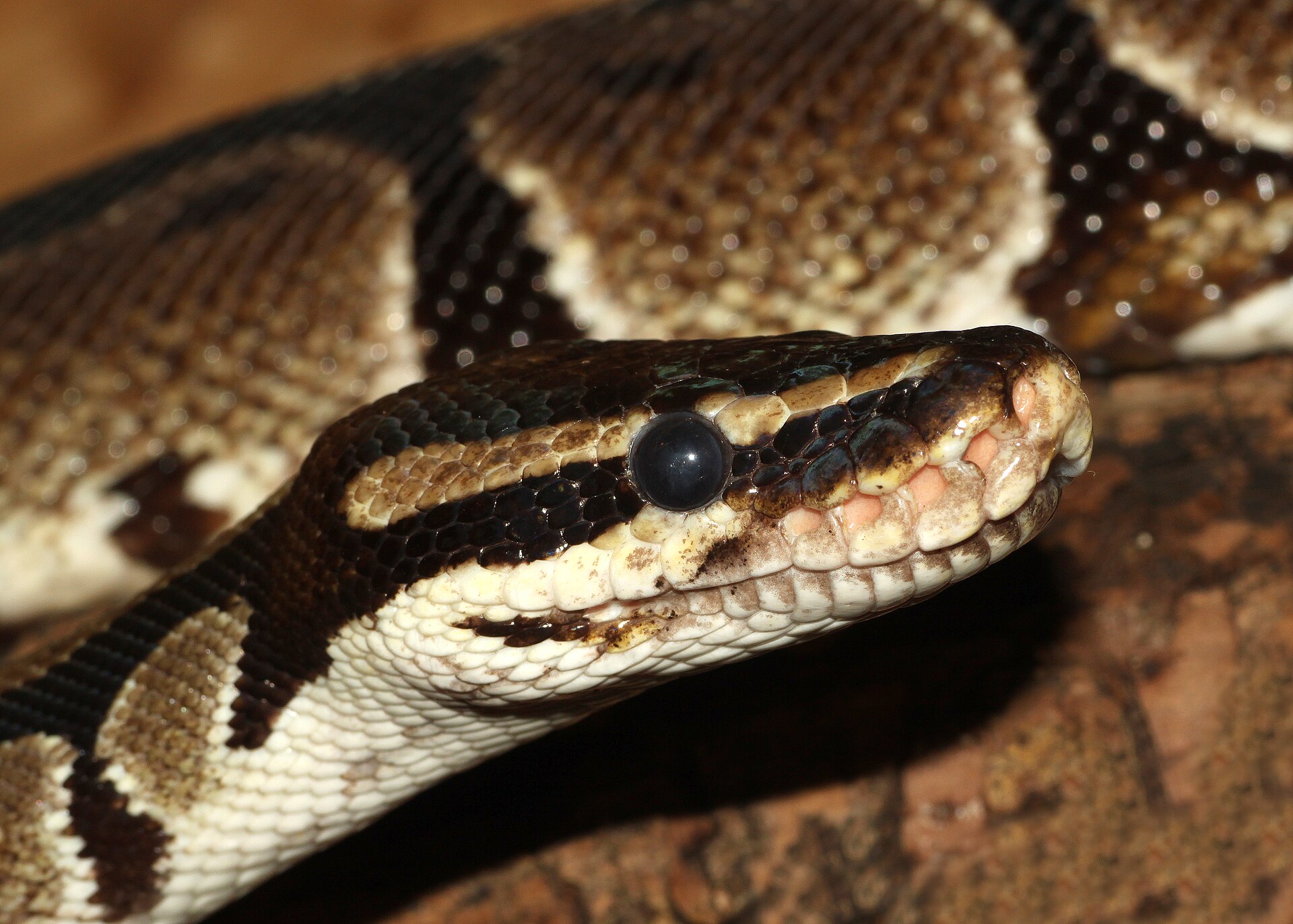
Ball Python
Python regius
Characteristics
Temperament
Docile, solitary, crepuscular-nocturnal. Defensive by hiding: coils into a "ball" without striking. Famous for hunger strikes lasting months.
Diet
Strict carnivore. In captivity: pre-killed and defrosted mice or rats. Frequency: every 5-7 days (juveniles), every 10-15 (adults).
The Ball Python (Python regius) is a constrictor snake native to West and Central sub-Saharan Africa. It is the smallest of the African pythons and one of the most widespread snakes worldwide in herpetoculture, thanks to its mild temperament, manageable size and characteristic habit of coiling into a "ball" — a defensive behaviour that has earned it its English name.
Classification and category
The Ball Python belongs to the order Squamata, suborder Serpentes, family Pythonidae. It is a species of the genus Python, which also includes other African and Asian snakes. It is a relatively small python: average length is 90-150 cm, with females noticeably larger than males and able to reach 180 cm. Average adult weight is 1-2 kg, but well-fed females can exceed 3 kg. It is not venomous: it kills prey by constriction, suffocating it with the coils of its body.
Habitat and distribution
The natural habitat of the Ball Python consists of wooded grasslands, savannas, open forests and agricultural land in West and Central sub-Saharan Africa. It prefers warm, dry environments with access to underground shelters (rodent burrows, abandoned termite mounds, cavities in the soil) where it can hide during the hottest hours of the day.
Its range covers Senegal, Mali, Ivory Coast, Ghana, Togo, Benin, Nigeria, Cameroon, the Central African Republic, South Sudan and western Uganda. Its conservation status was upgraded to Near Threatened (NT) by the IUCN in 2021, due to the combined pressure of the international trade in wild specimens (more than 3 million ball pythons legally exported from Ghana and Togo alone between 1980 and 2020) and habitat loss. The species is listed in CITES Appendix II.
Diet
The Ball Python is a strict carnivore: in the wild it feeds almost exclusively on small rodents (shrews, African rats, gerbils), bats and occasionally nestling birds. Hunting usually takes place at dusk or at night, when the snake leaves its burrow and locates prey thanks to the heat-sensing pits on its upper lip, capable of detecting body warmth from centimetres away.
In captivity it is fed with pre-killed and defrosted mice or rats, sized proportionally to the snake's diameter. Meal frequency varies with age: juveniles eat every 5-7 days, adults every 10-15 days. It is a species famous for its "hunger strikes" that can last several months, particularly in winter or during the breeding season, without health consequences as long as the weight remains stable.
Physical features
The Ball Python has a stocky, muscular body with a relatively small head that is clearly distinct from the neck. The classic wild-type pattern is characterised by brown and gold blotches and bands on a black background, with a camouflage effect that makes it nearly invisible in dry vegetation. Captive breeding has produced more than 8,000 recognised morphs — colour and pattern variants derived from genetic mutations (Pied, Pastel, Banana, Albino, Mojave, etc.) — which have made this species extremely popular in the reptile hobby.
It has anal spurs — small horny structures, vestiges of ancient limbs — more developed in males, which use them during courtship to stimulate the female. The pupils are vertical, the eyes small and of variable colour depending on the morph. The tongue is forked and is flicked outside the mouth to "smell" the environment through the Jacobson's organ.
Behaviour and curiosities
The name "regius" — royal — comes from the tradition that Cleopatra wore specimens of this species wrapped around her wrists as living jewellery. In many cultures of West Africa it is regarded as a sacred animal: at the Temple of Pythons in Ouidah, Benin, dozens of specimens live freely as symbols of the vodun religion and are fed by worshippers.
It is a solitary, crepuscular-nocturnal, low-metabolism snake: it spends most of its time hidden and is mostly active at dusk. When it feels threatened, it almost never attacks: it prefers to hide its head in the middle of its coils, forming the "ball" that gives it its English name. Lifespan is remarkable for a snake: in captivity 20-30 years are common, with documented records of over 47 years. For owners, a Ball Python is therefore a long-term commitment that must be carefully evaluated.
Pros
- Docile e facile da maneggiare
- Longevo (20-30 anni)
- Dimensioni contenute
- Oltre 8.000 morphs disponibili
Cons
- Specie Near Threatened: serve CITES e allevamento responsabile
- Dieta a base di roditori (per molti un tabù)
- Impegno a lunghissimo termine
- Scioperi della fame frequenti che possono spaventare i principianti