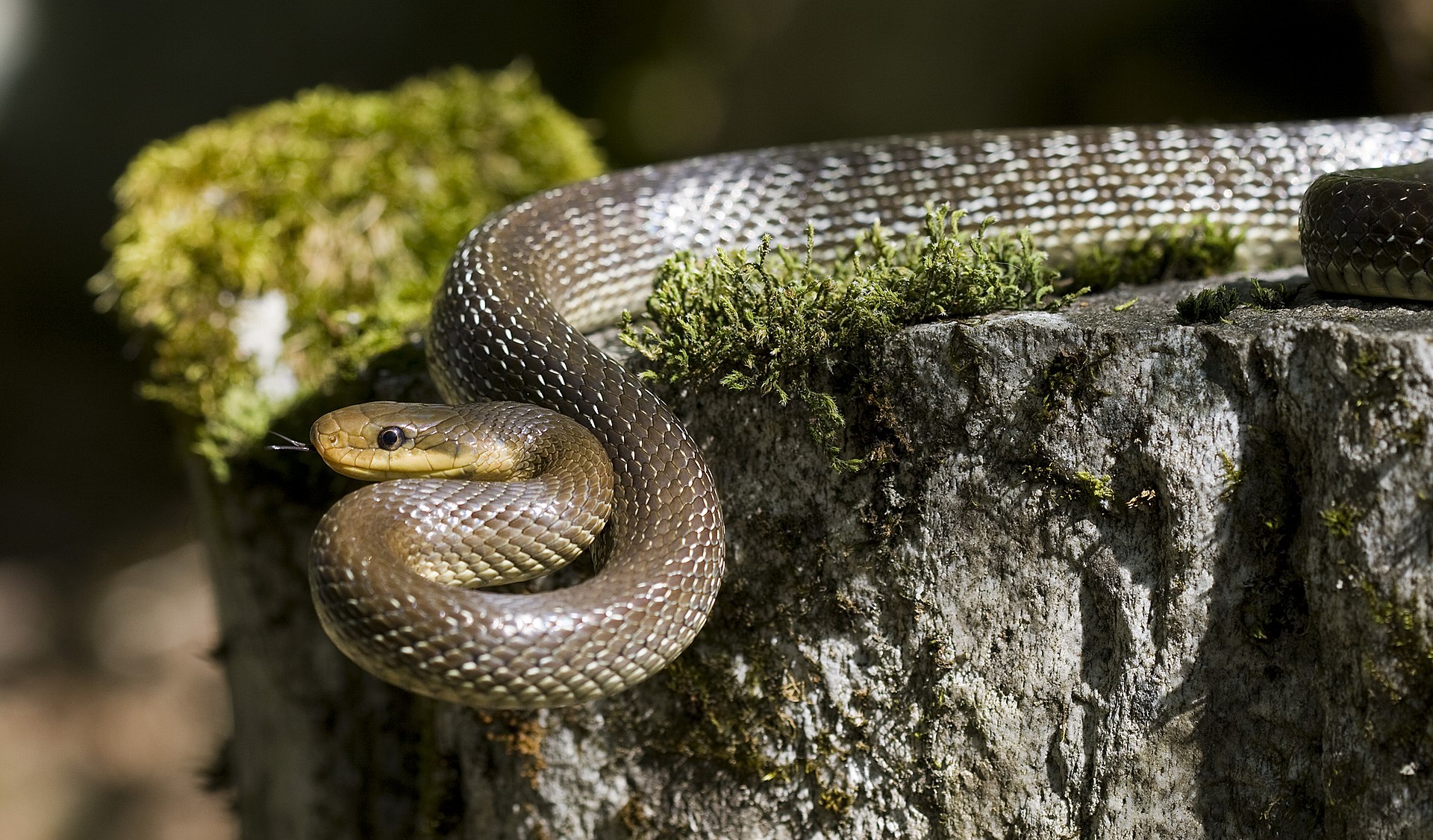
Aesculapian Snake
Zamenis longissimus
Characteristics
Temperament
A diurnal wild snake, shy and of a notably mild disposition. Faced with a human it flees and seeks shelter; only if grabbed may it attempt a defensive bite which, lacking venom, is entirely harmless. Solitary and territorial, it is a skilful, tireless climber, active in the warm hours. It is NOT an animal to handle for fun: it is protected wildlife, to be observed and respected in nature, where it plays the useful role of a predator of mice and rats.
Diet
A non-venomous constrictor predator. It feeds mainly on small mammals (mice, voles, rats), as well as birds and their eggs, which it reaches by climbing to nests, and when young on lizards and other small reptiles. Having no venom, it catches prey by wrapping it in its coils and suffocating it, then swallowing it whole. Feeding largely on rodents, it is a valuable natural ally of the farmer in controlling mice around fields, barns and houses.
The Aesculapian Snake (Zamenis longissimus) is one of the largest, most elegant and most history-laden snakes in Europe: a harmless, slender, glossy-bodied snake, deeply tied to human culture. Famous for:
- Harmlessness: it is not venomous and kills its prey by constriction; towards humans it is mild and shy
- Climbing skill: it readily goes up walls, trees, hedges and ruins, even into roofs
- A bronze, glossy body: even olive-brown colouring with metallic sheens and fine pale flecks
- Large size: one of the longest snakes on the continent, able to exceed a metre and a half
- Its link with medicine: it is the snake coiled around the Rod of Asclepius, the universal symbol of the medical art
- Ancient history: the Romans spread it around the temples and baths dedicated to healing
IUCN status: Least Concern (LC), but locally in decline. It enters this portal in the Snakes group, where vipers, elapids and large tropical constrictors had so far dominated: the Aesculapian Snake finally brings the voice of the harmless colubrids, the great family of "common", non-venomous snakes, and a native one at that, at home in Italy's woods and countryside.
Classification and category
Order Squamata (the scaled reptiles), suborder of the snakes (Serpentes), family Colubridae — the colubrids, the world's largest snake family, which groups most of the "common", largely harmless snakes. Its genus is Zamenis. In the portal it is placed among the Snakes. It is important to tell it apart from dangerous snakes and from look-alikes: unlike vipers and elapids (such as cobras and mambas), the Aesculapian Snake is not venomous — it has no venom fangs and poses no danger; young Aesculapian snakes have a more marked pattern and can be confused with the grass snake, also harmless; in Italy it shares habitats with other colubrids (such as the dark, very fast western whip snake); the Aesculapian Snake is recognized by its more uniform, bronze body and its calm nature. Etymology: the scientific name "longissimus" means "very long", referring to its size; the name "Aesculapian snake" refers directly to Asclepius (Latin Aesculapius), the Greco-Roman god of medicine, around whose staff a snake of this very species is coiled. Parameters: Length commonly 1.1-1.6 m, with specimens exceeding 2 m (among the longest snakes in Europe). Build slender and rangy, but muscular. Weight variable, generally a few hundred grams. Longevity remarkable — it can live a long time, with specimens exceeding 20-25 years. Reproduction: it is oviparous; the female lays eggs (usually 5-10) in warm, moist substrates such as decaying wood, leaf piles or manure, where the heat of decomposition aids incubation.
Habitat and distribution
The Aesculapian Snake is a mainly European, heat-loving snake: its range is Italy (most of the peninsula) and south-central Europe, from France to the Balkans, with some isolated populations farther north (historically linked to the Romans). Preferred habitats — warm, sunny environments rich in hiding places: woodland edges, clearings and scrub; hedges, dry-stone walls, vineyards, olive groves and mosaic countryside; and ruins, old houses, woodpiles and sunny rockfields, where it finds warmth, prey and shelter. It is a thermophilic species, hence tied to warm areas; in colder regions it survives only where the microclimate is favourable. It is an excellent climber: it may be found high up on trees, walls and roofs, where it hunts birds and rodents. In winter it goes into dormancy, sheltering in burrows, crevices and cellars. Its dependence on warm, well-structured environments makes it sensitive to the destruction of hedges, dry-stone walls and mature woods. IUCN: Least Concern globally, but in many areas, especially at the northern edge of its range and in heavily human-altered settings, populations are in decline due to habitat loss. It is a protected species in many European countries.
Diet
The Aesculapian Snake is a constrictor predator with a diet based mainly on small mammals. It eats: rodents (mice, voles, rats and other small mammals are its main prey); birds and their eggs, which it reaches by climbing up to nests; and lizards and other small reptiles, especially when young. Hunting strategies: constriction (not being venomous, it wraps its coils around the prey and suffocates it, then swallows it whole); high hunting (it uses its climbing skill to reach nests and dens up high); and ambush and active search (it alternates motionless waiting with exploring burrows, walls and cavities). Crucially, by feeding largely on mice and rats, the Aesculapian Snake is a valuable ally of the farmer, an efficient natural "pest controller". Not surprisingly, in the past it was often welcome around houses and barns precisely for controlling rodents.
Physical features
A long, slender, glossy-bodied snake of elegant appearance. Body and colouring: even olive-brown, bronze or greyish colouring, often with metallic sheens; fine white flecks or dashes scattered over the back, clearly visible up close; a paler, yellowish belly; smooth dorsal scales, which give the skin a smooth, shiny look. The body and head: a long, tapered, muscular body, suited both to crawling and to climbing; a narrow head, little distinct from the neck, of mild appearance (unlike the triangular head of vipers); round eyes with a round pupil, typical of diurnal, harmless colubrids. The young: they have a more marked, mottled pattern and sometimes a pale collar, making them resemble grass snakes; with growth the livery becomes more uniform. Performance: exceptional climbing (it scales vertical trunks and rough walls with surprising agility); fluid, silent movements; and a calm nature (it bites only if handled, and the bite — lacking venom — is entirely harmless).
Behaviour and curiosities
The Aesculapian Snake is a diurnal, shy snake of peaceful disposition. Faced with a human, its first reaction is flight: it tries to slip away quickly into the vegetation or a crevice. Only if grabbed may it try to bite, but being venomless its bite has no consequence. It is a solitary animal, active mainly in the warm hours.
The snake of medicine: the Aesculapian Snake is, in all likelihood, the snake depicted coiled around the Rod of Asclepius (Aesculapius to the Romans), the Greek god of medicine; that staff with a snake is still today the universal symbol of medicine and the health professions; according to myth, Asclepius healed the sick with the help of snakes, regarded as symbols of rebirth and healing because they could "renew themselves" by shedding their skin. The Rod of Asclepius versus the caduceus: beware of confusing two similar symbols — the true symbol of medicine is the Rod of Asclepius, with a single snake (the Aesculapian snake itself) and no wings; the caduceus, with two snakes and two wings, is instead the staff of Hermes/Mercury, god of commerce and messengers: it is often mistakenly used as a medical symbol, especially in the United States, but originally has nothing to do with medicine. The "Roman" spread: the Aesculapian Snake has some isolated populations surprisingly far north of its main range, for example in Germany, Austria and formerly Denmark; many scholars believe these are a legacy of the ancient Romans, who venerated this snake and kept or introduced it near the temples dedicated to Asclepius and the healing baths scattered across the empire; they would thus be the "descendants" of the sacred snakes of ancient medicine. The climber: the Aesculapian Snake is one of the most skilful climbing snakes in Europe; thanks to its muscular body and belly scales, it can climb vertical trunks, stone walls and even up the inside of old house walls, right under the roofs, where it hunts birds, eggs and mice; this ability makes it a snake one may meet "up high", not just on the ground. The change of clothes: like all snakes, the Aesculapian Snake periodically sheds its skin, freeing itself of the old layer in a single piece, often turned inside out like a sock; this very ability to "be reborn" with new skin helped, in ancient cultures, to make it a symbol of healing, renewal and immortality — another reason for its link with medicine. The farmer's friend: far from being an animal to fear, the Aesculapian Snake is a valuable helper of humankind; feeding heavily on mice and rats, it helps keep rodents in check in the countryside, in barns and around houses; for this reason, in many rural traditions, it was considered a welcome and even lucky guest, not to be killed but left to work undisturbed.
Pros
- Del tutto innocuo per l'uomo: non velenoso e di indole mite
- Alleato naturale dell'agricoltore: controlla topi e ratti
- Specie nativa d'Italia, ricca di storia e simbologia (simbolo della medicina)
- IUCN Least Concern; affascinante arrampicatore da osservare in natura
Cons
- NON è un animale da compagnia: è fauna selvatica protetta
- Sensibile alla perdita di habitat (siepi, muretti, boschi maturi): localmente in declino
- Spesso ucciso per paura o per averlo confuso con un serpente velenoso
- Termofilo: necessita di ambienti caldi e ben strutturati per sopravvivere