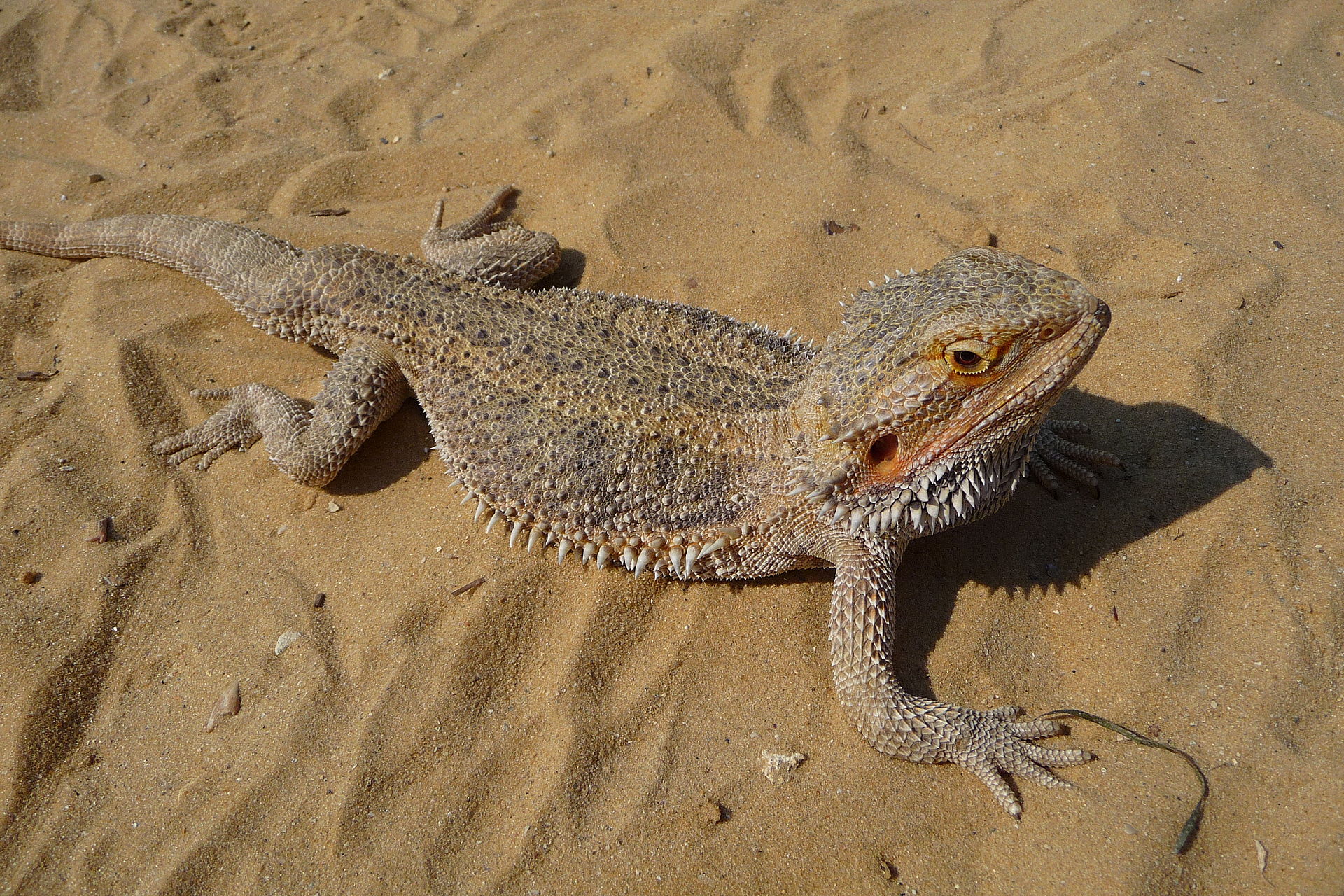
Bearded Dragon
Pogona vitticeps
Characteristics
Temperament
Diurnal, docile, curious. Rich visual communication (hand waving, head bobbing, beard inflation). Suitable for advanced beginners.
Diet
Omnivore: juveniles 70-80% insects, adults 70-80% vegetables. Gut-loaded insects + leafy greens + edible flowers. Calcium + D3 + UVB 10.0 essential.
The Bearded Dragon (Pogona vitticeps) is a lizard native to the arid regions of central Australia, today one of the most widespread reptiles in herpetoculture worldwide. It owes its name to the characteristic "beard" of spiky scales beneath the throat, which it inflates and displays as a sign of intimidation or courtship, changing colour from beige to deep black. Its docile and curious nature makes it one of the most beloved reptiles, suitable even for advanced beginners.
Classification and category
The Bearded Dragon belongs to the order Squamata, suborder Sauria, family Agamidae. The genus Pogona comprises eight species endemic to Australia; P. vitticeps is the largest and the most widespread in captivity. It is a medium-sized lizard: total length, including the tail, ranges from 45 to 60 cm; the tail accounts for just over half of total length. Average adult weight is 350-650 g, with males noticeably larger than females.
Habitat and distribution
The Bearded Dragon's natural habitat consists of the arid and semi-arid regions of central Australia: wooded savannas, sparse acacia forests, rocky deserts and steppes with xerophytic vegetation. It prefers areas with fallen logs, stumps and rocks for climbing to bask in the sun. Its range covers much of inland Australia, from Queensland and New South Wales to the Northern Territory and South Australia.
Conservation status is listed as Least Concern (LC) by the IUCN; Australian populations are abundant and stable. The export of wild specimens has been strictly forbidden by Australian law since 1960: virtually all Bearded Dragons in Europe, North America and Asia come from captive-bred lines, which have produced numerous morphs (selected colour variations) such as Citrus, Hypo, Leatherback, Silkback and Zero.
Diet
The Bearded Dragon is an omnivore, a relatively unusual trait among lizards. The diet changes notably with age: juveniles are mostly insectivorous (70-80% animal protein, 20-30% vegetables), adults become mostly herbivorous (70-80% vegetables, 20-30% insects).
In captivity a varied diet of crickets, roaches, mealworms and locusts is recommended, gut-loaded (fed with vegetables 24 hours before being offered) and dusted with calcium and D3. The plant component must include leafy greens (dandelion, chicory, rocket, mulberry leaves, escarole), occasionally edible flowers (hibiscus, calendula, organic roses) and small amounts of fruit. Absolutely to be avoided: spinach (binds calcium), iceberg lettuce (poor), avocado and rhubarb (toxic), wild-caught insects (parasite and pesticide risk). Water must always be available in a shallow, wide bowl; many specimens prefer drinking droplets sprayed on their skin.
Physical features
The Bearded Dragon has a dorso-ventrally compressed body, a wide triangular head and a relatively long, sturdy tail. The base colour ranges from beige to sand, orange, red and grey, depending on the population of origin and the morph. Captive selection has produced extraordinary colourations, from the intense yellow of the Citrus to the white-pink of the Zero, all the way to scaleless individuals (Silkback).
The most distinctive feature is the "beard": a collar of modified spiky scales beneath the throat, which can be inflated through a mobile hyoid bone. During territorial, courtship or intimidation interactions, the beard is displayed and turns intense black by contrast, while the rest of the body may darken or remain pale. Along the flanks run additional rows of spiky scales, while the back skin is covered with pointed tubercles. Above the head sits the parietal third eye, a small translucent patch sensitive to light but unable to form images, useful for detecting predator shadows from above and regulating circadian rhythms.
Behaviour and curiosities
The Bearded Dragon is a diurnal, solitary, terrestrial and arboreal animal. Throughout the day it alternates phases of basking in the sun (preferably on raised rocks or logs) with phases of hunting and feeding. Communication is remarkably developed for a reptile: it includes "hand waving" (the classic greeting with the front foot, a sign of submission or recognition), head bobbing (rapid head movements, dominance), beard inflation, skin darkening and postural changes.
During winter months, both in captivity and in the wild, it can enter a form of brumation (the reptilian equivalent of partial hibernation): it retreats to hiding spots and drastically slows metabolism, feeding and activity for 1-3 months. Sexual maturity is reached at 1-2 years; females lay up to 24 eggs per clutch in burrows dug in the ground, with the possibility of 2-3 clutches per season. An interesting peculiarity is temperature-dependent sex determination (TSD): at incubation temperatures above 32 °C, embryos with male chromosomes can "reverse" phenotypic sex and become functional females — a phenomenon described in 2015 and considered unique among lizards. Lifespan is 8-15 years in captivity, with documented records of up to 18 years.
Pros
- Carattere docile, tollera il maneggiamento
- Comunicazione visiva ricca, molto interattivo
- Longevo (8-15+ anni in cattività)
- Ampia disponibilità di morph colorate
Cons
- Terrario grande necessario (120x60x60 cm minimo)
- UVB 10.0 e calore basking 40 °C indispensabili
- Brumazione invernale stagionale può preoccupare
- Dieta varia e specifica per età