Jaguar
Panthera onca
Characteristics
Temperament
Solitary, territorial, nocturnal-crepuscular. South American apex predator. Most powerful bite of all felids (1,500 PSI). Exceptional swimmer. Sacred to Maya, Aztec, Olmec. Melanistic variant "black panther" (10% of population). Only Panthera native to the Americas.
Diet
Hypercarnivorous: 85+ prey species. Ambush hunting, kills by piercing the skull (only felid). Preys on capybara, caimans, turtles (opens shells!), tapirs, deer, peccaries, large fish. 1-2 kg meat/day. Success rate 1/3-4 attempts.
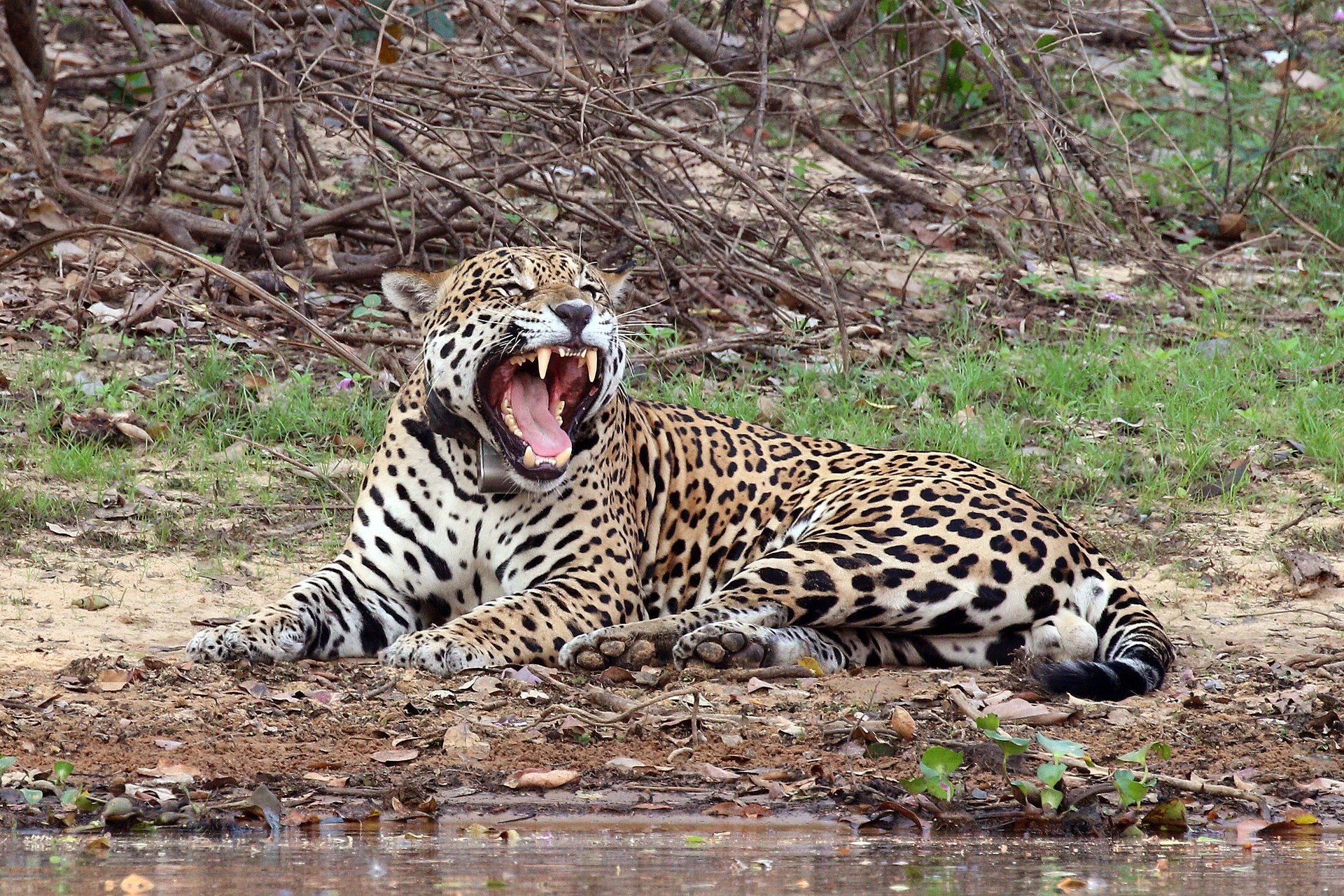
The Jaguar (Panthera onca) is the largest feline in the Americas and the third largest in the world, after the tiger (Panthera tigris) and the lion (Panthera leo). Distributed from northern Mexico to northern Argentina, it has its stronghold in the Brazilian Pantanal (the largest tropical wetland in the world) and the Amazon. Key feature: the coat is similar to that of the leopard but the rosettes have a dark central spot (the rosettes of the African leopard lack this). Weight: 56-96 kg for typical adult males (females 36-65 kg); specimens from the Pantanal reach 120-158 kg — the largest jaguars recorded. Head-body length: 1.2-1.9 m; tail 50-75 cm. It is the apex predator of Latin America: it has the most powerful bite force of all felids in proportion to its size (1,500 PSI), capable of piercing turtle shells and caiman skulls. A melanistic variant (black coat with barely visible rosettes) is called "black panther" and represents about 10% of the population. Sacred to pre-Columbian Maya ("Balam"), Aztec (god Tezcatlipoca) and Olmec civilisations, it was a symbol of royal power and divinity. IUCN status: Near Threatened (NT) — population in decline by 20-25% over the last 21 years.
Classification and category
The Jaguar belongs to the order Carnivora, family Felidae, subfamily Pantherinae, genus Panthera. Together with tiger, lion, leopard and snow leopard, it is one of the 5 "big cats" of the genus Panthera. It is the only Panthera native to the American continent. Recent phylogenetic studies (mitochondrial DNA) indicate that the jaguar diverged from the common lineage with the leopard about 1.9-2.5 million years ago; its ancestors crossed the Bering Strait during the Pleistocene.
Historically 8-9 geographical subspecies were recognised; however, modern genetic analyses (Eizirik et al., 2001) have shown very little variation between populations, suggesting a single panmictic species. Today zoologists tend not to recognise distinct subspecies. Regional populations differ in size: jaguars from the Pantanal and Amazon are the largest (males up to 158 kg), while those from Mexico and Central America are smaller (50-80 kg). The Smilodon ("sabre-toothed tiger") is not a relative — it was an extinct machairodontine, not a Panthera.
The morphological parameters are: weight 56-96 kg (M), 36-65 kg (F), record 158 kg (Pantanal); head-body length 112-185 cm; tail 45-75 cm; height at withers 63-76 cm. Longevity is 12-15 years in nature, up to 23 years in captivity. Sexual maturity: 3-4 years for males, 2-3 years for females. Gestation: 91-111 days; litter of 1-4 cubs (average 2). The cubs are born blind (weighing 700-900 g), open their eyes at 2 weeks, stay with the mother for 1.5-2 years.
Habitat and distribution
The Jaguar is a feline of tropical forests and wetlands. Preferred habitat: dense rainforest (Amazon), gallery forests along rivers, wetlands (Pantanal — habitat of maximum density), deciduous forests, savannas, thorn forests, mangrove swamps. Unlike most felids, the jaguar is an extraordinary swimmer: it also hunts in water, crosses wide rivers and often bathes for thermoregulation. It always prefers areas close to water: over 70% of sightings are within 100 m of a watercourse.
Historical distribution: from the southwestern United States (Arizona, New Mexico, Texas) to northern Argentina (Tucumán province). Current distribution: the jaguar is locally extinct in El Salvador, Uruguay, and most of the US territory; populations remain in 18 countries. The main strongholds are:
- Amazon Basin (Brazil, Peru, Colombia, Venezuela, Guyana): estimated population 60,000+
- Pantanal (Brazil-Paraguay-Bolivia, 200,000 km²): highest density in the world, 6.7 jaguars/100 km²
- Gran Chaco Forest (Argentina-Paraguay-Bolivia)
- Maya Forest (Mexico-Guatemala-Belize): 1,500 jaguars
- Sierra Madre Occidental (north-west Mexico): few isolated specimens
The global population is estimated at 64,000 mature individuals (IUCN 2017), with a trend of decline of 20-25% in the last 21 years. IUCN conservation status: Near Threatened (NT). CITES: Appendix I (international trade banned since 1975). Main threats: habitat loss (Amazon deforestation, agricultural expansion for soy and livestock), retaliation killings (ranchers protecting livestock), poaching (trade in body parts for traditional Asian medicine — increasing since 2015), habitat fragmentation (roads, dams), conflicts with sport hunters. Conservation programmes: "Jaguar Corridor Initiative" by Panthera (2008), which aims to genetically connect populations from Mexico to Argentina via ecological corridors of 6,300 km. In the US there are sporadic returns in Arizona (the individual "El Jefe" in 2015 was photographed for the first time in 50 years).
Diet
The Jaguar is an apex hypercarnivorous predator. The diet is extremely varied (over 85 documented prey species), including:
- Large mammals: capybara (favourite prey in Pantanal), tapirs, deer (white-tailed deer, marsh deer), peccaries (white-lipped, collared), giant anteaters
- Reptiles: caimans (yacaré caiman, broad-snouted caiman — active hunting in water, biting the skull), iguanas, anacondas, turtles (the only felid that opens shells with the force of its bite)
- Large fish: pirarucu, dorado, pacu (hunting in shallow water)
- Water birds: herons, ducks, cormorants
- Aquatic mammals: giant otters (rarely)
- Livestock: cattle, horses (cause of conflicts with ranchers)
The hunting technique is unique among felids. Unlike the leopard (which strangles), the lion (which suffocates) and the tiger (which attacks the jugular), the jaguar kills by biting directly through the skull: a feature derived from evolution to hunt prey with bone armour like caimans and turtles. The bite pierces the temporal bones between the ears, directly damaging the brain — instant death. The bite force is 1,500 PSI (pound-force per square inch): the most powerful of all felids in proportion to its size, and second in absolute only to tiger and lion. It is capable of:
- Piercing freshwater turtle shells (Podocnemis spp., Trachemys spp.)
- Shattering caiman skulls of 50-100 kg
- Dragging prey of 200+ kg onto high branches
The jaguar is a solitary, nocturnal-crepuscular hunter. It hunts by ambush: silent stalking from ground or branches, final leap of 6-7 metres. Effective attack range: up to 25 m. Average success: 1 capture every 3-4 attempts. Eats 1-2 kg of meat per day; a 50 kg caiman lasts it 1-2 weeks. Carrying to shelter: drags heavy prey up to 800 m from the kill point, sometimes into trees.
Physical features
The Jaguar has a massive, compact, muscular body, more stocky and robust than the leopard (which is slimmer). The legs are short and powerful. The head is large with massive jaws — adaptation for the lethal bite. The ears are small, rounded. The eyes are gold or greenish-yellow, with round pupils (characteristic of big cats); retinal reflection (tapetum lucidum) white-blue at night. The nose is large, dark.
The coat is the most recognisable feature. The base colour is golden yellow on the back and flanks, cream white on the belly. The rosettes are irregularly distributed:
- On the back and flanks: large rosettes (4-6 cm) with dark central spot — the key difference from the African leopard, whose rosettes are hollow
- On the head: small solid black spots
- On the legs: small solid spots
- On the tail: rings (more towards the tip)
- On the belly: spots more sparse on white background
A melanistic variant (melanism) is called "black panther": the coat appears almost completely black, but the rosettes are still visible in full light (ghosting effect). The responsible gene is MC1R (recessive in the leopard, dominant in the jaguar). Melanistic individuals represent ~10% of the population, more common in dense forests (cryptic advantage for hunting in low light). An albino or "white" variant is extremely rare (fewer than 10 documented cases).
The paws are powerful, with retractable claws 7-10 cm long. The foot pads are wide, adapted to soft/wet terrain. The tail is of medium length (45-75 cm) — shorter than that of the leopard, less useful for tree balance and more suitable for swimming.
Behaviour and curiosities
The Jaguar is a solitary, territorial, nocturnal-crepuscular animal. Adult males have territories of 25-150 km², females 15-50 km²; the territories of males overlap with those of 2-3 females. Territorial marking: urine spray on trunks, scratches on bark, vocalisations. The characteristic call is a low repeated grunt ("saw-cough") emitted at dusk or at night. Unlike lions and tigers, the jaguar does not roar loudly; its call is more like a deep cough.
Reproduction: no fixed season in the tropics; in the south, spring (September-November). Males violently court females; mating is intense but lasts only 6-17 seconds, repeated up to 100 times/day for 4-7 days. The female gives birth in hidden dens (hollow trunks, dense forests, under rocks). Cubs weigh 700-900 g at birth, are blind, completely dependent. At 6 weeks they begin to play; at 6 months they accompany the mother on hunts; at 1.5-2 years they separate and seek their own territories.
Famous curiosities: the jaguar in pre-Columbian cultures. It was the sacred animal of almost all the great Mesoamerican civilisations:
- Olmecs (1500-400 BC): worshipped a hybrid "man-jaguar" being; the iconic "colossal heads" of La Venta have feline features
- Mayans: the jaguar was "Balam" (in Yucatec); it embodied the god of the underworld (Xibalba); the shaman-kings wore jaguar skins in ceremonies; one of the most powerful royal names was "Yax B'alam" (Rising Jaguar). The supreme god "Itzamna" manifested as a jaguar at night
- Aztecs: "Tezcatlipoca" (the smoking mirror), deity of the night and war, had the jaguar as a spirit animal; the "jaguar warriors" (Ocēlōtl) were the military elite; they could wear jaguar pelts as uniform
- Moche (pre-Columbian Peru): ceramics depict jaguars killing sacrificial victims
- Anasazi Pueblos and Hopi (south-west USA): petroglyphs depict "guardian jaguars"
Bite curiosity: the jaguar has the most powerful bite force among felids in proportion to its size: 1,500 PSI compared to: lion 650 PSI, tiger 1,050 PSI, leopard 300 PSI. This allows it to pierce turtle shells (only felid capable) and caiman skulls. Swimming curiosity: the jaguar is the best swimmer among big cats, tied with the tiger. It crosses 10+ km wide rivers (Amazon), dives underwater to catch fish, and territories often revolve around rivers. Melanism curiosity: the "black jaguar" (black panther) is a melanistic variant of the same species. The gene is dominant in the jaguar (CDH1, recessive in the leopard). Common in jaguars of the Amazon basin (mimetic advantage in dense forest). Melanistic cubs can be mixed with normal rosette siblings in the same litter. Linguistic curiosity: the name "jaguar" derives from the Tupi-Guarani name "yaguara" = "beast that kills with one leap". In English "jaguar", in Spanish "jaguar" or "yaguareté", in Portuguese "onça-pintada". Land Rover Jaguar curiosity: the Jaguar car company (UK, founded 1922) has used the name since 1935 as a symbol of "power and grace"; the logo of the leaping feline is one of the most recognisable logos in the world. Cinema curiosity: the jaguar appears in the films "Apocalypto" (Mel Gibson, 2006), "The Emerald Forest" (1985), "Anaconda" (1997). Pantanal curiosity: the Brazilian Pantanal hosts the highest density of jaguars in the world (6.7/100 km², compared to 1-3/100 km² in the Amazon). Here jaguars are diurnal (unusual) and visible on photographic safaris. Hybrid curiosity: in captivity, they have been hybridised with leopards (jaglep), lions (jaglion) and tigers (jagtiger); all hybrids are sterile. "El Jefe" and "Sombra" curiosity: since 2015 some solitary male jaguars have been documented returning to Arizona after 50 years of local extinction; "El Jefe" was filmed in 2016 in the Santa Rita Mountains. Sports curiosity: the Jacksonville Jaguars (NFL) and the Memphis Tigers use the jaguar as a mascot. Jaguar vs leopard curiosity: apart from rosettes with central dots, the jaguar is more massive (45% more average weight), has wider jaws (width/length ratio), shorter legs, shorter tail (45-75 cm vs 60-110 cm), and rounder eyes. Also the jaguar only lives in the Americas and the leopard only in Africa-Asia (they only crossbreed in zoos). Modern religious curiosity: the Cofán tribe of Ecuador call the jaguar "tigre del rio" and consider it a spiritual ancestor; their shamans practise "transformation into jaguar" through ayahuasca. Conservation curiosity: the Jaguar Corridor Initiative by Panthera (2008) is the largest conservation project ever attempted for a big cat: it aims to genetically connect all populations from Mexico to Argentina with protected ecological corridors, along 6,300 km. Result so far: 70% of the corridor identified and protected to various degrees.
Pros
- Iconico del continente americano, terzo grande felino al mondo
- Morso più potente di tutti i felidi (perfora gusci di tartaruga!)
- Eccezionale nuotatore (unico tra i grandi felidi insieme alla tigre)
- Sacro per le civiltà Maya, Azteche, Olmeche
Cons
- Stato IUCN Near Threatened: declino del 20-25% in 21 anni
- Conflitti con allevatori (uccisioni per ritorsione)
- Bracconaggio in aumento (medicina tradizionale asiatica)
- Frammentazione habitat: 50% del territorio storico già perso