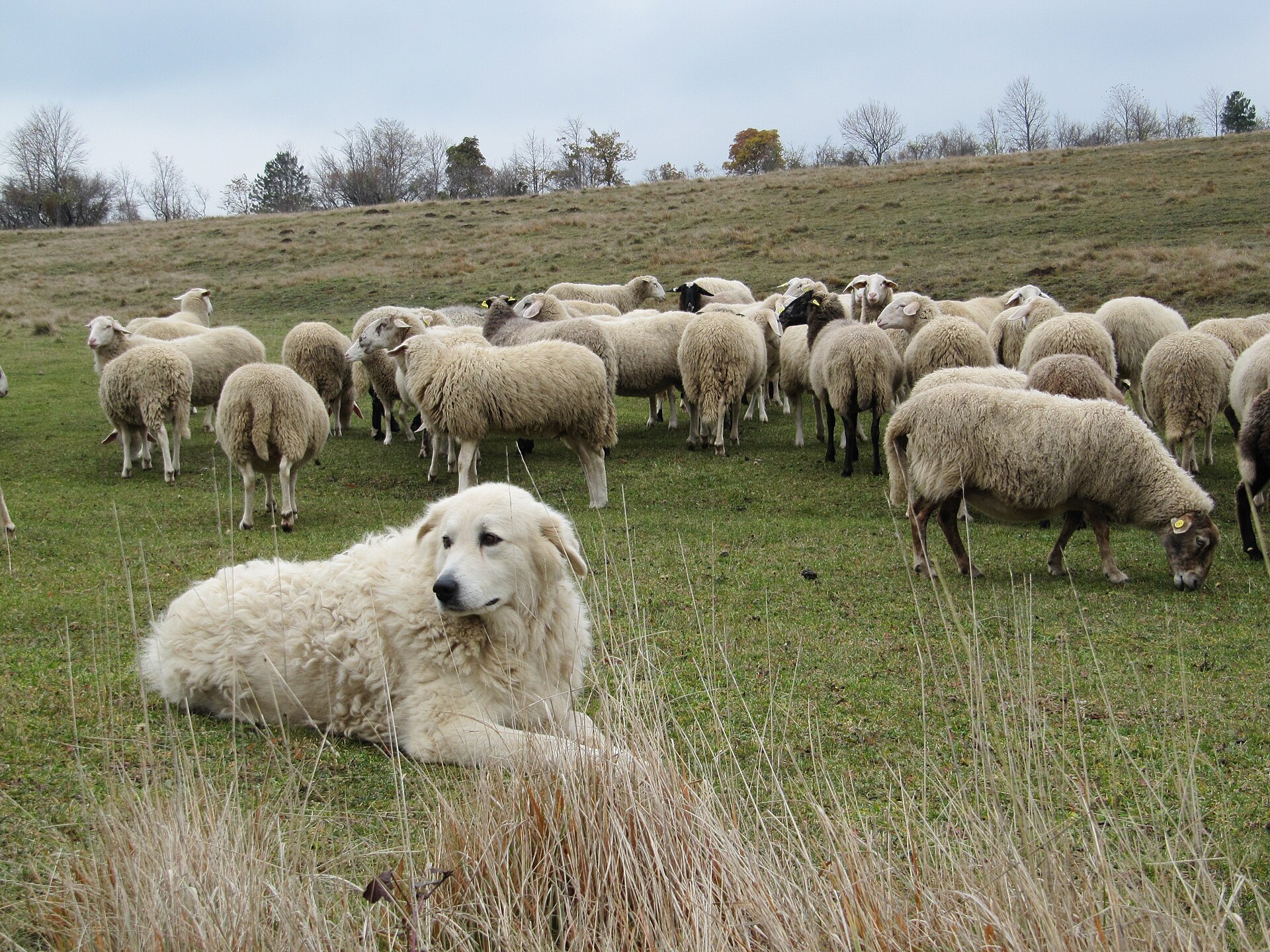
Maremma Sheepdog
Canis lupus familiaris
Characteristics
Temperament
A balanced, independent, proud and deeply protective guardian dog. With its own family and "flock" it is calm, reliable and loyal, but towards strangers and threats it is wary, brave and resolute. Used to working alone, it thinks for itself and makes decisions independently: it is therefore less "obedient" and more demanding than herding dogs. It is NOT an apartment dog nor for inexperienced owners: it needs space, a role to fulfil and competent guidance that respects its nature. Well managed, it is an unrivalled guardian and a companion of extraordinary loyalty.
Diet
An omnivore with a carnivorous bent, like all dogs; given its large size it needs a complete, quality food, rich in protein and suited to age and activity, with fresh water always available, especially if it works outdoors. Rations, substantial but controlled, should be split into several meals to reduce the risk of gastric torsion, typical of large dogs. Controlled puppy growth (for healthy bones and joints) and the right energy intake, which varies with season and work intensity, are essential. Rustic and frugal by nature, it nonetheless remains a large dog to be fed adequately.
The Maremma Sheepdog (Italian "Pastore Maremmano Abruzzese") is one of the oldest and noblest Italian breeds: the great white guardian dog that has protected flocks from predators for millennia. Famous for:
- The guardian role: it does not herd the sheep but lives with them and defends them from wolves, bears and thieves
- The white coat: thick and pure white, which blends it with the sheep and distinguishes it from the wolf at night
- The imposing bulk: large, powerful and rustic, built to face predators
- Independence: it works alone, making decisions on its own without needing human guidance
- Loyalty: deeply attached to the flock and the family, of whom it is the keeper
- Very ancient roots: it has accompanied Italian pastoralism for thousands of years
The Maremma Sheepdog is a domestic dog and enters the portal among the sheepdogs, alongside the Belgian Malinois — but with a fundamental difference. The Malinois (like the German Shepherd and the Border Collie) is a herding dog, which gathers and drives the flock; the Maremmano is instead a guardian dog, which protects the flock. It is, in a sense, the natural antagonist of the wolves in the portal.
Classification and category
The Maremma Sheepdog is a pedigree domestic dog (Canis lupus familiaris) of Italian breed, and in the portal it is classified among the sheepdogs. In the international canine classification (FCI) it belongs to Group 1 (sheepdogs and cattle dogs), but represents a particular category within it: that of the livestock guardian dogs. It is useful to distinguish the two great "trades" of dogs tied to flocks: herding dogs (like the Border Collie, German Shepherd, Malinois) gather and drive the livestock, working on the shepherd's orders; guardian dogs like the Maremmano live within the flock and defend it from predators, acting independently. The Maremmano is part of the great family of white livestock-guardian dogs, together with the Pyrenean Mountain Dog, the Hungarian Kuvasz, the Tatra Shepherd and others: different breeds but with the same task and the same pale, imposing look. Etymology: the name unites two areas of origin, the Maremma (between Tuscany and Lazio), where the dog wintered with the flocks, and Abruzzo, whose mountains were the summer pastures: two faces of ancient Italian transhumance. Parameters: Height at the withers males about 65-73 cm, females about 60-68 cm. Weight males about 35-45 kg, females about 30-40 kg. Appearance large, robust and rustic, with a "bear-like" head. Longevity: like many large dogs, generally 11-13 years. Reproduction: large litters; the puppies destined for work are raised from a young age in contact with the sheep, to bond with the flock.
Habitat and distribution
As a domestic breed, the Maremma Sheepdog has no wild range. It does, however, have a precise homeland, central Italy (Maremma and Abruzzo), and is tied to a well-defined working environment: pastures and mountains. Ideal living environment: pastures, farms, livestock holdings and large open spaces, where it can do its guarding work; families and owners with space and competence (it is NOT an apartment or city dog); and a "flock" to protect (be it sheep, other farm animals or the human family, it needs someone to watch over). Historically the Maremmano is the dog of transhumance: it followed the flocks on the long seasonal movements between the Maremma plain (in winter) and the mountain pastures of Abruzzo (in summer), watching over the sheep day and night. It works independently, often without any command, judging threats on its own. It is active mainly at night, when predators approach. For this reason it is not suited to city or sedentary life: it needs space, a role and an owner who understands its nature. Not being a wild animal, it has no IUCN conservation status. Its "fortune" today is tied, besides traditional farming, to the return of large predators in Europe, which has brought it back to the fore as a tool of coexistence.
Diet
Like all dogs, the Maremma Sheepdog is an omnivore with a carnivorous bent and, given its size, needs a complete, quality, well-proportioned diet. As a large domestic dog: complete foods for large dogs, rich in quality protein and suited to age; substantial but controlled rations, divided into several meals; and fresh water always available, especially if it works outdoors. Particular care: puppy growth (large-breed puppies must be fed carefully for healthy development of bones and joints); the risk of gastric torsion/bloat (as in many large dogs, it is best to avoid single large meals and exertion right after meals); and outdoor life (a dog working exposed to the weather has energy needs that vary with the season). Crucially, rustic and frugal by nature, the Maremmano was selected to withstand harsh conditions and a simple diet. It still requires adequate, quality food, especially as a puppy and when working, to sustain its size and stamina.
Physical features
An imposing, rustic, proud-looking dog. The coat — the most recognizable trait: long, thick, harsh and abundant fur, with a dense undercoat that protects it from cold and weather; exclusively white in colour (only slight shadings tolerated), to blend with the sheep and be distinguished from predators; a kind of thick "mane" around the neck. The body and head: a large, robust, powerful build, but harmonious and functional; a large, broad "bear-like" head, with a strong muzzle; a proud, attentive gaze. Performance: strength and courage to face predators like wolves; great endurance of toil and weather; and tireless vigilance, especially at night, and a powerful voice (the bark is the first deterrent weapon).
Behaviour and curiosities
The Maremma Sheepdog is a dog of balanced, independent, proud and protective temperament. With its family and its flock it is calm, reliable and deeply loyal, but towards strangers and threats it is wary and resolute. It is a dog that thinks for itself: used to working alone, it makes decisions independently, a precious quality in its trade but one that makes it less "obedient" and more demanding than herding dogs.
Guardian, not herder: the best way to understand the Maremmano is to distinguish it from "herding" sheepdogs like the Border Collie; the latter gather and drive the sheep by running around them; the Maremmano, instead, lives within the flock as if it were a larger sheep, and its task is to stay there, watch and intervene only if danger comes; it is a bodyguard, not a "manager" shepherd. Why it is white: the Maremmano's pure white coat is not just aesthetics; the white makes it similar to the sheep, letting it blend into the flock and not frighten it; at the same time, at night, it helps the shepherd distinguish his own dog (white) from the wolf (dark), avoiding tragic mistakes; it is an example of how even a breed's colour can be the result of a precise working function. The dog that grows up with the sheep: to become a good guardian, the Maremmano puppy must "bond" with the flock from a very young age; traditionally it is raised in close contact with the sheep, so as to consider them part of its own family and defend them instinctively; this early bond, more than training, is the secret of its work: the Maremmano protects the sheep because it feels they are "its own". The wolf's natural enemy: for millennia the Maremma Sheepdog was the main defence of flocks against the wolf; it does not chase the predator but stands in front of it, barks, faces it and discourages it, often working in a group with other dogs; with the return of the wolf in many regions of Europe, the Maremmano has again become a valuable tool of coexistence: it lets farmers protect flocks without resorting to killing or poison, in an entirely natural way. Transhumance: the Maremmano is the dog of one of the oldest Italian pastoral traditions, transhumance, the seasonal movement of flocks between plain and mountain; for centuries these dogs travelled, alongside shepherds and sheep, the ancient grassy droving roads (the "tratturi") between the Maremma and Abruzzo, watching over the flock on journeys of hundreds of kilometres; the breed carries the memory of this world in its very name. Not a dog for everyone: precisely because of its nature as an independent guardian, the Maremmano is not for just anyone; it needs space, a role, and an owner who understands and respects its proud, autonomous character; it is not an apartment dog, nor an "obedient" dog in the classic sense, nor suited to those seeking a companion to train for games; for those who live in the country and have animals or property to guard, however, it is an unrivalled guardian and a companion of extraordinary loyalty.
Pros
- Guardiano impareggiabile del bestiame: protegge le greggi dai lupi in modo naturale
- Gloriosa e antichissima razza italiana, legata alla transumanza
- Indipendente, coraggioso e resistente; profondamente leale a famiglia e gregge
- Strumento moderno di convivenza uomo-grandi predatori, alternativa ai metodi cruenti
Cons
- NON è un cane da appartamento né per proprietari inesperti
- Indipendente e poco "obbediente": difficile da gestire senza competenza
- Abbaia molto (di guardia, soprattutto di notte) e diffida degli estranei
- Mole grande, folto pelo da curare e necessità di spazio e di un "lavoro"