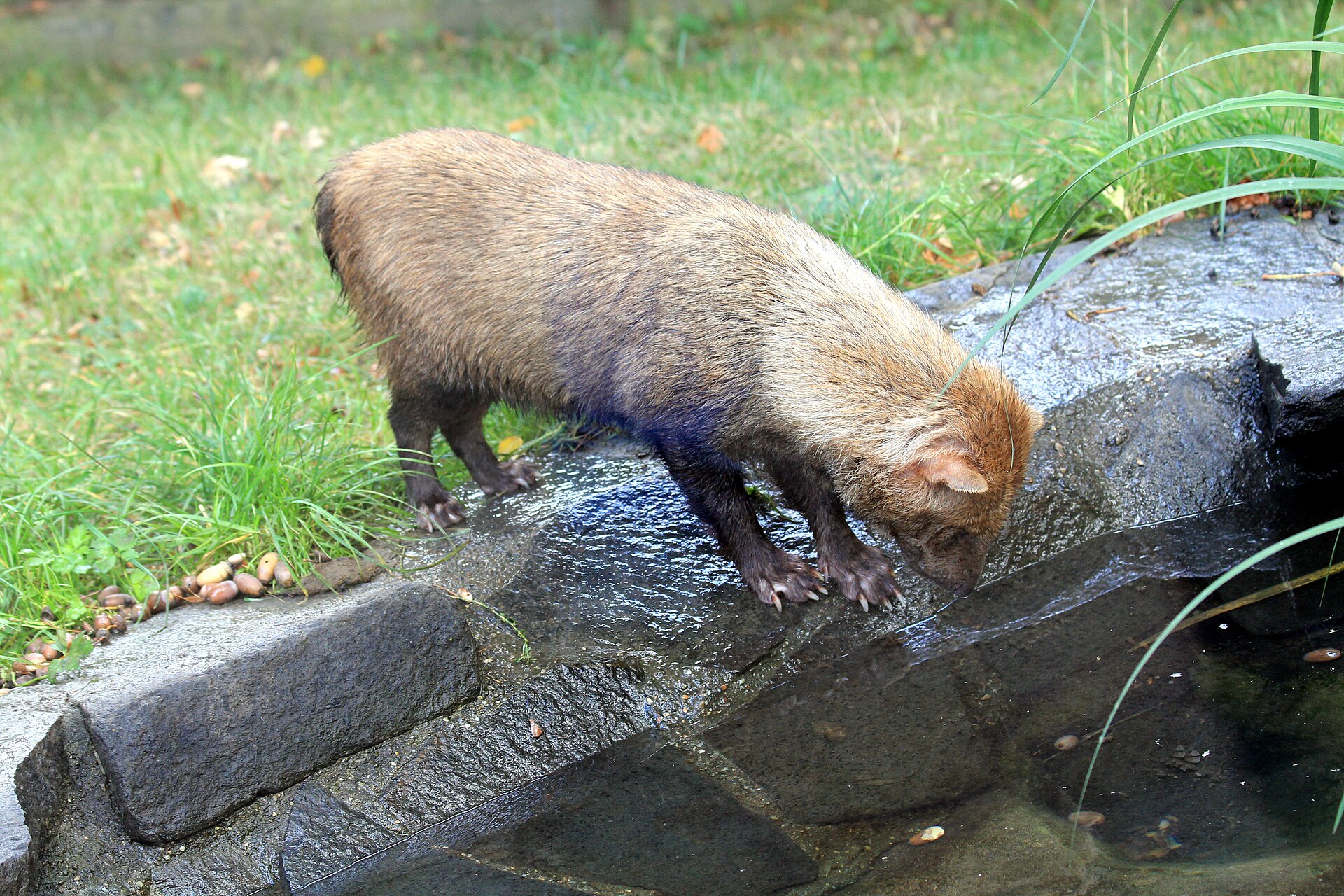
Bush Dog
Speothos venaticus
Characteristics
Temperament
Highly social (packs 4-12), crepuscular-diurnal, SEMI-AQUATIC. Completes CYNOPHARAONINI TRIAD with Lycaon+Dhole (3 monotypic genera across 3 continents!). ONLY 4 FRONT TOES, 38 teeth (reduced). Pack hunts prey 5-10x own weight (capybara 50 kg!). Excellent swimmer with webbed paws. UNIQUE cooing-whine vocalizations. "Handstand urination" for high marking. Described FIRST from fossils (Lund 1842).
Diet
Social hypercarnivorous predator. Large rodents 50-70% diet (capybara 50-70 kg, paca, agouti), armadillos, sloths, reptiles, birds, fish (hunted IN WATER!), amphibians. Pack hunting coordinated by cooing-whines, persistent pursuit including aquatic, can kill prey 5-10x individual weight thanks to cooperation. 0.5-1 kg meat/day.
The Bush Dog (Speothos venaticus), in Portuguese Cachorro-vinagre ("vinegar dog"), in Spanish Zorro vinagre, is a small South American canid UNIQUE IN ITS GENUS. Endemic to South American tropical forests (Panama-Argentina). Famous for:
- COMPLETES CYNOPHARAONINI TRIAD: with African Wild Dog (in catalogue) and Dhole (in catalogue) — 3 social canids across 3 continents
- 4 FRONT TOES: like Lycaon and Dhole — tribe diagnostic
- Only 38 teeth: reduced from other canids' 42 — fresh meat adaptation
- SOCIAL PACKS: 4-12 individuals (exceptional for such a small canid!)
- Pack hunting: prey up to 5x individual weight (capybara 50 kg!, paca, agouti)
- SEMI-AQUATIC: excellent swimmer, can dive and swim underwater
- Partially webbed paws: rare adaptation among canids
- UNIQUE VOCALIZATIONS: high-frequency "cooing whines" for dense forest communication
IUCN status: Near Threatened (NT) since 2008. Global population: ~10,000 mature individuals.
Classification and category
Order Carnivora, family Canidae, tribe Cynopharaonini, genus Speothos (MONOTYPIC!). 3 subspecies: S. v. venaticus (Amazon), S. v. panamensis (Central America), S. v. wingei (SE Brazil/Bolivia). Closest relatives: Lycaon (in catalogue) and Dhole (in catalogue). Three genera form the unique Cynopharaonini tribe, separated 5-7 Mya. Shared characteristics: only 4 front toes, reduced teeth (38-40), social packs, monogamous alpha pair, cooperative breeding with regurgitation, ability to kill very large prey. Etymology: "Speothos" Greek "cave" + "jackal". "Venaticus" Latin "hunter". Described by Lund 1842 FROM FOSSILS first! Parameters: Weight 5-8 kg (record 10 kg). Length 60-75 cm. Shoulder 25-30 cm (low and stocky!). Tail 12-15 cm (short, atypical). Longevity 8-10 years natural, 12-14 captive. Sexual maturity 10-12 months. Gestation 65-83 days. Litter 1-6 cubs (avg 3-4).
Habitat and distribution
Endemic to Neotropics — South American tropical forests. Panama (limit), Colombia, Venezuela, Brazil (main population — Amazon, Pantanal, Cerrado, Atlantic Forest), Guyana, Suriname, French Guyana, Ecuador, Peru, Bolivia, N. Argentina (Misiones), Paraguay. Habitats: lowland rainforest (main), varzea, Cerrado, Pantanal, gallery forest. Prefers areas near water (semi-aquatic). Avoids deforested areas, deserts, urban. IUCN: Near Threatened since 2008. Threats: deforestation (main), habitat fragmentation, canine viral diseases, road accidents, prey depletion. CITES: Appendix I.
Diet
Social hypercarnivorous predator. Diet: large rodents (main — capybara 50-70 kg = 5-10x bush dog weight!, paca, agouti), armadillos, sloths, reptiles (aquatic turtles, lizards), birds, fish (caught in water!), amphibians, large insects. Pack hunting technique: patrolling forest near water + whistle-whine coordination + persistent pursuit (including aquatic) + multi-angle attack + 30-60 minute consumption. Successfully kills prey 5-10x individual weight. 0.5-1 kg meat/day.
Physical features
UNUSUAL silhouette — looks like terrestrial otter or badger. Coat: uniform reddish-brown, lighter yellow-orange head, dark muzzle, black/dark tail, dense short fur (aquatic adaptation). Head: short robust muzzle (atypical for canids), small rounded ears (smaller than other canids), small brown eyes, very powerful jaws for size, ONLY 38 TEETH (reduced like Lycaon/Dhole). Body: low, stocky, elongated (otter-like!), short legs, ONLY 4 FRONT TOES, partially webbed paws (rare among canids), SHORT TAIL 12-15 cm (diagnostic). Speed terrestrial 30-40 km/h, excellent swimmer, can submerge 10-15 seconds. UNIQUE "cooing whine" vocalizations.
Behaviour and curiosities
Highly social, crepuscular-diurnal, semi-aquatic. Packs 4-12 individuals with monogamous alpha pair. Territory 100-150 km². Marking: urine, feces, anal secretions, "handstand urination" (males urinate while standing on front legs!). Monogamous breeding, 1-6 cubs, cooperative care with regurgitation.
Famous: CYNOPHARAONINI TRIAD — completes with Lycaon (Africa) and Dhole (Asia). Relict distribution from 5-7 Mya radiation. SEMI-AQUATIC behavior rare among canids — convergence with otters, fishing cat. HANDSTAND URINATION: males urinate while balancing on front legs to mark trees high. FIRST DESCRIBED FROM FOSSILS: Lund 1842 found fossils in Brazilian caves before live specimens — like coelacanth! Capybara hunting: main predator of world's largest rodent (in catalogue). Unique vocalizations: cooing whines convergent with Dhole's whistles. Monotypic genus: only living Speothos species. Indigenous cultures: Yanomami sacred, Guaraní "small jaguar", Suriname "water dog". Rarely sighted: among most elusive South American mammals.
Pros
- Completa la triade Cynopharaonini (Licaone+Dhole+Bush Dog)
- Canide più sociale del Sud America
- Semi-acquatico — convergenza con lontre
- Unico nel suo genere — fascino evolutivo straordinario
Cons
- IUCN Near Threatened (~10.000 individui maturi)
- Deforestazione amazzonica minaccia popolazioni
- Vulnerabile a malattie virali da cani domestici
- Molto schivo — difficile da studiare/conservare