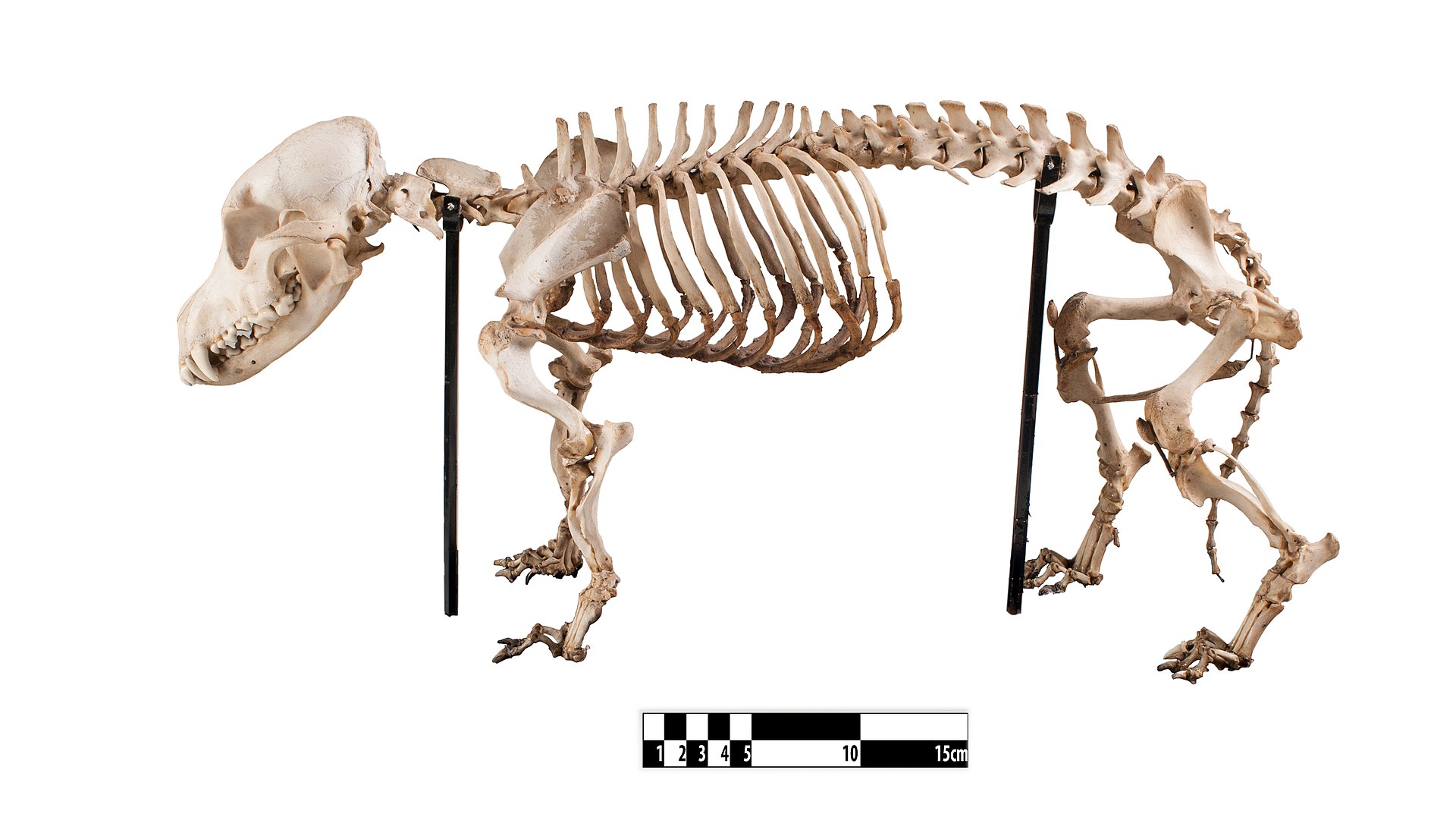
Dachshund
Canis lupus familiaris
Characteristics
Temperament
Courageous, lively, intelligent, independent, stubborn. Strong voice for small size (legacy of burrow hunting). Excellent alarm dog. Affectionate with family. Requires special attention to back (25% IVDD risk).
Diet
Carnivore: 400-700 kcal/day (standard), 200-350 kcal (miniature/kaninchen). 2 meals/day. Obesity tendency: 20% overweight triples IVDD risk. Frequent food intolerances (chicken, beef, dairy, wheat).
The Dachshund (in German "Dachshund", composed of "Dachs" = badger + "Hund" = dog), is a dog breed of German origin, recognised by the FCI in Group 4 (Dachshunds), as the only breed in the group. Developed from the Middle Ages for burrow hunting of badgers, rabbits, foxes, it is a compact, low, elongated dog, with short legs and long trunk, perfect for sneaking into underground tunnels. It exists in 3 coat varieties (short, wire, long) and 3 size varieties (standard, miniature, kaninchen) for a total of 9 official combinations. It is one of the most popular breeds in the world: in 2024 it is 9th in AKC USA rankings. It weighs 9-15 kg (standard), 4-6 kg (miniature), 3-4 kg (kaninchen). Its iconic silhouette has earned it the nickname "sausage dog" in English. Courageous, lively, intelligent and affectionate, it is an exceptional family companion but requires special attention to its back.
Classification and category
The Dachshund is classified by the FCI (Fédération Cynologique Internationale) in Group 4 — Dachshunds, single section. FCI standard number 148. The breed is also recognised by the AKC (American Kennel Club) in the "Hound" group. The official standard provides for 3 size varieties, classified based on chest circumference (measured at 15 months):
- Standard Dachshund — chest circumference 35+ cm, weight 7-15 kg, height at withers 20-27 cm. Hunts badger, fox.
- Miniature Dachshund — chest circ. 30-35 cm, weight 4-6 kg, height 15-21 cm. Hunts rabbit, weasel.
- Kaninchen Dachshund ("Rabbit Dachshund") — chest circ. up to 30 cm, weight 3-4 kg, height 12-15 cm. Hunts rabbit in narrow burrows.
The 3 coat varieties are: short hair (the most classic, shiny and adherent), wire hair (Wirehaired, rough hair with beard and eyebrows), long hair (Longhaired, silky hair similar to setter). The origins date back to medieval Germany (15th century), descending from tracking dachshunds "Schweißhunden" mixed with small terriers. The breed stabilised in the 18th century in the German territories of Brandenburg, Saxony and Wurttemberg. The first Dachshund club ("Deutscher Teckelklub") was founded in 1888 in Germany. The modern standard was codified in 1925. Longevity of the Dachshund is excellent: 12-16 years, with records up to 21 years (the dachshund "Chanel" from NY reached 21 years in 2009, Guinness World Record for the oldest living dog at that time).
Habitat and distribution
The Dachshund is a domestic dog (Canis lupus familiaris) and therefore has no natural habitat. It adapts well to houses with or without garden, and also small apartments thanks to its compact size. Its origin as a burrow hunting dog makes it particularly adaptable to confined spaces: its favourite home has burrows to take refuge in (cushions under the bed, under the sofa, inside baskets). It needs 30-60 minutes of physical activity per day: walks, play, olfactory exploration. It is not a great running dog, but it is extraordinarily resistant: a 1-hour walk is enough for its physical health. It suffers from cold (short coat in short-haired varieties) and icy winds: in winter better protective coats.
The global distribution of the Dachshund is very wide. The largest populations are in: Germany (country of origin, where the breed has the status of symbolic "Nationalhund" — it was the official mascot of the Munich 1972 Olympics with "Waldi"), USA (10th place AKC 2024, millions of specimens), United Kingdom, Japan, Brazil, Russia, Poland, Italy. The British Kennel Club registers about 8,000 puppies per year. The world population is estimated in several million specimens. It is also famous as a dog of famous personalities: Queen Victoria of England had several in the 19th century, Pablo Picasso was often photographed with his Dachshund "Lump" (muse of some paintings), Andy Warhol, John F. Kennedy, Marlon Brando, Adele.
Diet
The Dachshund is a carnivore with needs suitable for a small-medium active dog. The daily caloric requirement for an adult is 400-700 kcal for the standard variety, 200-350 kcal for the miniature/kaninchen varieties. The ideal diet includes: premium kibble with high protein content (28-32% protein), moderate fats (12-16%), complex carbohydrates (rice, sweet potatoes), vitamins, minerals. It is essential to avoid obesity: the Dachshund loves to eat and gains weight easily, and overweight dramatically aggravates back problems (intervertebral disc), which are the main health concern of the breed. It is recommended to divide the meal in 2 daily portions to avoid gastric distension and maintain stable energy.
Puppies require specific "small breed puppy" kibble formulated for controlled growth (not too fast to avoid joint problems). They should be fed 3-4 meals a day until 4 months, then 2 meals. Forbidden foods: chocolate, grapes, onions, garlic, cooked bones, xylitol, alcohol, avocado. Tendency to obesity: the Dachshund is a breed genetically predisposed to overweight. The ideal weight should be monitored visually with the "waist rule": looking from above, a "waist" must be visible between ribs and hips. If the dog appears cylindrical/sausage-shaped, it is overweight. Dachshund obesity is one of the most lethal factors for long-term health: 20% overweight above the ideal weight increases the risk of IVDD (intervertebral disc disease) by 6-10 times. Useful supplements: glucosamine+chondroitin after 5 years (cartilage), omega-3 (skin), probiotics for sensitive intestine. The Dachshund has frequent food intolerances: chicken, beef, dairy, wheat are common triggers. In case of itching, diarrhoea, frequent vomiting, consider a veterinary hypoallergenic diet.
Physical features
The Dachshund has a unique and immediately recognisable physique: long, low, robust and muscular body; short but strong legs; elongated and noble head. The height-to-length ratio is 1:1.7-1.8 (dog almost twice as long as tall). The height at the withers depends on size: standard 20-27 cm, miniature 15-21 cm, kaninchen 12-15 cm. The weight is 9-15 kg (standard), 4-6 kg (miniature), 3-4 kg (kaninchen). The head is long, conical, with little accentuated stop. The muzzle is long and strong, of elongated triangle shape; the nose is black (or chocolate/brown colour in red coats).
The eyes are medium-sized, oval, of dark brown colour (exception: blue-grey eyes in "merle" coats — see "Dapple" variant). The ears are long, wide, set high, hanging, well rounded at the tips, mobile. The neck is long, muscular, slightly arched. The trunk is elongated (unique characteristic of the breed), with straight back, robust loin, broad and deep chest (distinctive characteristic: the chest must have the shape of an extended "ship's keel"). The tail is natural (amputation is now prohibited), carried horizontal or slightly raised.
The legs are the most distinctive sign after the body: very short, robust, well angled; compact feet, with strong black nails. Four front toes, four hind toes. The coat exists in 3 varieties:
- Short hair (Kurzhaar): shiny, adherent, dense hair. Minimum maintenance, moderate shedding.
- Wire hair (Wirehaar): rough, bristly hair, with characteristic moustache, beard and eyebrows. Medium maintenance (periodic stripping).
- Long hair (Langhaar): silky, wavy, long hair. High maintenance (daily brushing).
The colours admitted include: red (most common), black and tan, chocolate and tan, isabella, dapple (merle), brindle, salt and pepper. There are also rare "double dapple" and "piebald" combinations.
Behaviour and curiosities
The Dachshund is a dog of courageous, lively, intelligent, independent, loyal character. Its temperament reflects its origins as a burrow hunting dog: it was designed to chase badgers in underground tunnels — aggressive animals weighing 15-25 kg, larger than it! For this reason the Dachshund developed a disproportionate courage: it never backs down in the face of danger, considered one of the most courageous dogs in the world in proportion to its size. This characteristic today translates into a determined and stubborn dog, which requires an owner with firm but gentle leadership. It is very vocalising: it barks with power (voice disproportionate to size — evolutionary strategy to intimidate prey in burrows). Excellent alarm dog.
Health curiosity: intervertebral disc disease (IVDD) is the main concern of the breed. The exceptional length-to-height ratio causes mechanical stress on the spine; 25% of Dachshunds will develop IVDD over their lifetime (vs 1-3% in other breeds). Symptoms: sudden hindquarter paralysis, intense pain, weakness. Treatment: surgery (€2,000-5,000) or prolonged rest; in severe cases it can cause permanent paralysis. Prevention: avoid jumps (from sofa, stairs, from arms), maintain ideal weight, avoid obesity. Historical curiosity: the Dachshund was the first official mascot of an Olympics: "Waldi", a long-haired Dachshund with blue-orange stripes, was chosen as the symbol of the Munich 1972 Olympics — first official sports mascot design. Literary curiosity: the Dachshund appears in dozens of children's illustrated books; the character "Pretzel" (1944) is the archetype. Even the French comic strip "Idéfix" of Asterix's companion is inspired by a Dachshund (although the breed is not explicitly declared). Ethological curiosity: the "longest dog in dog parade" was organised in Germany in 2008, where 1,000+ Dachshunds paraded in a row in Berlin. Linguistic curiosity: the English term "hot dog" (the sausage roll) would derive — according to some theories — from the fact that Frankfurter sausages reminded of the shape of Dachshunds, particularly popular among German immigrants in the USA of the 19th century. Competitive curiosity: the only dog to have won twice the "Cute Dog Contest" in 2017 and 2019 at the Westminster Kennel Club was a long-haired Dachshund. Breed curiosity: the life expectancy average of the Dachshund (12-16 years) is higher than that of many similar-sized breeds. Fertility is excellent: litters of 4-8 puppies are the norm, females can have up to 3 litters per year. Name curiosity: in Germany the official name is "Dachshund" (badger-dog), but it is also called "Teckel" (dialect variant), "Dackel" (diminutive), "Krummbeiniger" (twisted legs).
Pros
- Silhouette iconica universalmente riconoscibile ("sausage dog")
- Longevità eccellente (12-16 anni, record 21)
- Carattere coraggioso, leale, ottimo compagno familiare
- Disponibile in 9 combinazioni (3 taglie × 3 peli) per ogni esigenza
Cons
- Predisposto a IVDD (malattia disco intervertebrale): 25% incidenza
- Non adatto a chi ha scale ripide o salti frequenti
- Testardo: richiede addestramento paziente
- Tendenza all'abbaio e a comportamenti possessivi