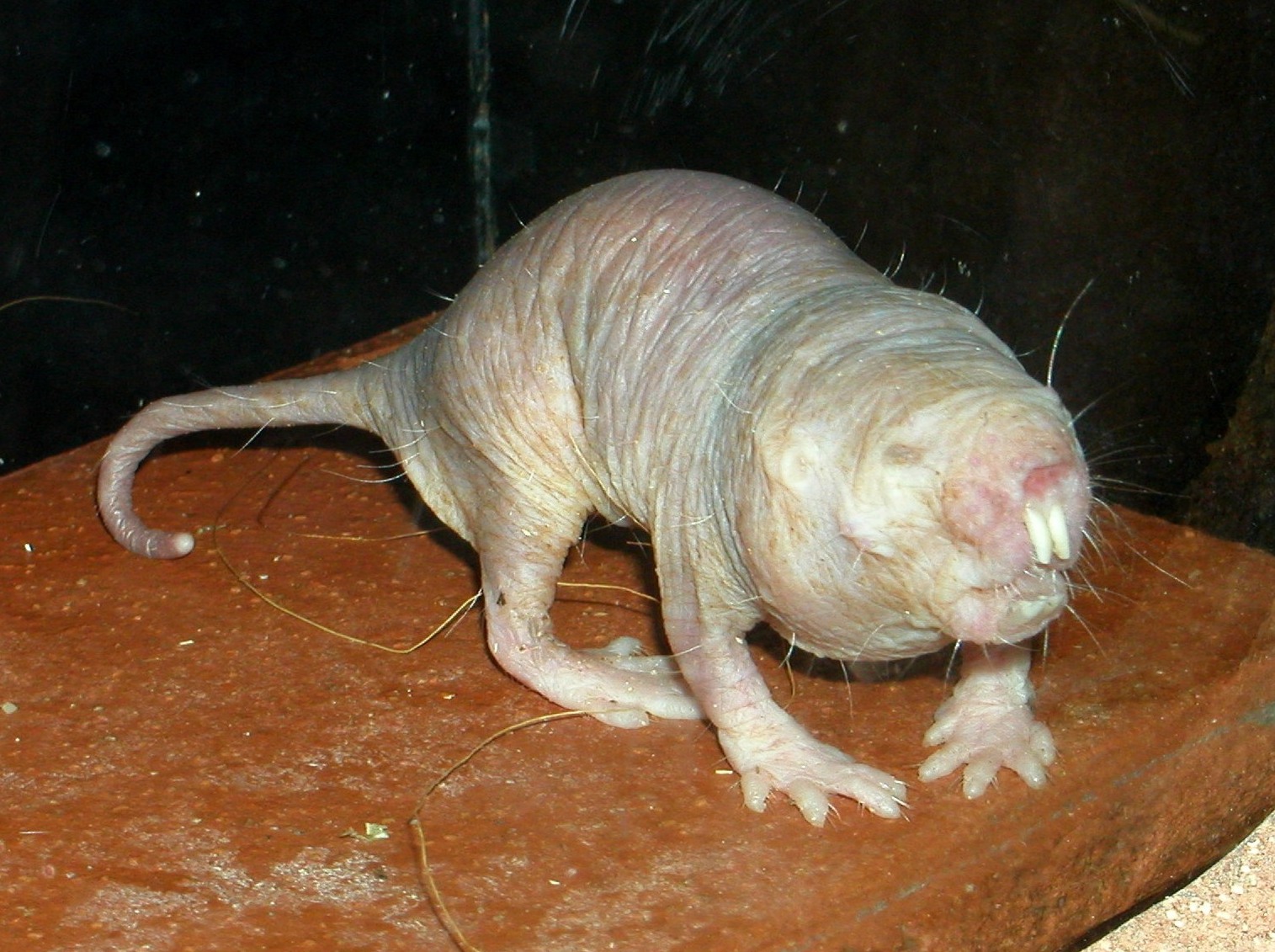
Naked Mole Rat
Heterocephalus glaber
Characteristics
Temperament
Only eusocial mammal: reproductive queen, sterile workers, soldiers. Lives in subterranean colonies with up to 5 km of galleries. Cancer-resistant, hypoxia-resistant (18 min without O₂), acid-insensitive.
Diet
Strict herbivore: subterranean tubers (Pyrenacantha, Macrotyloma). Never drinks in its lifetime (water from tubers). Metabolism switches from glucose to fructose in hypoxia. Forages in collective chain.
The Naked Mole Rat (Heterocephalus glaber) is one of the most extraordinary animals studied in modern biology. A small subterranean rodent with a hairless, wrinkled body, endemic to the arid areas of the Horn of Africa, it defies all biological expectations linked to its size: it lives in eusocial colonies like bees and termites (unique among mammals), can reach 30+ years of age (10 times the expected longevity for a rodent of its size), is practically immune to cancer, and survives 18 minutes in total absence of oxygen. These extraordinary adaptations make it a fundamental model for biomedical research on aging, oncology, neurosciences and hypoxia medicine.
Classification and category
The Naked Mole Rat belongs to the order Rodentia, suborder Hystricomorpha, family Heterocephalidae (recently separated from the Bathyergidae, of which it was considered a member), genus Heterocephalus. It is the only species of the genus and of the entire family. It is a very small rodent: body length 8-10 cm, short tail of 3-4 cm. The average weight is only 30-80 g, with the queen (reproductive female) significantly larger (50-80 g) than workers. Sexual dimorphism is normally minimal; the queen develops an elongated vertebral column following multiple gestations. The scientific name Heterocephalus derives from Greek and means "different head", referring to the unique cranial shape, while glaber means "naked, hairless", referring to the skin almost totally devoid of fur.
Habitat and distribution
The habitat of the Naked Mole Rat is exclusively subterranean: a network of galleries dug at 2-3 metres depth in the clayey soils of the semi-arid areas of East Africa — Ethiopia, central-southern Kenya, Somalia, Djibouti. The tunnel system of a single colony can extend for over 3-5 kilometres and contain hundreds of specialised chambers (common chambers, dormitories, toilets, food stores, queen's birthing room, cemetery). Colonies are completely isolated from the external environment: individuals never emerge to the surface (except for the dispersal of new queens), and conduct their entire life in total darkness.
The environment is extreme: constant temperature 28-32 °C (mole rats are in fact poikilothermic, the only exception among placental mammals), very high humidity, CO₂ concentration up to 5-6% (lethal level for other mammals), low oxygen concentration (8-10%, well below 21% atmospheric). The tunnel network has a sophisticated geometry: main galleries for movement, thermoregulatory "anti-chambers", removable "plugs" that isolate sections. Conservation status is listed as Least Concern (LC) by the IUCN, but colonies are difficult to monitor due to the subterranean nature. The species is the subject of intense scientific studies: over 30 laboratories worldwide maintain colonies in captivity (Bronx Zoo, Berlin, Hannover, Calico Life Sciences) for research on aging and oncology.
Diet
The Naked Mole Rat is a strict herbivore specialised in subterranean tubers: its diet consists almost exclusively of roots, tubers, bulbs and rhizomes of wild plants from East Africa (mainly species of the genus Pyrenacantha, Macrotyloma, Vigna). Foraging is one of the main activities of the colony: workers constantly dig new galleries in search of tubers, forming a chain of "transporters" that bring food back to the central chambers for collective consumption.
A single large tuber (some can weigh 50 kg) can sustain a colony for months: naked mole rats do not kill the plant, but dig and gradually eat the tuber from the inside, leaving intact the outer bark that continues to regenerate new pulp. This behaviour is an example of "intuitive agriculture". Water is obtained almost entirely from tubers and atmospheric condensation in the gallery network; naked mole rats never drink in their lifetime. Physiologically, they possess a unique ability to survive in severe hypoxia: in the absence of oxygen, their metabolism switches from glucose to fructose (as plants do), allowing them to remain cerebrally active for 18 minutes without oxygen and completely reversible after reoxygenation. By comparison, a human suffers permanent brain damage after 4-5 minutes.
Physical features
The Naked Mole Rat has an as unmistakable as bizarre appearance. The body is cylindrical and elongated, of pink-greyish colour, with apparently hairless skin (actually covered by about 100 thin tactile sensory whiskers, often not visible). The skin is wrinkled and soft, disproportionately large compared to the body (can "rotate" on the body, allowing the rat to turn easily in narrow galleries). The ears are reduced to small openings, the eyes are minute, semi-eyelidded, practically non-functional (the animal is almost blind).
The most notable features are the incisor teeth: enormous, prominent, constantly visible even with closed mouth, they constitute about 25% of the animal's total muscle mass. They are used for digging and can move independently of each other (a behaviour similar to a pair of chopsticks). The lips close behind the incisors, preventing soil ingestion during digging. The legs are short, sturdy, equipped with sharp claws. Physiological characteristics are equally surprising: naked mole rats are insensitive to pain caused by acids and capsaicin (lack of "Substance P" in cutaneous nerves), have behavioural thermoregulation (they huddle to warm up or disperse to cool down), and possess such pronounced cancer resistance that not a single case of tumour has ever been observed in natural colonies — high-molecular-weight hyaluronic acid-specific proteins block uncontrolled cell proliferation.
Behaviour and curiosities
The Naked Mole Rat is famous for being the only known eusocial mammal (together with the Damaraland mole rat, Fukomys damarensis, considered only partially eusocial). The social structure is similar to that of bees and termites: each colony (60-300 individuals) has only one reproductive female (the "queen"), 1-3 reproductive males, and all other individuals are sterile workers divided into castes — small workers (foraging, gallery maintenance), large workers (defence against predator snakes, gallery enlargement), "living sofas" (inactive young that serve as incubators for warmth).
The queen is established through hierarchical fights against other females; once dominant, she produces pheromones that suppress reproduction of all other colony members. Gestation lasts 70 days and the queen can give birth to 4-5 litters per year with 12-28 young each — the highest number recorded for a mammal. Mothers nurse the young but are helped by the whole colony: workers feed the young with "caecotrophs" (semi-liquid faeces rich in nutrients). When the queen dies, a period of intense fighting between worker females erupts to establish the new queen, a process that lasts weeks. Longevity is the absolute record for a mammal of its size: in captivity documented 32 years and 7 months (specimen deceased at the San Diego Zoo in 2018), against the theoretical expectation of 4-6 years. Queens live even longer (30-40 years) and maintain fertility until death. Scientifically, the Naked Mole Rat is today one of the most studied models for: oncology (never a case of cancer), geroscience (no apparent senescence), neurosciences (resistance to stroke and hypoxia), and evolutionary biology (origins of eusociality in mammals). The sequencing of its genome (2011) revealed over 100 unique genes linked to longevity and tumour resistance, currently under study for applications to human medicine.
Pros
- Longevità record per un roditore (30+ anni)
- Immunità praticamente totale al cancro
- Sopravvive 18 min senza ossigeno
- Modello scientifico chiave per geroscienze e oncologia
Cons
- NON è un animale da compagnia, esclusivamente da laboratorio/zoo
- Detenzione vietata fuori da istituzioni accreditate
- Minacciato dalla perdita di habitat in Etiopia/Kenia
- Estremamente sensibile alle variazioni di temperatura e umidità