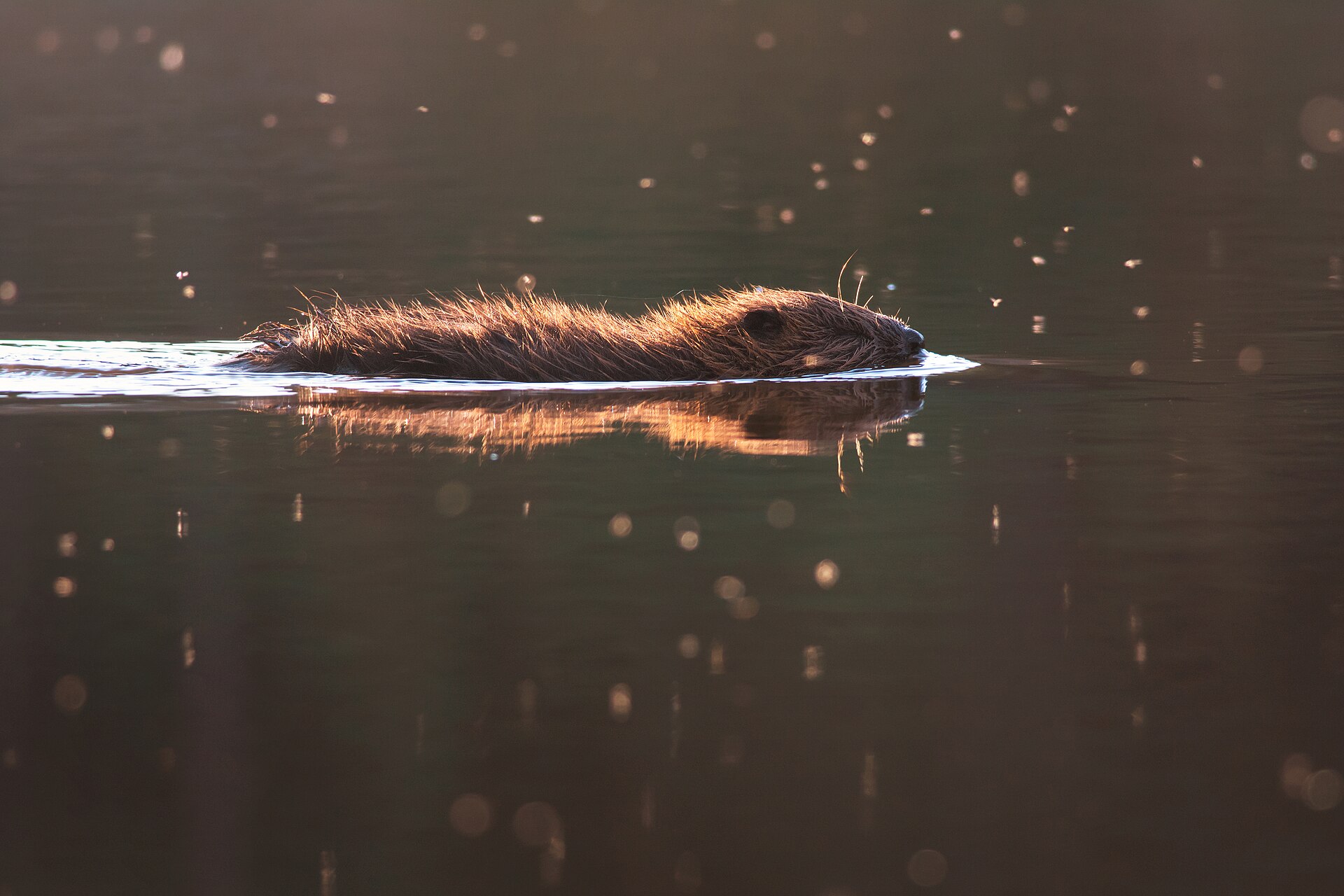
Eurasian Beaver
Castor fiber
Characteristics
Temperament
Monogamous, lives in family units. Crepuscular-nocturnal. Ecological engineer: builds dams, canals and lodges. Keystone species for river biodiversity.
Diet
Strict herbivore: aquatic plants, leaves and flowers in summer; willow and poplar bark and twigs in winter. Up to 2 kg of vegetation per day.
The Eurasian Beaver (Castor fiber) is a large semi-aquatic rodent, second in size only to the Capybara. Famous for its ability to profoundly reshape the landscape through the construction of dams and canals, it is today considered one of the most important ecological engineers of the Eurasian river ecosystem. Its recent history is that of a species brought to the brink of extinction and then saved by one of the largest reintroduction campaigns ever carried out in Europe.
Classification and category
The Eurasian Beaver belongs to the order Rodentia, family Castoridae, of which only two living species remain today: the Eurasian Castor fiber and the North American Castor canadensis, separated by at least 7-8 million years of independent evolution. It is a remarkably large mammal: body length ranges from 80 to 120 cm, to which a flat, scaly tail 25-40 cm long must be added. Average adult weight is 18-30 kg, but specimens over 40 kg have been recorded.
Habitat and distribution
The beaver's natural habitat consists of slow-flowing rivers, streams, lakes and wetlands bordered by deciduous woodlands, particularly willow, poplar, birch and alder. It prefers waters at least 50 cm deep, enough to allow it to swim in winter even under the ice.
Its historical range covered almost all of Eurasia, from the Iberian Peninsula to Mongolia. Between the 17th century and the early 20th, hunting for fur, meat and castoreum (a glandular secretion used in perfumery and medicine) brought the species to the brink of extinction: by 1900 perhaps only 1,200 individuals survived in five isolated populations (Rhône, Elbe, Norway, Belarus and Western Siberia). Since then, massive reintroduction programmes have brought the beaver back to Germany, Poland, the Netherlands, Belgium, the United Kingdom, Spain and — from 2018 in Friuli and from 2021 in Tuscany — also to Italy, after more than 500 years of absence. Today its conservation status is listed as Least Concern (LC) by the IUCN, with a European population estimated at over one million individuals.
Diet
The beaver is strictly herbivorous. In spring and summer its diet consists mostly of herbaceous plants, leaves, flowers, fruits and aquatic vegetation; in autumn and winter it shifts to bark, twigs and shoots of soft-wood trees, particularly willow and poplar.
An adult beaver can consume up to 2 kg of vegetation per day. It does not eat wood itself: it uses twigs mainly for the cambium, the thin and nutrient-rich layer immediately beneath the bark. During autumn it accumulates large amounts of branches underwater, near the lodge, creating a winter food cache that allows it to feed without leaving the shelter even when the pond is frozen over.
Physical features
The Eurasian Beaver has a stocky, sturdy body perfectly adapted to semi-aquatic life. The fur is composed of a dense layer of woolly waterproof underfur and longer, darker guard hairs, ranging from chestnut to reddish brown. Its most recognisable feature is the broad, flat, scaly tail, used as a rudder in water, as a counterbalance on land, as an alarm signal (slapped on the water it produces a crack audible hundreds of metres away) and as a fat reserve.
The hind feet are webbed; the forefeet are highly dexterous, almost hand-like, able to manipulate food and twigs. The incisors are a bright orange thanks to the high iron content of the enamel, grow continuously (typical of rodents) and are self-sharpening: the upper incisors abrade the lower ones, always maintaining a cutting edge. The beaver can close nostrils and ears underwater and has a transparent nictitating membrane that protects the eyes during diving, staying active for 10-15 minutes without coming up for air.
Behaviour and curiosities
The beaver is a monogamous animal living in family units composed of the breeding pair, the kits of the year and the yearlings from the previous year. Its main activity — the construction of dams of branches, mud and stones — does not serve to store food, but rather to create a deep pond that protects the entrance of the lodge (always underwater) and facilitates movement.
Dams can exceed 100 metres in length; the longest ever documented, in Alberta (Canada), measures over 850 metres and is visible from space. The beaver also builds canals to transport timber and lodges of branches and mud, with underwater entrance and a dry inner chamber. Its activity slows down watercourses, creates wetlands, reduces flood impacts and dramatically increases local biodiversity: for this reason it is considered a keystone species. Lifespan is 10-15 years in the wild, up to 25 in captivity. It is mostly crepuscular and nocturnal and communicates with conspecifics through scent secretions deposited on small mounds of mud at the edges of the territory.
Pros
- Specie chiave per la biodiversità
- Ingegnere ecologico naturale
- Reintrodotto con successo in Europa
- Non richiede protezione attiva nelle aree adatte
Cons
- Specie selvatica e protetta, NON è un pet
- Può entrare in conflitto con coltivazioni e infrastrutture
- Molto difficile da osservare (notturno e timido)
- Reintroduzione richiede protocolli stringenti