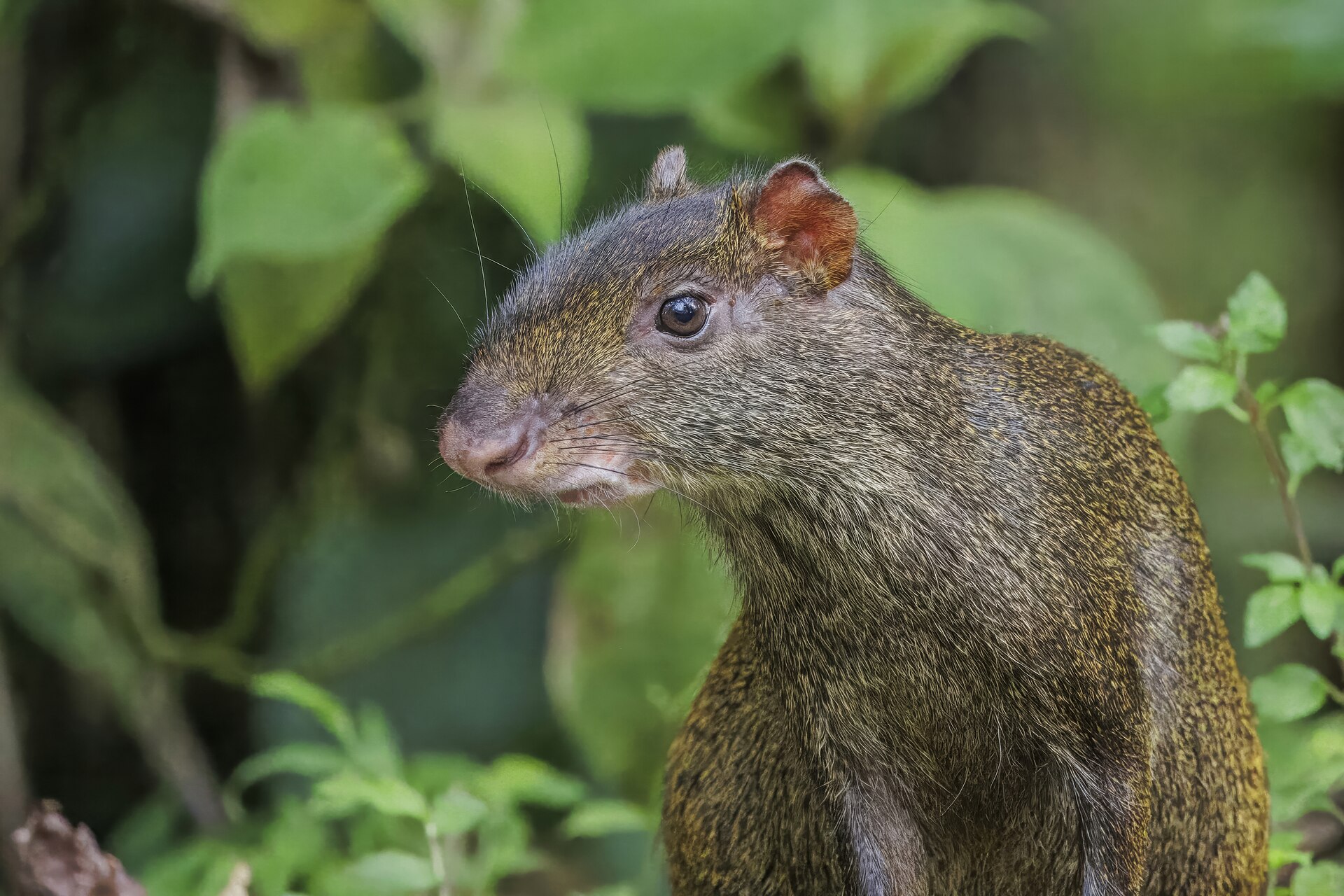
Central American Agouti
Dasyprocta punctata
Characteristics
Temperament
Monogamous (very rare among rodents!), territorial, diurnal. "FOREST GARDENER": disperses Brazil nuts (UNIQUE!) and almendro via scatter-hoarding of 200+ caches. Gallops on hoof-like claws like small deer (convergence with Mazama). VESTIGIAL tail 1-3 cm. Precocial cubs (run after 1 hour). Sprint 50-60 km/h. Lifelong mate.
Diet
Frugivore-granivore. Brazil nuts (UNIQUE disperser!), almendro, tropical fruit, legume seeds, tubers. SCATTER-HOARDING: 200+ caches/individual, recovers 60-70% — the 30-40% of forgotten seeds = regenerating forest. At Barro Colorado 97% of young almendro derive from seeds hidden by the Agouti.
The Central American Agouti (Dasyprocta punctata), known in Spanish as Ñeque, Picure, Guatusa, is a medium-large neotropical Caviomorph rodent (3-6 kg) belonging to the family Dasyproctidae. It is the main "gardener" of neotropical forests: the only mammal capable of dispersing huge seeds like Brazil nuts (Bertholletia excelsa), cuipo, almendro, through the "scatter-hoarding" behaviour (buries seeds in hundreds of hiding places, forgetting some of them = germination = forest regeneration!). The Agouti is famous for:
- Ungulate-like gallop: runs on the tips of hoof-like claws (convergence with small deer of the genus Mazama!)
- Monogamy: one of the very few truly monogamous rodent species (lifelong pair)
- Diurnality: active during the day (rare among rodents, exposed to predators)
- Precocial young: born with eyes open, fully furred, able to run after 1 hour
Distribution: from southern Mexico to western Ecuador, throughout Central America (Belize, Guatemala, Honduras, Nicaragua, Costa Rica, Panama) and northern South America (Colombia, Venezuela, Ecuador). Habitat: rainforests, dry forests, montane forests (up to 2,000 m). IUCN status: Least Concern (LC), but local populations decline due to commercial hunting ("bushmeat") and deforestation.
Classification and category
The Central American Agouti belongs to the order Rodentia, suborder Hystricomorpha, infraorder Caviomorpha (New World rodents), family Dasyproctidae, genus Dasyprocta. The Caviomorpha are an evolutionary radiation exclusive to the Americas, originating probably from African ancestors (Hystricognathi) who arrived through oceanic "rafting" ~40 Mya. It includes: guinea pigs, capybaras, agoutis, pacaranas, pacas, chinchillas, viscachas, cuíes, degus, nutria, New World porcupines. The Agouti is the largest species of the Dasyproctidae family together with its congener Dasyprocta fuliginosa.
The genus Dasyprocta comprises 11 species:
- D. punctata — Central American Agouti (subject of this entry)
- D. azarae — Azara's Agouti (Brazil/Argentina)
- D. coibae — Coiba Agouti (Coiba Island, Panama, endemic)
- D. croconota — Golden Agouti
- D. fuliginosa — Black Agouti (Amazon)
- D. guamara — Orinoco Agouti
- D. kalinowskii — Kalinowski's Agouti (Peru)
- D. leporina — Red-rumped Agouti (E. Amazon, Antilles)
- D. mexicana — Mexican Agouti
- D. prymnolopha — Black-rumped Agouti (Brazil)
- D. ruatanica — Ruatán Agouti (Honduras, islands)
Closest relatives: the Pacas (genus Cuniculus, family Cuniculidae) — very similar but larger (6-12 kg) and with light-spotted pattern. Three families of neotropical "ungulate-rodents": Dasyproctidae (Agoutis), Cuniculidae (Pacas), Dinomyidae (Pacarana). All convergent with small forest ungulates (Mazama, Tragulus).
Etymology: "Dasyprocta" from the Greek "daseîos" (hairy) + "prōktós" (rear) — reference to the long hair of the flanks that stands erect when the animal is excited. "Punctata" from the Latin "spotted" — reference to the light tips of the coat hairs. The agouti was described by Gray in 1842.
The morphological parameters:
- Weight: 3-6 kg (record 7 kg). M slightly larger than F
- Head-body length: 45-65 cm
- Tail: 1-3 cm (vestigial!)
- Height at withers: 25-35 cm
Longevity: 10-15 years in captivity, 4-6 years in nature (high predation). Sexual maturity: 6-12 months. Gestation: 100-120 days (long for a rodent!); litter of 1-3 cubs (average 2). Precocial cubs: born with eyes open, furred, able to run after 1 hour from birth. Reproduction: 2 litters/year.
Habitat and distribution
The Central American Agouti occupies tropical and subtropical forests of Central America and northern South America:
- Mexico: Veracruz, Tabasco, Chiapas, Yucatán
- Belize, Guatemala, Honduras, Nicaragua: forested lowlands
- Costa Rica: wide distribution, particularly Corcovado, La Selva
- Panama: including many islands (Coiba, Barro Colorado)
- Colombia, Venezuela: coastal and Andean lowlands
- Western Ecuador: southern limit
Preferred habitats:
- Lowland rainforest: first choice (humidity, cover, seeds)
- Tropical dry forest: Central American Pacific
- Montane forest: up to 2,000 m altitude
- Riparian scrub: sheltered environments along rivers
- Secondary forest: regeneration areas
- Plantation margins: where there is still forest proximity
Does NOT tolerate: completely deforested areas, open pastures, urban areas. Depends on forest cover for protection from predators and for food fruits/seeds.
IUCN status: Least Concern (LC). Estimated global population: millions of individuals. The species is common in its range. However:
- Coiba subpopulation (D. coibae, sometimes treated as subspecies): Vulnerable
- Ruatán subpopulation (D. ruatanica): Critically Endangered
- Mexico subpopulation: slightly declining (hunting + deforestation)
Threats:
- Commercial hunting: the "bushmeat" — the Agouti is one of the most hunted species in tropical America for meat (tasty, compared to pork). Markets of Caracas, Panama, Lima regularly sell it
- Deforestation: rates among the highest in the planet (Colombian and Ecuadorian Amazon)
- Habitat fragmentation: limits gene flow between populations
- "Sport" hunting: in developed countries (USA: Florida has introduced populations)
- Conflict with plantations: occasionally attacks crops (bananas, cassava, pineapple)
CITES: NOT included. Conservation: protection through national parks (Corcovado, Tikal, Manuel Antonio). The Agouti is an "umbrella species" for forest health — its presence indicates a functional forest ecosystem.
Diet
The Agouti is an opportunistic frugivore-granivore. The diet is composed mainly of fruits, seeds and nuts:
- Brazil nuts (Bertholletia excelsa): the Agouti is the ONLY disperser! The shell is too hard for other animals. Opens with extremely strong incisors
- Almendro (Dipteryx panamensis): large nutritious seed, critical dispersal
- Tropical fruit: papaya, wild mango, avocado, palm fruits
- Legume seeds: Inga, Cassia, Mucuna
- Tubers: wild yuca (cassava), sweet potatoes, roots
- Tender leaves: occasional
- Insects: very rare (5% of diet) — especially cubs
- Mushrooms: occasional
- Crops: in anthropized areas, eats bananas, pineapple, corn
The feeding technique:
- Search: patrols the diurnal undergrowth, particularly under fruit trees
- Position: stands on hind legs to visually explore
- Opening: uses incisors (3-5 cm, yellow, self-sharpening) to open hard shells
- Consumption: eats in "squirrel" position — seeds held between forepaws
- Scatter-hoarding: NON-consumed seeds are buried in multiple hiding places (caches) scattered in the territory (dozens up to 200/individual)
- Recovery: returns to look for the hiding places using spatial memory + smell (60-70% recovery)
Key feature: "scatter-hoarding" is the MAIN MECHANISM of regeneration of the tropical forest for large seeds. The 30-40% of forgotten seeds germinate in optimal places (loose soil, distance from parent tree = no competition). Without the Agouti, neotropical forests progressively lose large-seeded species ("defaunation" effect). Studies in Barro Colorado (Panama) have shown that 97% of young almendro plants derive from seeds hidden by the Agouti!
Notable: the Agouti is one of the few animals able to open the Brazil nuts — the large woody fruits of Bertholletia excelsa (weight 1-2 kg, woody wall 1 cm thick) open naturally on the ground, and the Agouti is the only mammal able to break the individual seeds inside with its incisors. Bertholletia depends almost entirely on the Agouti for reproduction. It is a classic example of species-specific mutualism.
Physical features
The Central American Agouti has a compact and robust body, similar to a large guinea pig but with long galloper legs. Physical features:
Coat:
- Base colour: reddish-brown to dark black (varies by population and individual)
- Flanks: longer, "shaggy" hair, often bright orange or yellow-gold
- Rear: hair that stands erect in alarm (origin of the etymology "Dasyprocta")
- Chin, throat, belly: cream-white or yellowish
- Light spots on the body ("punctata"): coat dotted with light
- Coat variable by subspecies:
- - D. p. punctata: uniform brown
- - D. p. variegata: brown with orange flank
- - D. p. dariensis: reddish-gold flank
The head is large, rounded, with elongated muzzle. The face has:
- Incisors large, yellow (resistant enamel for hard nuts)
- Eyes large, black, lateral (wide visual field for predators)
- Ears small, rounded, mobile (to locate sounds)
- Vibrissae long on the sides of the muzzle
- Nose small, dark
"Miniature ungulate" anatomy (evolutionary convergence!):
- Hind legs: long, slender (longer than the forelegs), muscular
- Forelegs: short, agile
- Feet: 4 front toes (reduced thumb), 3 rear toes (dominant central)
- Claws: strong, elongated, similar to small hooves (ungulate-like) — runs on the tip
- Tail: VESTIGIAL — 1-3 cm, almost invisible (lost evolutionarily with running)
- Foot pads: small
Physiological features:
- Speed: 50-60 km/h in short sprints (50-100 m)
- Jumper: jumps up to 2 m in height to escape (can jump on low branches)
- Swimmer: swims agilely — dives to escape predators
- Vocalisations: grunting, hisses, sharp cries in danger, clicking teeth as a threat
- Smell: excellent — used to find hidden food
- Sight: good, diurnal, monochromatic
- Hearing: extremely sensitive — detects steps at 50+ m distance
Behaviour and curiosities
The Agouti is a monogamous, territorial, diurnal animal. Lives in a fixed pair (sometimes with the not yet emancipated young) — exceptionally rare behaviour among rodents (the majority are polygamous or solitary). Territory: 2-5 ha (small for its size, but intensely defended). Territorial marking: urine, feces, anal glands.
Social behaviour: the couple shares the territory for life, sleeps together in dens dug under roots, fallen logs, or in ground cavities. They often touch each other with the muzzle, scratch each other. Olfactory communication very important: the couples constantly mark the territory. Reproduction: 2 litters/year, litter of 1-3 cubs (usually 2). Long gestation for a rodent: 100-120 days. The cubs are precocial: born with eyes open, complete fur, teeth, able to run after 1 hour from birth! Adaptation to predation: the cubs must be immediately able to flee. They are hidden separately in small camouflaged shelters (reducing total nest predation).
Defensive behaviour: the Agouti is nervous, attentive, sudden. If detected, it sprints at 50-60 km/h zigzagging between trees and roots. Jumping on fallen logs, crossing streams, diving into water pools. Alert reaction: raises the rump hair, emits sharp grunting, kicks with the hind leg before sprinting. Main predators: jaguar, ocelot, puma, anaconda, boa, eagles, caimans.
Famous curiosity: the "forest gardener". The Agouti is the main disperser of large seeds in neotropical forests — particularly for:
- Bertholletia excelsa (Brazil nut) — ONLY disperser
- Dipteryx panamensis (Almendro) — primary disperser
- Astrocaryum (palms with hard seeds)
- Attalea (palms)
- Carapa (Spanish cedar)
- Hymenaea (American carob)
Without the Agouti, these species would disappear from the undergrowth within 1-2 generations (defaunation effect). It is a classic example of "asymmetric mutualism": trees cannot reproduce without the Agouti, but the Agouti can survive eating other fruits.
"Convergence with ungulates" curiosity: the Agouti is one of the best examples of evolutionary convergence in mammals. In the South American tropical forests live few small ungulates (Mazama, Tragulina absent). The Caviomorphs have "occupied the niche": the Agouti and Paca run on the tips of ungulate-like nails, have compact body, long legs, short tail — exactly like small deer. This convergence is so marked that many naturalists of the 19th century classified them alongside deer!
"Gallop" curiosity: the Agouti runs with a special gait called "rotatory gallop" — the 4 legs move in diagonal sequence, exactly like a horse or deer at gallop. Sprint speed: 50-60 km/h, comparable to a hare. The hind legs are dominant and generate the propulsion. Nothing to envy of a small ungulate!
Spatial memory curiosity: the Agouti remembers hundreds of hiding places of seeds scattered in its territory. GPS and radio tracking studies have shown that a single Agouti can create 200+ caches in one season and find back successfully 60-70% of them. Cognitive abilities comparable to Arctic squirrels (Tamiasciurus). The 30-40% of forgotten seeds = forest that regenerates.
"Courtship" curiosity: the male Agouti courts the female by spraying her with urine from a distance of 1-2 m! The "urinary shower" is a sexual marking behaviour that the female receives as a demonstration of interest. Then, the female shows receptivity and accepts the mating. Behaviour shared with many Caviomorphs.
Monogamy curiosity: the Agouti is one of the very few truly monogamous rodents. Studies at Barro Colorado (Smithsonian Tropical Research Institute, Panama) have tracked Agouti pairs for years — no case of "cheating" documented. Fidelity is almost absolute. When a partner dies, the other can remain single for months before accepting a new companion. Lifelong companion.
Hunting curiosity: the Agouti is one of the most "bushmeat" consumed species throughout tropical America. Tasty meat, compared to pork ("cerdito de monte" in Spanish). Markets of Caracas, Panama City, Lima regularly sell Agouti — very often illegally. In some rural communities, the Agouti represents up to 30% of consumed animal protein. Traditional hunting uses scenting dogs, traps or bows. Historically venerated by the Maya: archaeological findings of Agouti bones in ceremonial sites.
Mobile ears curiosity: the Agouti can rotate each ear independently 180° — one ear forward, the other backwards. Allows monitoring sounds from different directions simultaneously. Anti-predator advantage in the thick undergrowth.
Swimming curiosity: contrary to its "terrestrial ungulate" appearance, the Agouti is an excellent swimmer. It dives into water pools and crosses rivers to escape predators. Curious case: agoutis observed crossing 200 m rivers in zones of Costa Rica. Traces back to their neotropical aquatic ancestor (the Capybara is a distant relative).
Maya name curiosity: the ancient Maya called the Agouti "haaleb" (Yucatec) or "tepezcuintle" (Nahuatl). It was an important food and symbol of forest fertility. Findings at Tikal, Calakmul, Palenque show Agouti remains in offerings to the rain gods.
Introduction curiosity: the Agouti has been introduced into Florida (USA) in the 20th century (few specimens escaped from zoos). Populations still exist in the southern Everglades. It is also introduced into some Antilles: Trinidad, Tobago, Grenadines (some natural populations, others anthropogenic).
"Cousin of the Guinea Pig" curiosity: the guinea pig (Cavia porcellus, domestic) is a fairly close relative of the Agouti (both Caviomorphs). The Caviomorphs are an evolutionary radiation exclusive of the New World: guinea pigs, capybaras, agoutis, pacas, pacaranas, chinchillas, viscachas, degus, nutria, hutias, New World porcupines, mara, cuíes. All descend from African ancestors arrived through oceanic "rafting" ~40 million years ago.
Longevity curiosity: in captivity, the Agouti can live 15+ years (record 20 years in some zoos). In nature: 4-6 years (very high predation). In zoos it is popular because diurnal, active, easy to observe. Smithsonian National Zoo, Bronx Zoo, ZooParc de Beauval have successful breeding.
"Coiba Agouti" curiosity: the subpopulation of the Coiba Island (Panama) — Dasyprocta coibae, considered a separate species by some authors — is endemic to a single island. The total population: few thousand individuals. The Coiba Island hosts a UNESCO national park, but the species is classified Vulnerable by the IUCN for the tiny distribution and potential future threats.
Plant symbiosis curiosity: the Almendro de Montaña (Dipteryx panamensis) is considered the "most important tree" of Central American forests because it provides seeds (consumed by the Agouti, macaw) and nests (Great Green Macaw, Ara ambiguus, in critical danger). The Almendro-Agouti-Macaw form an essential symbiotic triangle: without Agouti → no almendro → no great green macaw. This network has been defined as "keystone interaction" of the neotropical forest.
Pros
- Unico mammifero in grado di disperdere noci brasiliane
- Monogamo a vita (rarissimo tra roditori)
- Convergenza evolutiva straordinaria con piccoli ungulati
- Keystone species per rigenerazione foreste neotropicali
Cons
- Caccia intensiva come 'carne di monte' nei mercati tropicali
- Dipende strettamente da copertura forestale (deforestazione)
- Sottopopolazioni insulari Critically Endangered (Ruatán)
- Predazione molto alta in natura (longevità 4-6 anni)