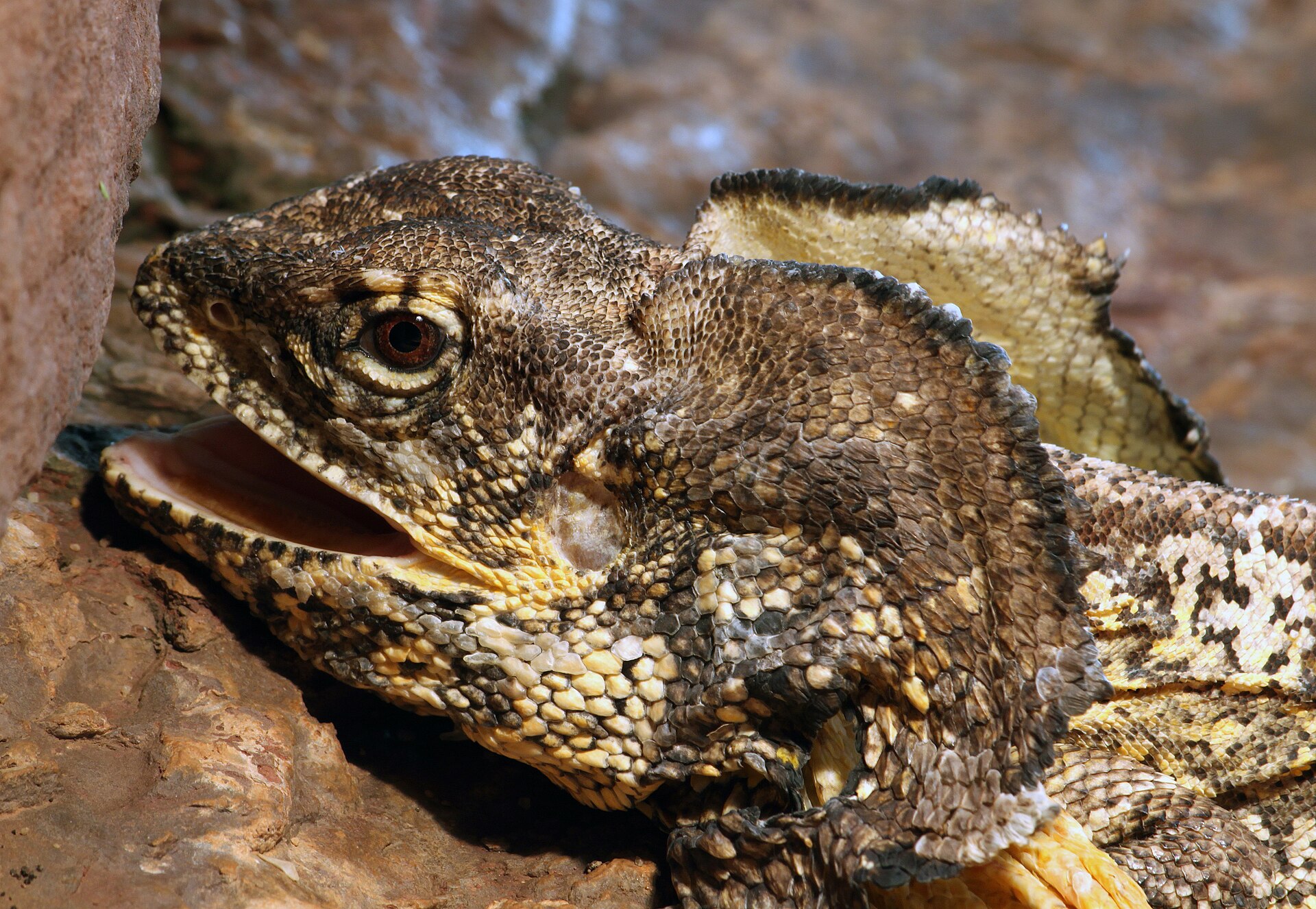
Frilled Lizard
Chlamydosaurus kingii
Characteristics
Temperament
Diurnal, solitary, arboreal, territorial. Iconic Australian agamid lizard. FRILL DISPLAY: when threatened it suddenly flares its huge skin frill (up to 30 cm) like an umbrella, gapes its yellow-pink mouth, hisses and lashes its tail to look enormous and scare predators (bluff/deimatic display). If that fails, it RUNS ON TWO LEGS ("bicycle lizard"). Almost entirely arboreal, camouflaged on trunks. Inspired the Jurassic Park Dilophosaurus. Australian icon.
Diet
Arboreal insectivore/carnivore. Insects (main: ants, termites, beetles, cicadas, moths, grasshoppers), spiders and arthropods, occasional small lizards and small mammals. Sit-and-watch hunting from a tree or perch, then descends and grabs prey in a dash. Feasts in the wet season (winged-termite and cicada swarms) to build reserves for the dry season.
The Frilled Lizard (Chlamydosaurus kingii), also called the frill-necked lizard, is one of the world's most spectacular and iconic lizards, a symbol of northern Australia. Famous for:
- THE HUGE FRILL! It has an enormous ruff of skin around its neck (up to ~30 cm across) normally folded against the body. When threatened it suddenly FLARES it open like an umbrella, to look much bigger and scare off predators!
- RUNS ON TWO LEGS: if the frill bluff isn't enough, it flees running on its hind legs only (bipedal sprint) to the nearest tree — earning the nickname "bicycle lizard"!
- Full intimidation display: open frill + gaping mouth (bright yellow-pink interior) + hissing + tail lashing
- Largely arboreal: spends most of its life in trees
- Australian icon: featured on the old Australian 2-cent coin
- Inspired cinema: the frill and behaviour of the Dilophosaurus in "Jurassic Park" were inspired by this lizard!
IUCN status: Least Concern (LC). Still widespread but sensitive to fires, predation by introduced species, and the toxic cane toad.
Classification and category
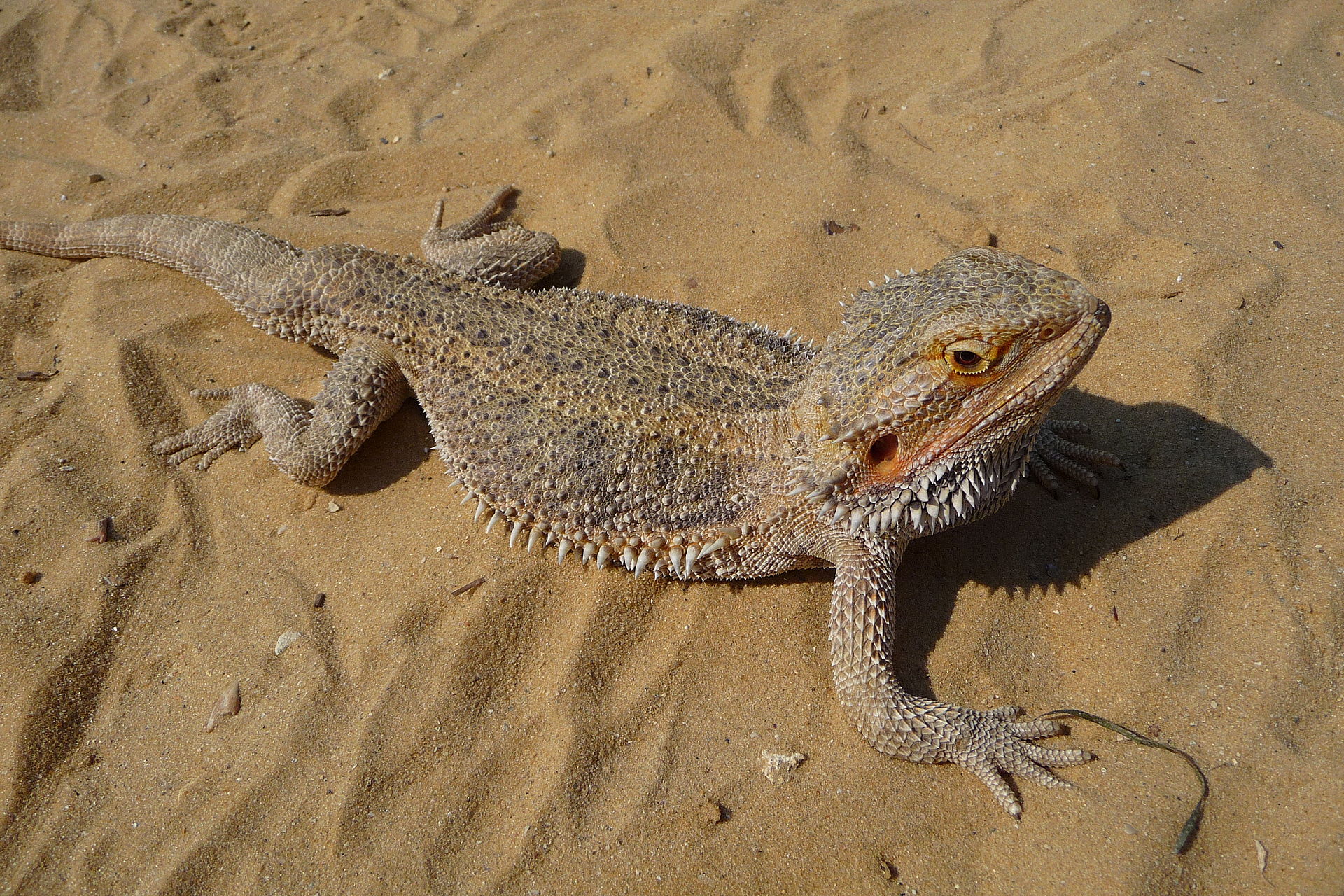
Order Squamata (lizards and snakes), family Agamidae (dragon lizards), genus Chlamydosaurus — a species UNIQUE in its genus (monotypic): no other lizard has such a frill. Agamidae includes Old World and Australian "dragons", with relatives already in the catalogue: Pogona (the bearded dragon, also Australian), Draco (the gliding "flying dragons" of SE Asia), Uromastyx (spiny-tailed lizards), Chlamydosaurus (this entry). Etymology: "Chlamydosaurus" Greek "chlamys" (a cloak/mantle worn by ancient Greeks) + "sauros" (lizard) = "cloaked lizard" for the frill; "kingii" honours Phillip Parker King, the British explorer who collected the first specimens. Parameters: Total length up to 85-90 cm (tail ~two-thirds). Weight ~0.5-1 kg (males larger). Open frill up to ~30 cm across. Longevity 10-20 years. Oviparous; 8-23 eggs in an underground nest; temperature-dependent sex determination; hatchlings self-sufficient and can already open the frill.
Habitat and distribution
Northern Australia and southern New Guinea: northern Australia (Kimberley, Top End of the Northern Territory, northern Queensland/Cape York), southern New Guinea. Habitats: tropical/subtropical forests and woodlands, wooded savanna, dry forest (ideal), savanna with scattered trees, scrub and eucalypt woodland. Needs trees for its arboreal life and a climate with marked wet and dry seasons. Avoids true deserts and treeless areas. Closely tied to trees (arboreal): spends most of its time on trunks, camouflaged against bark, descending mainly to feed and move. Its life follows the seasons: very active in the wet season (Australian summer) when food is abundant; in the dry season it reduces activity, sheltering high in trees in a state of semi-dormancy (aestivation) to save energy. IUCN: Least Concern, but faces fires, predation by introduced cats and foxes, and especially the cane toad (Rhinella marina, a toxic invasive — a frilled lizard that tries to eat it is poisoned).
Diet
Mainly insectivore/carnivore. Diet: insects (main — ants, termites, beetles, cicadas, moths, grasshoppers), spiders and other arthropods, occasional small lizards, occasional small mammals (rodents). Hunting: sit-and-watch from a tree or perch, spotting prey with good eyesight; descends quickly and grabs prey in a dash; seasonal feasting in the wet season when termites and cicadas swarm, feeding voraciously to build reserves; catches insects with the tongue and strong agamid jaws. In the wet season it feeds intensively on insect booms (winged termite swarms, cicadas); these reserves carry it through the dry season when food is scarce and activity drops.
Physical features
An unmistakable look dominated by the frill. The frill (the most extraordinary feature): a large membrane of skin surrounding the neck like a ruff or umbrella; supported by cartilaginous/bony rods connected to the hyoid bone and jaws — when the lizard opens its mouth, the frill unfolds automatically; up to ~30 cm across when open (huge relative to the head); vividly coloured, often with orange, red, yellow and black patches (a warning signal); folded in pleats along neck and shoulders at rest. Body: grey-brown/reddish/sandy (camouflaged against bark); very long tail (about two-thirds of total length, used for balance); long sturdy legs, especially the hind ones, for bipedal running and climbing; head with a large mouth (bright yellow/pink interior, shown in display); slender agile body. Behavioural features: the frill opens via a mechanism linked to the mouth; bipedal run (rises on hind legs and runs upright); camouflage (motionless against a trunk, almost invisible).
Behaviour and curiosities
Diurnal, solitary, arboreal, territorial. Spends much time clinging to trunks, camouflaged. Generally shy, preferring to avoid a fight: its spectacular display is precisely a way to scare off enemies WITHOUT having to fight. Breeding: males also use the frill to court females and challenge rivals (not just against predators). The female lays 8-23 eggs in an underground nest, then leaves them; sex is temperature-determined; hatchlings are independent and can already open their small frill.
Famous: the frill display — one of the most spectacular defensive behaviours in the animal kingdom. When a predator approaches, the frilled lizard puts on a show: it suddenly flares the huge frill like an umbrella around its head, gapes its mouth showing the bright yellow-pink interior, hisses and lashes its tail, swaying its body. The effect turns a medium lizard into a suddenly huge, menacing creature — "I'm too big and dangerous, leave me alone!" A remarkable bluff, a classic example of deimatic (startle) behaviour. "Bicycle lizard": if the frill bluff fails, it switches to plan B — bipedal flight: it rises on its hind legs alone and runs upright like a little dinosaur, forelegs raised, tail as balance, dashing to the nearest tree (hence "bicycle lizard"). "How the frill works": supported by long cartilage rods linked to the hyoid and jaws, so opening the mouth automatically unfurls the frill like an umbrella. Jurassic Park Dilophosaurus: the film's dinosaur was given an extendable frill inspired by this lizard (pure invention for the dino). Australian icon: on the old 2-cent coin, in logos and stamps. Seasonal life: active in the wet season, aestivates in trees through the dry season. Cane toad threat: poisoned if it tries to eat the toxic invasive toad.
Pros
- Display del collare tra i più spettacolari del regno animale
- Icona australiana, ha ispirato il cinema (Jurassic Park)
- Rara lucertola capace di corsa bipede
- IUCN Least Concern, ancora diffuso
Cons
- Minacciato dal rospo delle canne tossico (invasivo)
- Vulnerabile a incendi e predatori introdotti (gatti, volpi)
- Dipende dagli alberi (sensibile al disboscamento)
- Non è un animale domestico facile (esigenze specifiche)